


Financing for equity in primary and secondary education
1. Education resources to subnational governments
2. Education resources to schools
3. Education resources to students and families
4. Social policies and family support programmes
Introduction
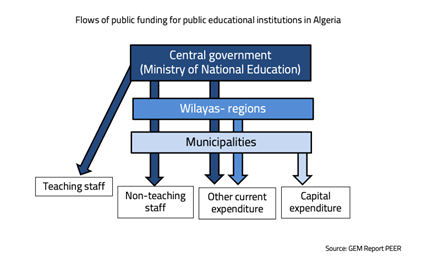
In Algeria, education financing and governance are shared between central and local authorities. The Ministry of Education oversees the overall organisation and funding of primary and secondary education. It covers nearly all costs for staff salaries, equipment, operations, and social services across these levels.
At the regional level, Executive Decrees 90-174 and 90-09 define the roles of the wilaya—a legally and financially autonomous territorial authority. Wilayas are responsible for the construction, maintenance, and major repairs of secondary, technical, and vocational schools, in line with national standards and the carte scolaire (Art. 74).
Each wilaya houses a Direction de l’éducation, operating under the Ministry’s authority. It implements national policies, manages local education services, supervises schools, allocates staff, enforces pedagogical standards, oversees infrastructure planning, and collects educational data (Art. 3). The Director of Education acts as a secondary budget officer, managing funds from the central government.
At the municipal level, local governments are responsible for financing the operational costs of primary schools.
1. Education resources to subnational governments
The government allocates education funding to wilayas and municipalities, but the specific mechanisms for these transfers—including whether they account for equity—are undocumented.
2. Education resources to schools
No equity-based funding initiatives from the Ministry of Education to individual schools have been identified.
3. Education resources to students and families
School Allowance Programme
The school allowance programme, established by Decree 01-238 (2001), provides annual financial support for vulnerable students to cover back-to-school costs. Initially managed by the Ministry of National Education (Decree 25-168), it is now overseen by the Ministry of National Solidarity and the Social Development Agency since 2025 (see section 4). It targets orphans, children of terrorism victims, children with disabilities, children from disadvantaged families, children whose parents have no income or have exhausted unemployment insurance rights, and children whose parents have a monthly income below 8,000 DZD.
School Transportation Programme
The Ministry of National Education's School Transportation Programme provides transport for students in rural and remote areas to reduce dropouts and improve educational outcomes, particularly for girls. In 2023, as part of its social investment strategy, the state-owned company Sonatrach supported this effort by donating 60 school buses to 60 municipalities across 41 wilayas to enhance access to education in isolated regions.
4. Social policies and family support programmes
School Allowance Programme
In 2025, Decree N. 25-168 placed the School Allowance Programme under the Ministry of National Solidarity. The Social Development Agency (ADS) now handles its financial execution, with operational oversight by technical committees at the wilaya level. The eligibility criteria were revised to include students whose parents or guardians have no income or earn at or below the national minimum wage. The cash transfers are intended to cover back-to-school expenses.
Family Allowances
Established by Decree No. 65-75 in 1965 and updated through various decrees, Algeria’s family allowance system now consists of two components: Allocations familiales and Prime de scolarité. Both are provided by the Ministry of Labour. To qualify, workers must have dependent children under 17 (or under 21 if studying, in low-paid apprenticeships, or disabled) and either contribute at least 50% of the minimum wage to social security or receive benefits such as medical leave, retirement or disability pensions, a work accident pension (with ≥66% disability), an orphan’s pension, or unemployment benefits.
Allocations familiales are monthly cash transfers for families earning 15,000 DZD or less. They provide 600 DZD per child for the first five children and 300 DZD for each additional child. For families earning above this threshold, the allowance is 300 DZD per child, regardless of the number of children. Prime de scolarité is an annual school bonus paid in September to families with children aged 6–17 (or up to 21 if still in school). For households earning 15,000 DZD or less, the bonus is 800 DZD per child for the first five children and 400 DZD for each additional child. For higher-income households, it is 400 DZD per child.
School Kits
The Trousseaux Scolaires (school kits) initiative, led by the Ministry of National Solidarity with support from the wilayas and the Algerian Red Crescent, provides essential school supplies to disadvantaged students, especially in rural and remote areas. Kits are delivered to Communal Directorates of Social Action (DCAS) and distributed to eligible children by municipal social agents, promoting equitable access to education by ensuring vulnerable students have the materials they need to start the school year.
5. School meal programmes
School canteens are regulated by Decree No. 65-70 (1965) and overseen by the Ministry of National Education. They provide free midday meals to disadvantaged primary students, affordable meals for those unable to return home, and promote nutrition and hygiene. Funding comes from the state budget, subsidies, donations, and sometimes parents. The central government supplies food to regional warehouses, while municipalities handle transport, staff, and fuel. A system of inspectors and advisory councils at national, regional, and local levels ensures proper administration. Decree 18-03 mandates regular monitoring by municipalities and wilayas—in coordination with education and health sectors—focusing on health, hygiene, and meal nutrition.
The PEER team acknowledges Ms. Rosa Mahdjoub, Head of the Educational System Performance Evaluation Unit at ONEF and Education Consultant, for her valuable input on this profile.










