
Financing for equity in primary and secondary education
1. Education resources to subnational governments
2. Education resources to schools
3. Education resources to students and families
4. Social policies and family support programmes
Introduction
In Paraguay, the State, through the Ministry of Education and Science, directly finances educational institutions with a budget that must not be less than twenty per cent of the General Budget of Expenditures of the Nation. This funding covers salaries, infrastructure, and current expenditures, including equipment and educational materials. The national education system also receives contributions from governors and municipalities, though these remain limited. Although the MEC centralises regulations, Law No. 1264/98 (General Education Law) and Law No. 3966/10 (Municipal Organic Law) grant direct powers to municipalities and provincial governments. Centralisation is budgetary, but implementation is mixed.
Article 148 of Law 1264 stipulates that priority must be given to the education of marginalised sectors, including rural communities, underserved urban areas, and border regions. Rather than distributing resources differentially to lower levels, the State addresses equity through compensation programmes, with educational authorities tasked with providing targeted support to groups and regions facing economic, demographic, and social disadvantages. The State is also responsible for ensuring the inclusion of students with special educational needs. These programmes aim to create equal opportunities by removing barriers in public and private education, as well as in formal and non-formal settings. Low-income individuals are prioritised for admission to free public educational institutions, and when capacity is insufficient, the State funds placements in private schools through partial or full scholarships.
Law 4758 established the National Fund for Public Investment and Development (FONACIDE) and the Fund for Excellence in Education and Research. Article 12 of the latter fund focuses on financing ICT integration in education, enhancing teacher training, improving educational offerings, strengthening school cooperation networks with families, and bolstering the National System for the Evaluation of the Quality of Education.
1. Education resources to subnational governments
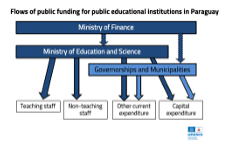
The educational budget allocated by the Ministry of Finance is divided into two main components. The first is the budget designated for the central level, specifically for the Ministry of Education, which accounts for the majority of expenditures. The second allocates resources to decentralised entities, including governorships and municipalities.
The National Fund for Public Investment and Development (FONACIDE) was established under Law No. 4758 and is financed through income received as compensation for the construction of the Itaipú and Yacyretá hydroelectric dams. Its resources are intended to support development initiatives, including those in the education sector. Some municipalities affected by the dam projects receive a higher proportion of funds than those that are not affected.
The budgets assigned to departmental and municipal governments are limited to infrastructure and school meal provision. According to Article 4 of FONACIDE, at least 50% of the income received by departmental and municipal governments must be allocated to educational infrastructure projects, while 30% was to be directed to school lunch programmes for children in early and basic education. Since 2024, with Law 7264/2024 (Zero Hunger Act), the articles of Law 4758/12 relating to the distribution of resources for school meals have been repealed.
2. Education resources to schools
Resources for schools are either directly allocated by the Ministry of Education or, for specific expenditures, provided by regional authorities, including municipalities and governorships.
Inclusive Education
In 2013, Law No. 5136 and its corresponding regulation, Decree No. 2837, were enacted to establish the framework for developing an inclusive educational model within the regular education system. The law requires the State to guarantee resources for pedagogical and technical support. Under this framework, attention is provided to students with specific educational support needs arising from physical, intellectual, auditory, visual, or psychosocial disabilities; specific learning disorders; high intellectual capacities; late incorporation into the education system; or other personal or educational circumstances requiring support or adjustments to foster their full development.
There are several types of centres designed to address diverse educational needs. Educational Inclusion Support Centres (CAI) provide curricular support and specialised services for students with special educational needs. Special Education Centres serve children and adolescents with permanent intellectual, sensory, motor, or multiple disabilities. Specific Support Centres focus on students with significant needs related to a single type of disability. The Pedagogical Support Service in Basic Schooling offers resources to promote educational inclusion for students with special needs within basic education. Special Grades in Basic Schools assist children with significant and permanent disabilities. Early Attention Services (SAT) offer non-formal education focused on the development of psychomotor, language, and social skills. Special Schools deliver formal education for children with intellectual, sensory, motor, or multiple disabilities. Compensatory Educational Attention Services are provided in various settings for students in vulnerable situations, covering Early Education, Basic School Education, and High School Education as appropriate.
3. Education resources to students and families
Equity Package
Within the education funding framework, there is an equity package composed of four distinct projects, three of which provide direct support to students.
The Scholarship Programme, managed by the National Scholarship Council under the Ministry of Education and Culture since 2013, aims to ensure conditions that promote access, retention, and timely completion of studies within the National Education System, particularly for students from socioeconomically vulnerable households. Its purpose is to support the development of citizens capable of improving their own quality of life and that of their families and communities. Eligibility criteria include good academic performance and appropriate conduct within educational institutions. Applicants must come from low-income families whose parents or guardians do not work in public institutions. For minors, parents must lack the financial means to begin or continue their education. The maximum age limit for applicants is 15 years for the Third Cycle of Basic Education (EEB) and 18 years for Secondary Education. There are no age restrictions for applicants who identify as Indigenous or have disabilities.
The School Supplies Programme provides educational materials to all students enrolled in different levels and modalities of officially managed educational institutions, as well as to a proportion of students in state-subsidised private institutions.
The Student Ticket Programme offers a 50% fare reduction to students in kindergarten, elementary, and secondary education in both public and state-subsidised private institutions. This programme operates on a demand basis and has limited coverage.
4. Social policies and family support programmes
TEKOPORÃ, now TEKOPORÃ MBARETE, is a socio-family and community support programme combining social accompaniment by technical staff with conditional cash transfers. Created in 2012 and regulated by Resolution No. 563/2016, it aims to improve the quality of life of households by promoting access to food, health, and education services, strengthening social networks, and reducing the intergenerational transmission of poverty. The programme has nationwide coverage, prioritising the poorest districts based on the Geographic Prioritisation Index (IPG), and coordinates with local governments through Municipal Community Participation Committees (MPCs). It is part of the social protection system managed by the Ministry of Social Development (MDS), formerly the Social Action Secretariat, alongside Propais II and Ñopytyvo. In 2024, the average transfer under this initiative was from PYG 50,000 per person to PYG 100,000-281,000 for families.
TEKOPORÃ targets households facing poverty or vulnerability, particularly those including people with severe disabilities or members of Indigenous communities. Cash transfers are provided bimonthly to the household head or guardian, prioritising women, and consist of a fixed Bono Alimentario and a variable Bono Familiar, linked to the number of eligible household members such as children, pregnant women, older adults, and people with disabilities. Indigenous families receive a single consolidated payment. Children aged 6 to 18 (up to four per household) must be enrolled in school, maintain at least 85 per cent attendance, and progress to the next grade. Family Guides monitor attendance and record it in a programme matrix.
Monitoring and evaluation occur in stages: after four years, the first evaluation assesses quality of life and areas for improvement; after six years, a second evaluation determines whether families can graduate or transition to other programmes; if vulnerability persists, participation may be extended for an additional two years, followed by a third evaluation. Families may remain in the programme for up to ten years and graduate once sustained improvements in living conditions are observed.
In 2023, the programme was restructured by the National Government (Decree 124/23), increasing payments by 25% to compensate for inflation.
5. School meal programmes
Programa de Alimentación Escolar del Paraguay – PAEP (School Feeding Programme of Paraguay)
The School Feeding Programme of Paraguay (PAEP) provides school meals through snacks and lunches. Until 2015, this benefit was intended exclusively for students in Basic School Education, and in 2016, a pilot programme expanded snack provision to the 3rd cycle of Basic Education (EEB) and High School Education. Law No. 5,210/14, “School Feeding and Health Control, in accordance with the rights to food and health of students,” establishes in Article 9 the principle of universality, stating that school feeding is aimed at all students to guarantee the right to food.
Decree No. 2366 defines the beneficiaries of the programme as students in officially managed formal educational institutions at all levels, including Early Education (formal and non-formal), Basic School, and High School, across morning, afternoon, and evening shifts. Indigenous students are included, with attention to cultural habits, and selected students in state-subsidised private institutions also benefit.
Law No. 5,210/14 designates the Ministry of Education and Science as the responsible authority for the programme. The new regulation, from the law No. 7264/2024, mandates that the Ministry of Social Development (MDS) manages food distribution in Asunción, Central, and Pdte. Hayes, while the provincial governments are responsible for implementation in the other departments, under the supervision of CONAE.
In 2024, the “Zero Hunger in our Schools and Education System” Bill was launched to universalise school lunches based on equity criteria and address hunger among students. The bill establishes the National School Food Council (CONAE) as the regulatory body responsible for provision, administrative and operational controls, accountability, and oversight. The Comptroller General of the Republic (CGR) will conduct concurrent controls, and citizens can report non-compliance regarding the provision and quality of meals. The bill also establishes the National School Food Fund (FONAE) to ensure transparency and traceability of all resources financing the programme.
This profile was reviewed by Prof. Maria Gloria Paredes, PhD in Education.