
Financing for equity in primary and secondary education
1. Education resources to subnational governments
2. Education resources to schools
3. Education resources to students and families
4. Social policies and family support programmes
Introduction
In Oman, the Ministry of Finance (MoF) is the central body responsible for allocating and overseeing the overall national budget, including education. The Ministry of Education (MoE) is the lead agency in managing and implementing the budget for basic education. It finances teacher salaries, staffing, school infrastructure, materials, curriculum, transportation, and special education.
Education financing follows a centralized, top-down model. First, the Ministry of Education develops a detailed budget proposal for each fiscal year. This proposal is then reviewed and approved by the Ministry of Finance as part of the national budget. Subsequently, funds are disbursed from the central treasury to the Ministry of Education. The Ministry allocates these funds directly to schools, regional education offices, and specific programs. There is no formal system of fiscal transfers to decentralized local authorities for education. Instead, individual schools receive allocations based on the Ministry’s assessments, student enrolment numbers, and school needs. Schools have limited financial autonomy; decisions regarding expenditures, staffing, and major purchases are typically made at the ministry level or through regional directorates.
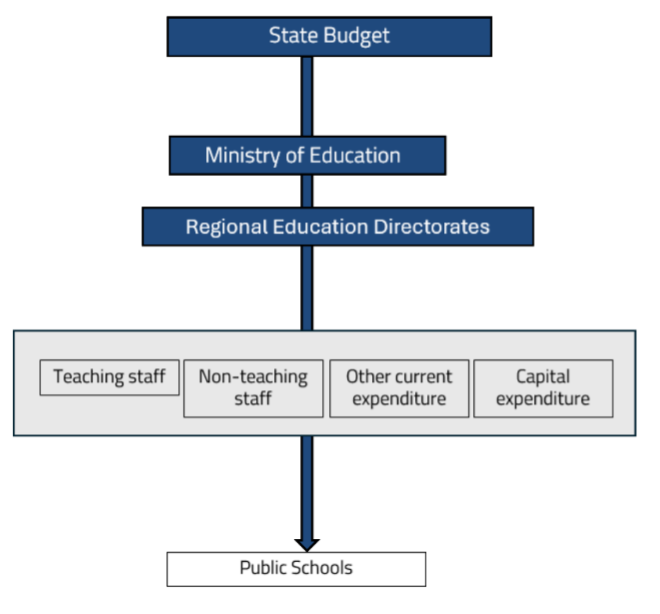
Source : PEER Team
1. Education resources to subnational governments
There are no fiscal transfers to local governments.
2. Education resources to schools
School funding is centrally managed by the Ministry of Education, which allocates resources directly to schools based on assessed needs, student numbers, and programme requirements.
The Ministry of Education allocates resources to schools with special education programmes through budgetary funding, staffing, infrastructure, and materials. Selected schools receive annual financial support to cover operational costs specific to special needs education.
Since 2005/2006, the inclusive education initiative has been the primary policy guiding resource allocation for schools serving students with disabilities. This initiative provides both financial and human resources, targeting students with intellectual disabilities and partial integration autism spectrum disorders mainly within basic education (grades 1–9). It also supports students with hearing and visual impairments, learning difficulties, and full integration autism spectrum disorders, mainly within basic education (grades 1–12).
Although no formal equity funding formula is publicly available, allocations consider factors such as the number and type of students with disabilities, diagnostic assessments, availability of specialised staff and facilities, and geographic location, including remoteness. Resources include assistive technologies (e.g., Braille books, audio devices), specialised classroom equipment (e.g., smart boards, adaptive furniture), and transportation support (e.g., special buses). Schools with inclusive programmes are also assigned special education teachers and speech-language therapists.
Several nationwide programmes also support special education implementation:
- Addressing Learning Disabilities in Schools Programme (since 2000/2001), expanded to cover grades 1–4 and grade 9 of basic education.
- Integration of Children with Disabilities Programme (launched 2005/2006), which established dedicated classrooms for students with hearing and intellectual disabilities across all Governorates.
- Speech-Language Impairment Programme, providing diagnostic and therapeutic services via scheduled visits from speech-language pathologists.
- (Total/Partial) Integration Programme for students with autism (since 2016/2017), offering educational and rehabilitative support to promote inclusion in general education schools.
- Purchase of educational services for partial integration autism spectrum disorders (2023/2024). The Ministry of Education started a pilot initiative, in collaboration with private schools.
This approach is aligned with Royal Decree No. 31/2023 (School Education Law), which emphasises equitable access to education and appropriate support for students with disabilities. It is further reinforced by Royal Decree No. 92/2025 promulgating the Law on the Rights of Persons with Disabilities, which guarantees the right to inclusive, accessible, and adequately resourced education.
3. Education resources to students and families
No information was found.
4. Social policies and family support programmes
The Child Benefit Initiative was established by Royal Decree No. 33/2021 and managed by the Social Protection Fundwith the Ministry of Social Development. It provides Omani children aged 0–18, who hold citizenship, reside in Oman, and have a registered civil ID and bank account, with a monthly cash benefit of 10 Omani Riyals (USD 25) , and 130 Omani Riyals (USD 338) for children with disabilities. Aligned with Royal Decree No. 31/2023, the initiative supports education by potentially helping families cover school-related costs such as supplies, and nutrition, which promote school attendance and performance. This initiative is part of Oman’s Vision 2040, addressing the needs of over 40% of the population under age 18. Benefits are managed online, requiring beneficiaries to maintain updated records.
5. School meal programmes
Oman does not have a free meal programme in place that is delivered in schools.
This profile was reviewed by Shununa Salim Alhabsi, Assistant Director General for Special Needs at the Ministry of Education of the Sultanate of Oman and Dr Khalaf Marhoun Al’Abri, Associate Professor of Education Systems and Policies, College of Education, Sultan Qaboos University.