


Financing for equity in primary and secondary education
1. Education resources to subnational governments
2. Education resources to schools
3. Education resources to students and families
4. Social policies and family support programmes
Introduction
San Marino’s education system is centrally governed by the Secretariat for Public Education (equivalent to a Ministry of Education), which manages regulations, proposes curriculum reforms, revises study plans, promotes teacher training, and fosters international collaboration. It prepares an annual education report for the Congress of State and the Grand and General Council, and promotes performance evaluations. The Didactic Coordination Committee supports coordination across education levels, sets guidelines, and implements decisions; it includes the Secretary of State, the Education Department Coordinator, and School Principals. The Public Education Council, replacing the former Public Education Commission, serves as a stakeholder forum on policy, reports, and legislation. Budget preparation involves the Secretariat identifying sector needs, while overall financial decisions are managed by the Congress of State and approved by the Grand and General Council. The Secretariat allocates then, the funds for projects, schools, staff, and all capital and non-capital expenditures.
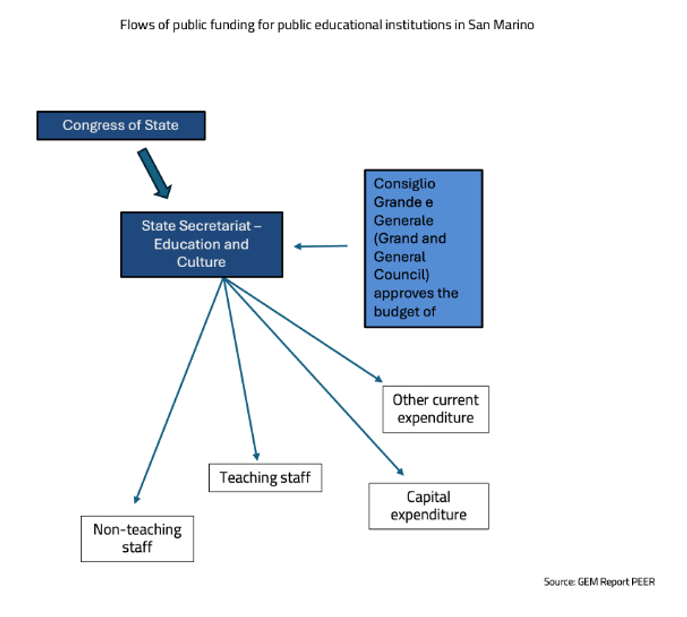
1. Education resources to subnational governments
In San Marino’s highly centralised education system, there are no equity-based funding mechanisms that transfer resources from the central government to local governments.
2. Education resources to schools
Basic education schools receive funds to provide special education services for students with special needs.
3. Education resources to students and families
Diritto allo Studio (Right to Education)
In 2004, Law No. 5 established permanent programmes, managed by the Secretariat for Public Education, to guarantee and facilitate the right to education in San Marino for students in upper secondary education. They aim to promote equal opportunities—especially for students from vulnerable socio-economic backgrounds—support academic and professional excellence, prepare students for the labour market, and reduce financial barriers for low-income families. The study allowance provides annual financial aid to citizens and residents in upper secondary education, with amounts based on family income. The merit-based study allowance rewards outstanding academic results in secondary education; secondary students receive €513.04 for an average of at least 8.5/10 or final exam scores of 90/100 or more. The textbook contribution helps upper secondary students buy books not provided for free: €262.24 for first- and third-year students, €199.53 for second-, fourth-, and fifth-year students, with a 50% reduction for repeat years (once per cycle). The transportation subsidy ensures access to schools in San Marino and abroad, with annual passes costing students €50 internally or €70 externally, and the State covering the rest. The law also grants full tax deductibility of secondary tuition fees and up to €2,000 in deductions for accommodation and boarding when studying outside the country.
4. Social policies and family support programmes
Assegni Familiari (Family Allowances)
In 1979 (regulated further in 2009), San Marino introduced the Assegni Familiari (Family Allowances) programme managed by the Institute for Social Security and still active today. It provides a base monthly allowance regardless of income: €86.67 for the first dependent, €110.02 for the second, €137.40 for the third, €162.75 for the fourth, and €195.20 for the fifth and subsequent dependents (2026 figures). Automatic family allowance adjustments are regulated by Law No. 158 of 22 December 2025, which established the family financial support system and a mechanism for regular cost-of-living adjustments.
To promote equity, an integrative allowance is added based on per capita household income. In 2024, families earning up to €8,100 receive a €300 bonus; €8,100.01–€9,300 receive €200; and €9,300.01–€10,600 receive €100. Single-parent households receive higher integrative rates—100%, 70%, and 50% for the three groups—without further increases.
5. School meal programmes
The state provides school meals in primary education, but they are not free. Since Resolution No. 39 of December 17, 2013, families pay €4.20 per lunch, which includes a mid-morning fruit or yoghurt snack, with bills issued every two months. The State covers part of the cost, and families with three or more children in primary school receive a 20% fee reduction. Exemptions from payment are possible, but parents or guardians must pick up and return their child during lunchtime, as no alternative meals or transport are provided for exempt students. Meals are prepared in strict accordance with a menu developed by the Dietetics Service of the I.S.S., aimed at providing students with the right nutritional intake during the school day while also encouraging them to adopt a healthy, balanced diet.










