


Financing for equity in primary and secondary education
SCOTLAND
1. Education resources to subnational governments
2. Education resources to schools
3. Education resources to students and families
4. Social policies and family support programmes
Introduction
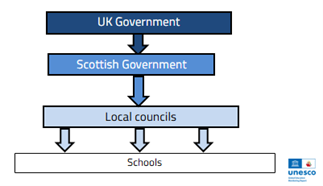
In Scotland, the Cabinet Secretary for Education and Skills holds overall responsibility for education. The Learning Directorate in the civil service is responsible for proposing legislation and policy in the sector. Education Scotland is the independent executive agency charged with supporting quality and improvement in the Scottish education system. Local councils are primarily responsible for delivering mandatory education within their areas and for ensuring that national education policy and guidelines are implemented effectively.
Public expenditure for Scotland, as with Wales and Northern Ireland, is allocated by the UK central government using the Barnett formula, which distributes funds based on population rather than assessed need. The Scottish Government then allocates funding to local councils, each of which manages its own education budget and distributes resources to schools accordingly.
1. Education resources to subnational governments
Scotland has 32 Local Authority councils, each responsible for providing education and other local services. Council funding is primarily drawn from four sources: the Scottish Government grant, service income, Non-domestic Rates, and Council Tax. The distribution of funds is guided by the Convention of Scottish Local Authorities.
The calculation of General Revenue Funding (GRF) begins with the Grant Aided Expenditure (GAE) and the Special Islands Needs Allowance (SINA), which take into account factors such as population size, child deprivation indicators, standardised mortality ratios, rurality, and school meals. To ensure fairness, each service area is considered separately within the Funding Allocation Formula. For education specifically, 29 different areas are assessed, including school levels, school meals, equity-focused programmes, and teacher funding.
The government grant is designed to provide councils with a targeted amount after accounting for their own budget contributions. In addition, Strategic Equity Funding, introduced in 2022, is allocated to all 32 councils to address the poverty-related attainment gap. Distribution is based on data on Children in Low Income Families, with councils prioritising six family types identified by the Scottish Government as most at risk of child poverty: lone parent families, ethnic minority families, families with a disabled adult or child, families with a young mother, families with a child under one, and larger families with three or more children.
2. Education resources to schools
Local councils are primarily responsible for allocating funds to schools. Education accounts for almost half of net revenue expenditure in councils, making it their largest spending area. Councils exercise considerable control over allocation, with roughly two-thirds of funds going directly to individual schools and one-third managed centrally by the councils themselves.
Pupil Equity Funding (PEF) is additional money allocated directly to schools to help close the poverty-related attainment gap. Funding is determined by free school meal registration and is implemented through existing school planning procedures, including school improvement plans and standards and quality reports. In the 2022-23 school year, schools received an additional GBP 1,225 per eligible pupil. PEF is targeted at the six priority family types and must be spent on resources, activities, and approaches that directly support learners affected by poverty.
Deprivation Weighted Local Authority Funding
Many local councils have employed the Scottish Index of Multiple Deprivation (SIMD) to inform education funding since the index was published in 2004. SIMD measures relative deprivation across small geographical areas, taking into account seven domains: 1) income, 2) employment, 3) education, 4) health, 5) access to services, 6) crime, and 7) housing.
3. Education resources to students and families
Families can apply for a school clothing grant through their local council, which determines eligibility and administers the programme. The grant provides at least GBP 120 per primary school child and GBP 150 per secondary school child, paid directly into the family’s bank account.
Education Maintenance Allowance (EMA)
The EMA supports pupils aged 16 to 19 to continue their education. Eligibility is based on residency, full-time enrolment, and household income (up to GBP 24,421 for single-child households or GBP 26,884 for households with multiple dependent children). Pupils must also participate in a learning agreement with the local council, setting academic and attendance goals. The allowance is GBP 30 per week, and pupils must apply each academic year.
4. Social policies and family support programmes
Several social programmes provide cash grants to families raising children. These programmes are funded and administered directly by local councils and are not managed centrally at the national level.
The School Age Payment is a one-time payment of GBP 319.80 per child, provided in the year the child first becomes eligible to start school. Families can use this money for clothes, school trips, stationery, or other school-related expenses.
The Scottish Child Payment is a weekly benefit of GBP 27.15, paid every four weeks to support families with children until the child reaches 16 years old. Families may qualify if they receive certain social supports, such as income-based allowances, Universal Credit, or child tax credit.
The Child Disability Payment provides financial support for families with children under 16 who have additional care or mobility needs. The care component has three payment levels: the lowest rate of GBP 29.20 per week is paid for children who require attention for a significant part of the day; the middle rate of GBP 73.90 per week is provided for children who need frequent attention during the day or prolonged or repeated attention at night; and the highest rate of GBP 110.40 per week applies to children who require both frequent attention during the day and prolonged or repeated attention at night. The mobility component has two payment levels: the lower rate of GBP 29.20 per week is for children who can walk but require guidance, while the higher rate of GBP 77.05 per week is for children who cannot walk or have a severe disability.
Together with non-government organizations City Council has introduced and developed the role of financial inclusion support officers (FISO) in schools across the city. In 2024/25 1,306 clients accessed the service of which 775 had been supported to secure approximately £4.85 million in financial support. Additionally, 188 clients were supported through debt management with a total of £600,000. The service engages with the following priority groups lone parent families, families which include a disabled adult or child, families with 3 or more children and minority ethnic families.
5. School meal programmes
All children in Primary 1 to Primary 5 in local council or Scottish Government-funded schools are entitled to free school lunches regardless of financial circumstances. Children attending public special schools also receive free school lunches. For pupils in Primary 6 and 7, eligibility for free school meals depends on qualifying for social benefits such as the Scottish Child Payment, Income Support, or Universal Credit. Secondary school pupils can receive free meals if they qualify for the Scottish Child Payment or Income Support. Young people aged 16 to 18 who receive any of these benefits in their own right are also eligible. Children receiving free school meals may also qualify for meal support during school holidays. The government has started a phased expansion of universal free school meals to include Primary 6 and 7 pupils. Children experiencing financial hardship who cannot access government social benefits due to immigration status are also eligible.
Bright Start Breakfasts Programme
The Scottish Government is expanding breakfast provision nationwide through the Bright Start Breakfasts Programme. This initiative aims to make breakfast clubs available to all primary school children and their families. As of the 2024–25 school year, nearly half of Scotland’s schools were already offering breakfast before the start of the school day, with funding for full expansion expected from August 2025 onwards.
Nutritional standards are governed by the secondary legislation of The Nutritional Requirements for Food and Drink in Schools (Scotland) Regulations 2020.
This profile was reviewed by David Watt, Associate Tutor and Michael Cairney, MA Comparative Education, University of Edinburgh.










