


Financing for equity in primary and secondary education
1. Education resources to subnational governments
2. Education resources to schools
3. Education resources to students and families
4. Social policies and family support programmes
Introduction
In Belize, the Ministry of Education, Youth, Sports and Culture oversees the nation’s schools, working closely with churches, communities, and private organisations to ensure the provision of effective education. Guided by the Education and Training Act (2020), the Ministry emphasises collaboration with these partners to achieve efficient and inclusive education across the country.
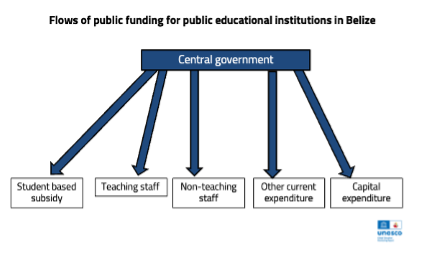
The Ministry manages all public education funding, with budgets projected according to district enrolment. While the government covers roughly 50% of education costs, families contribute the remainder, including expenses for uniforms, school materials, food and transport in primary schools, and tuition fees in secondary schools. Private primary education providers also receive government support, which covers teacher salaries and an additional 30% for operational costs.
Under the direction of the Minister, the Chief Education Officer administers the education system, ensuring resources are allocated within the approved budget, facilities are maintained, school attendance is promoted, and both school management and student safety are upheld. All government and government-aided schools operate under authorities responsible for managing policies and daily operations.
Supporting this framework, the National Council for Education appoints committees to guide specific areas. The Committee on School Services advises on access to early childhood, special, primary, secondary, and technical vocational education, as well as the management of associated schools. Meanwhile, the Committee for Exceptional Populations and Student Welfare focuses on developing programmes for exceptional learners and addressing wider concerns such as student protection, parental responsibilities, nonparticipation, health and wellbeing, textbook loan schemes, and initiatives to support student success and retention.
1. Education resources to subnational governments
District Education Centres, under the local Boards of Management, serve as the Ministry’s administrative hubs in each district, responsible for the coordinated management, supervision, and promotion of schools to ensure high-quality educational services. Each Centre assesses district-level needs and develops a prioritised sector plan and implementation strategy aligned with national education objectives, while also administering routine services such as monitoring student financial assistance and grant programmes. Resources allocated through an equity-based formula are distributed directly to schools to support targeted educational initiatives.
2. Education resources to schools
Belize’s education system is primarily publicly funded, with service delivery divided between government and denominational schools, as established under the Education Act of 2010. Secondary education operates under a partially decentralised model.
Secondary Education Funding Reform
Before 2010, the Ministry of Education (MOE) financed secondary schools through grants covering teacher salaries and operational costs. Operational funding varied widely, typically 5–25% of salary expenditures, with additional funds raised locally by principals and school councils.
In 2010, the government introduced a new enrolment-based funding formula, effective from 2011, which allocates resources according to student enrolment and compensates for socio-economic and academic needs. Previously, private schools received higher funding per student due to experienced teachers and diverse curricula. Under the new system, each student generates a standard grant, adjusted to provide additional support for disadvantaged learners. Schools whose grants fall above the national average are classified as Above Average Funding schools, while those below are designated Below Average Funding schools. The government plans to gradually close the gap between these categories over a seven-year period before fully implementing the enrolment-based formula. The primary objective of this reform is to promote equity in education funding, ensuring that resources are distributed more fairly across districts and schools, particularly for those serving disadvantaged populations.
3. Education resources to students and families
The School Community Liaison and Security Programme (now the Student Welfare Unit) started in the 1998–1999 school years, with the liaison/“truancy” component established in 1998 and the security component added in June 1999.
The Ministry of Education, Culture, Science, and Technology has established the Student Welfare Unit, also known as the School Community Liaison and Security Programme, to ensure regular school attendance for all children of compulsory school age. The Unit collaborates with social service organisations to identify and support students facing social barriers to inclusion and learning, including refugees, children living in poverty, and those from remote rural areas.
The Unit provides targeted support services to students and parents, helping schools ensure that students in need have access to essential resources such as uniforms, textbooks, and digital devices. In addition, the Ministry offers financial educational assistance for secondary and university students across Belize, further supporting access to education for disadvantaged populations.
4. Social policies and family support programmes
Building Opportunities for Our Social Transformation (BOOST)
The BOOST programme, launched in 2010, is a national conditional cash transfer initiative targeting households experiencing poverty, specifically those with children under 18 and pregnant women. It provides monthly financial transfers of BZD 44 to BZD 82 per beneficiary for up to six beneficiaries per household. A key feature of the programme is its educational conditionality, which requires children to maintain at least 85% school attendance, linking financial support directly to school participation and promoting educational inclusion for vulnerable populations.
5. School meal programmes
National Healthy Start Feeding Programme (NHSFP)
The National Healthy Start Feeding Programme (NHSFP) provides nutritionally balanced meals to primary and secondary school students, following a school feeding menu developed in 2022 that includes breakfast and lunch options prepared with over 70% locally produced items. The programme aims to promote good health and nutrition, support SDG 2 (Zero Hunger), and reduce barriers to education by ensuring that children consume wholesome meals while at school, thereby improving their ability to learn. The National School Feeding Coordinator, through the National School Feeding Taskforce, plans to finalise a National School Feeding Policy in 2024–2025 and oversee its implementation, while continuing to expand the programme at the primary level.










