


Financing for equity in primary and secondary education
1. Education resources to subnational governments
2. Education resources to schools
3. Education resources to students and families
4. Social policies and family support programmes
Introduction
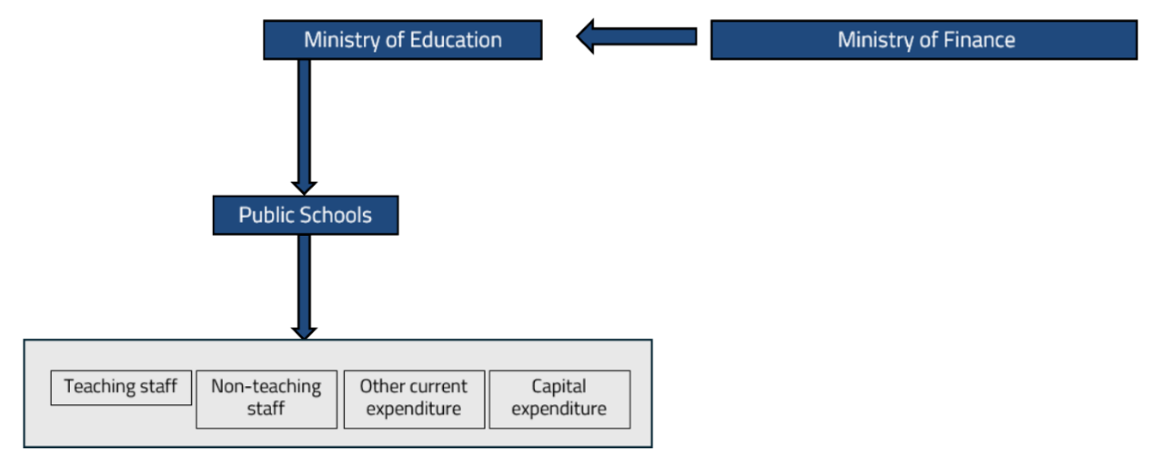
In Bahrain, education financing is highly centralized and overseen primarily by the Ministry of Finance and National Economy (MoFNE), which allocates budgets to the Ministry of Education (Moe). The Moe is responsible for planning, budgeting, and managing all aspects of basic education—including primary, lower secondary, and secondary education. There is no subnational or local government responsibility for basic education provision or financing.
The government fully finances public education from the central budget. This includes teacher and administrative staff salaries, school infrastructure and maintenance, curriculum development and learning resources, school transportation, special education and inclusive education services, and vocational and technical education at the secondary level. Funds flow directly from the MoFNE to the Moe, which then allocates resources to individual schools through internal budgetary mechanisms.
Source : PEER Team
1. Education resources to subnational governments
The education system is centrally administered, and there are no subnational governments with authority over education financing.
2. Education resources to schools
Resource allocation to schools is transitioning from a traditional centralised model to a needs-based funding mechanism that links financial resources directly to specialisation, number of students, and other programmes. Under this model, schools are granted autonomy in spending through clearly defined guidelines and accountability frameworks, allowing them to manage budgets more flexibly in line with their priorities. The Moe oversees the allocation process, guided by a funding formula designed to ensure fairness and efficiency.
The estimated budget allocated to each school also includes a provision for social assistance, which the school may allocate based on its circumstances and financial capacity. This is to support students from low-income families in purchasing stationery, uniforms, and other essential educational supplies.
The Support for Students with Special Needs in Public Schools Programme
The Bahraini government has implemented various policies and initiatives aimed at ensuring that all students, regardless of their abilities, have the access to quality education in all public schools. The Moe ensures inclusive and equitable education for all learners, including those with learning difficulties, intellectual disabilities, autism, Down syndrome, speech and psychological disorders, and gifted students. Introduced in 2005, this development initiative aims to enrol students with special needs in public schools and provide specialised academic, developmental, therapeutic, and social services. The Ministry supports this by appointing special education teachers, consultants, speech therapists, and psychologists, primarily in primary schools, and by developing tailored curricula, diagnostic tools, and Arabic assessments. Inclusive classrooms are designed to meet individual needs, and staff receive ongoing local and international training. It includes quality assurance mechanisms, evaluation systems, and continuous research on special education practices.
3. Education resources to students and families
Free Textbooks and School Supplies
The Ministry of Education has implemented a policy of providing free textbooks and essential school supplies to all students enrolled in public schools, as part of its broader mandate to ensure universal access to free basic education. While the provision is universal by design, this programme primarily benefits students from low-income and disadvantaged households by alleviating the financial burden associated with educational materials. There is no formal selection or eligibility criteria for receiving textbooks, as all Bahraini and non-Bahraini students enrolled in government schools automatically receive them in each academic year.
As part of community partnership and social participation initiatives, the Moe, in collaboration with private sector partners, implements programmes to support students and their families. These initiatives include the provision of discount vouchers for all students, regardless of economic status, to facilitate the purchase of school stationery, uniforms, and other essential educational supplies from approved vendors. The programme aims to reduce the financial burden on families and strengthen collaboration between the education sector and the wider community.
4. Social policies and family support programmes
No information was found.
5. School meal programmes
Bahrain does not operate a publicly funded school meal programme in pre-primary education. Food services may be available through school or nursery canteens, where meals and snacks are offered at low cost and paid for by parents. These services are not subsidised by the government and do not form part of a targeted nutrition or social protection programme.
This profile was reviewed by Dr. Abbas Mohamed Ahmed, Senior Special Education at the Bahrain Ministry of Education; and Lulwa Ghassan Al Muhana, Director of Licensing & Follow-up of Private Schools at the Bahrain Ministry of Education.










