


Financing for equity in primary and secondary education
1. Education resources to subnational governments
2. Education resources to schools
3. Education resources to students and families
4. Social policies and family support programmes
Introduction
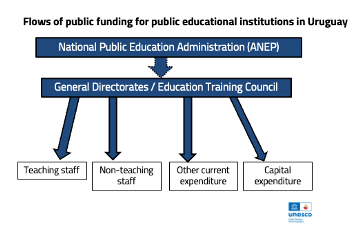
In Uruguay, the Ministry of Education coordinates public education funding, which is managed by the National Administration of Public Education (ANEP), an autonomous entity established under Law No. 15,739 on 28 March 1985, centralizing most educational resources.
ANEP is the state agency responsible for the planning, management, and administration of the Public Education System, covering all levels from preschool to technical and vocational training, including secondary and tertiary technical-technological education. It is governed by the Central Board of Directors (CODICEN), which provides overall strategic direction and oversight.
The administration is organised into four main subsystems: the Education Training Council (CFE), which focuses on teacher training and educational policy development, and three general directorates: the General Directorate of Early and Primary Education, the General Directorate of Secondary Education, and the General Directorate of Technical and Vocational Education. Each subsystem is tasked with implementing policies, managing resources, and ensuring educational quality within its respective domain.
1. Education resources to subnational governments
State intervention in the funding of educational centres remains highly centralised. While the Ministry of Education could, in principle, allocate resources to equalise opportunities based on student characteristics such as socioeconomic status or educational needs, this mandate is not clearly defined. There is no established funding formula at the general, intermediate, or institutional levels, and local authorities do not have a role in influencing the distribution of resources.
2. Education resources to schools
The National Public Education Administration (Administración Nacional de Educación Pública, (ANEP)’s Central Directorate (CODICEN) allocates the overall budget to each educational subsystem, with the respective directorates responsible for distributing resources to schools. Individual educational institutions have limited control over staff and most of their funding, managing primarily small budget items for day-to-day expenses or minor repairs. This process is based on historical allocation and increases are tied to specific programs or an area to be strengthened rather than individual school needs, yet in the case of the most vulnerable quintile, each directorate allocates resources equitably, with higher per-student spending.
Through targeted programmes and differentiated modalities (such as full-time and extended-day schools, which are predominantly located in disadvantaged areas) additional resources are channelled in the form of school meals, teacher salary incentives, and specific pedagogical support. In this sense, centralisation is not a limitation to inclusion but rather a mechanism that enables fairer and more coherent resource distribution in line with the principles of Uruguay’s public education system.
Funding for each school is divided into three main components: salaries, operating expenses, and investments, with salaries representing the largest share. Teachers in priority schools receive additional pay for coordination and planning responsibilities, and these schools are prioritised for programme implementation. As a result, salary costs per student in these schools are approximately 10% higher than in regular urban schools, reflecting a lower teacher-student ratio and slightly higher teacher salaries.
Programa Aprender (Learning Programme)
The A.Pr.En.D.E.R. Programme (Atención Prioritaria en Entornos con Dificultades Estructurales Relativas – Priority Attention in Structurally Disadvantaged Contexts) is a component of Uruguay’s inclusive education strategy. Established in 2011 and continued under subsequent administrations, it aims to provide access to quality education for children in socio-cultural contexts of high vulnerability through differentiated resource allocation and pedagogical support.
Within this framework, Full-Time and Extended-Time schools (ETC and ETE) serve as instruments for equity, focusing resources on schools in socio-economic quintiles 1 and 2. These schools receive additional financial support, which includes extended pedagogical hours, free school meals, increased teaching staff allocation, and salary incentives for coordination and planning tasks.
School funding is structured into three components: salaries, operating expenses, and investment, with salaries making up the largest portion. In priority schools, per-student salary costs are approximately 10% higher than in regular urban schools, which is associated with a lower student–teacher ratio and additional measures intended to improve learning conditions.
3. Education resources to students and families
Beca Butiá (Butiá Scholarship)
The Butiá Scholarship offers financial support to students in public secondary education who face economic hardship, facilitating access, retention, and reintegration into the education system. Designed to promote equal opportunity, the scholarship ensures that financial constraints do not impede completion of high school, emphasising inclusion and social equity. Introduced in 2011 as part of the Educational Commitment Programme, it targets adolescents and young people—particularly first-year higher secondary students—who face social and educational challenges or have weak connections to the formal education system.
4. Social policies and family support programmes
Asignaciones Familiares — Plan Equidad (Family Allowances - Equity Plan)
The Family Allowances - Equity Plan is a conditional cash transfer programme established in 2008 to support children and adolescents from vulnerable households. It replaced the National Social Emergency Response Plan that ran from 2005 – 2007. Managed by the Bank of Social Security Institute (BPS) in coordination with the Ministry of Social Development (MIDES), it expands cash transfers for formal workers contributing to social security and aims to reduce poverty while encouraging school attendance and reintegration into formal education. Eligibility covers children in primary school up to age 14, extended to age 16 for those who have not completed elementary school due to illness or living more than 5 km from a school. Secondary school students in state or authorised private institutions remain eligible until age 18. Beneficiaries of the BPS disability pension are also covered until age 18, while children with disabilities not entitled to a pension may receive benefits for life or until qualifying for another BPS benefit, if they apply before turning 18 with a certificate from Centro Martínez Visca. Where multiple eligible individuals exist, preference is given to the woman.
5. School meal programmes
Programa de Alimentación Escolar – PAE (School Feeding Programme)
The School Feeding Programme (PAE), implemented in 2003 and now managed by the National Public Education Administration (ANEP), provides food assistance to approximately 2,218 educational centres nationwide, including kindergartens, primary schools, and, to a lesser extent, secondary schools in specific contexts. The programme delivers daily meals during the school year, Monday to Friday, and offers centralised services in selected schools located in vulnerable areas during summer and winter vacations. Meals are provided to all full-time and extended-time students, as well as those in single-time modalities, with particular attention to children in vulnerable contexts.
The programme operates through three modalities depending on meal preparation and delivery. In the Traditional Mode, school staff, usually the Head Teacher or Bursar, prepare meals on-site, handling food purchases, fuel, and cleaning while following recipes provided by the PAE Technical Team. The Transported Outsourced Modality involves meals prepared in food processing plants according to the Technical Team’s menu and transported to schools where on-site preparation is impractical. The Outsourced Modality “Cooked at School” allows external companies to prepare meals directly at the schools using their own ingredients, staff, and equipment in accordance with the PAE menu.
This profile was reviewed by Laura de Torres Carballal, Tenured Principal, Liceo de Barros Blancos.










