


Financing for equity in primary and secondary education
1. Education resources to subnational governments
2. Education resources to schools
3. Education resources to students and families
4. Social policies and family support programmes
Introduction
In Antigua and Barbuda, the education system encompasses various types of institutions that address diverse educational needs. Public schools are fully funded and managed by the government at both primary and secondary levels. Private schools operate independently and are privately funded—some private institutions are classified as denominational schools, which are established and maintained by religious communities at their own expense. Additionally, there are assisted private schools, which are privately operated yet receive government support in the form of grants or teacher salaries, while retaining a degree of operational autonomy. The country also includes special education institutions.
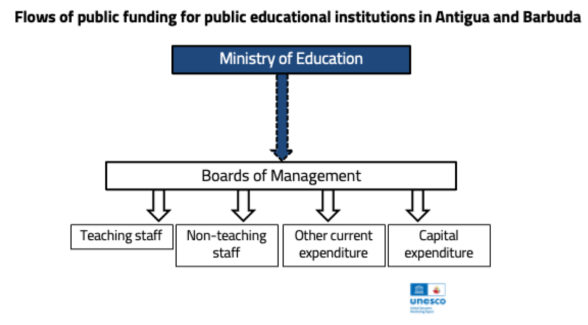
The school funds are managed collaboratively between the Ministry of Education and the Boards of Management of the schools. The Ministry establishes the policies and priorities for fund allocation, while Parliament delegates to the Board of Management the responsibilities of managing, controlling, operating, and maintaining the school. This includes the receipt, disbursement, and accounting for the expenditure of funds allocated for the school's operations.
1. Education resources to subnational governments
Resources are managed directly between the central level and the school level.
2. Education resources to schools
The Board of Management is tasked with the oversight and administration of the Education Fund since 1994. Board members are appointed by the Minister for a term of three years. At the commencement of each year, the Minister provides the Board with policies that outline the priorities for the allocation of funds from the Education Fund. Nevertheless, it is the responsibility of the Board to provide an estimation of the resources available in the Fund and to determine the expenditures allocated to various programmes for the financial year.
In addition to scholarships and textbooks, the Board of Education offers several benefits to improve the educational system of Antigua and Barbuda. These benefits include the provision of supplies and materials for the curriculum, maintenance of government school grounds, provision and maintenance of equipment and computers for schools, repair and refurbishment of school facilities, and supply of textbooks to all schools approved by the Ministry of Education.
The Fund comprises all proceeds from the levies that are raised and collected, transfers from Parliament, donations and endowments, as well as funds generated by the Board. The distribution of the fund is described as impartial; nonetheless, even if not explicitly referenced, the scholarship component and the nature of the resources allocated suggest the presence of an equity dimension.
There is no evidence of additional staff incentive support such as salary-based incentives specifically designed to attract or retain teachers in disadvantaged schools.
3. Education resources to students and families
No programme offering education resources to students and families targeting equity has been found.
The Board of Management does not offer scholarships specifically targeting students in basic education (primary and lower secondary levels). Their scholarship programs are primarily designed to support students advancing to higher education.
4. Social policies and family support programmes
In 2020, the government enacted the Social Protection Act, which reformed the social assistance framework to provide support at the household level, taking into account the specific needs of family members. Under its predecessor, the Poor Relief Act 1961, there were no clear eligibility criteria to identify poor and vulnerable individuals and decisions were made on a case-by-case basis. The Fund is a corporate body in which all funds allocated for the management of social protection programmes are vested and administered by its own Board.
The objectives of the Fund include the improvement of living conditions, the promotion of community participation, and the enhancement of social protection infrastructure related to health, education, and financial assistance, among other forms of support. Categories of assistance pertaining to education encompass school support for children enrolled in primary and secondary schools, as well as educational provisions for children diagnosed with special needs, aged 5 to 21 years.
Eligibility criteria encompass a household income of less than XCD 1,500 per month. The target groups include individuals aged 65 and older residing in low-income households of two persons or fewer; single parents with low income who have two or more dependents; low-income households with three or more dependents; and low-income households that include individuals with severe disabilities.
5. School meal programmes
National School Meals Program (NSMP)
The National School Meals Programme began operating in 2005, with 31 public schools participating during the 2020/2021 academic year. This initiative is administered by the Ministry of Education and is designed to achieve multiple objectives, including the enhancement of educational outcomes, the provision of a social safety net, the attainment of nutritional and health-related goals, and the prevention or mitigation of obesity. The programme includes specialized training for cooks and caterers in nutritional practices. It is aimed to bring at least one nutritious meal a day to all public primary schools and one public pre-school.
Complementary to this programme, education on food and nutrition has been implemented in the majority of participating schools.
This profile was reviewed by Dr. Lystra Hagley-Dickinson.










