
Financing for equity in primary and secondary education
1. Education resources to subnational governments
2. Education resources to schools
3. Education resources to students and families
4. Social policies and family support programmes
Introduction
In Serbia, the Ministry of Education (MoE) primarily oversees pre-university education, including primary and secondary schools. The MoE sets educational standards, regulates the selection and recruitment of school staff, and leads the sector.
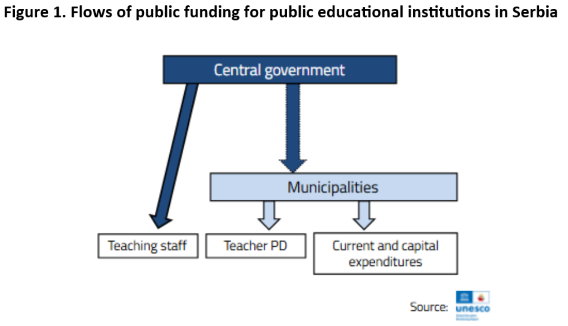
At the republic level, the government regulates and provides funding for professional development, salaries, and other employee compensation in primary and secondary schools. It also finances development programmes, school projects, and capital investments. Autonomous provinces, particularly Vojvodina, contribute additional funds and manage schooling and minority language instruction through the Provincial Secretariat for Education.
Regional authorities approve the number of classes and teachers and manage intermediary functions between the central government and schools. Local Self-Governing units (LSGs) are responsible for approving the local portion of school budgets and allocating funds for operational expenses, including maintenance, teacher professional development, student transportation, and preschool education. LSGs also establish and manage school networks, participate in school boards, coordinate inclusive education, and oversee school inspections. Schools may obtain additional funding from donations, projects, or other sources to cover materials or investment projects.
1. Education resources to subnational governments
Financing of Local Self-Governing Units (LSGs)
In the Republic of Serbia, the financing of Local Self-Governing units (LSGs) is governed by the Law on Local-Government Financing. Local governments receive funds through three main channels. First, own-source revenue, which includes property taxes and other local levies. Second, shared revenue, consisting of a percentage of other taxes such as income tax, inheritance tax, and charges on common goods and natural resources. Third, intergovernmental grants, which may be non-earmarked or earmarked for horizontal and vertical equalisation, and represent the primary mechanism through which the central government transfers funds to municipalities.
The general transfer for vertical equalisation is calculated based on population, area, and the number of schools and classes in pre-university education and preschools. In 2009, the central government either suspended or reduced non-earmarked grants to local governments.
2. Education resources to schools
In 2023, the Ministry of Education (MoE) issued the Rules on Criteria and Standards for Financing Institutions Providing Primary Education and Upbringing and the corresponding rules for secondary education. These regulations set out the framework for school financing. Funds are allocated based on school development plans agreed with local governments. The allocation considers the school’s price of services, which includes the number of working hours, staff required for the annual work plan, curriculum, school size and equipment, number of classes and groups, student numbers, staff qualifications, and material costs. In areas with lower populations, institutional grants are calculated based on the number of classes.
Inclusive Education Funding
Support for inclusive education is primarily the responsibility of local self-government units. Central government funding is guided by the 2023 rules for financing schools for students with developmental disabilities, providing additional resources to cover extra staff and material costs.
Priority Development Funding
The Ministry of Education also allocates funds to implement specific national development priorities, distributing resources to schools that meet defined conditions.
3. Education resources to students and families
Loans and Subsidised Accommodation
The government provides financial support in the form of loans and subsidised accommodation and meals in dormitories for pupils from vulnerable social groups. These include children from materially disadvantaged families, orphaned children, those from single-parent homes, members of the Roma national minority, people with disabilities or chronic illnesses, refugees and displaced persons, returnees, and deported students. The Law on the Foundations of the Education System (No. 72/2009) grants the right to scholarship, loan, board and lodging within a boarding school in accordance with the pertaining law.
The Free Textbooks Award Programme
Since the 2009/10 school year, the government has financed textbook purchases for primary school students, administered annually by the Ministry of Education. The programme began with first graders and was later expanded. Free textbooks are primarily provided to socially or materially disadvantaged pupils, students following Individual Education Plans—including adapted formats such as large print, Braille, and electronic formats—and third-or-subsequent children in a family enrolled in the education system. Schools collect applications and submit data to the Ministry within a set deadline each year.
Monthly Student Scholarship
At the secondary level, the Ministry of Education provides a monthly student scholarship covering accommodation and meals in student dormitories. Local governments also offer their own scholarships. Students from vulnerable social groups are eligible to apply for these scholarships and student loans under more flexible criteria.
4. Social policies and family support programmes
Financial Social Assistance (FSA)
Financial Social Assistance (FSA) provides income support to families meeting eligibility criteria related to income, asset ownership, and unemployment status. The level of assistance varies according to household size and age structure, with families with children representing approximately half of all beneficiaries.
Child Allowance (CA)
The Child Allowance (CA) programme supports the income of poor households with children and universally covers families of children with disabilities. Families receiving FSA are required to ensure their children attend school. Special provisions apply for children with disabilities and for those in single-parent, foster, or guardian households. While funded by the national budget, the programme is administered by local governments. As of 2025, the maximum monthly income for eligibility is RSD 12,898.88 for typical families, with higher thresholds for single-parent households and families of children with disabilities.
5. School meal programmes
School Meals in Primary Education
Students in primary schools may receive free or reduced-price meals. According to the 2018 Rulebook on the detailed conditions for organising, implementing, and monitoring pupil nutrition, school meals are managed by the school director in cooperation with the Parents’ Council. Schools may prepare meals on-site, share kitchens with other schools, or contract external caterers. Meals must comply with sanitary and food-safety standards, follow official nutrition norms based on age, time at school, and energy and nutritional requirements, and be monitored in cooperation with public health institutes. Schools must conduct internal and external controls, procure food and services according to public procurement law, and provide special diets based on a physician’s report and a dietitian-prepared menu.
Local governments are primarily responsible for organising school meals. The Strength2Food programme (2016–2021) aimed to improve primary school nutrition, developing procurement criteria for better food quality and promoting nutrition awareness among students and parents with teacher support.
School Meals and Accommodation in Secondary Education
Secondary school students are entitled to accommodation and meals under the Law on Pupil and Student Standards. Students from vulnerable social groups may access these services under more lenient eligibility criteria.
This profile was reviewed by Djina Ivanovic, Research Associate, and Marija Antonijević, Research Assistant, at the Institute of Economic Sciences, Belgrade, Serbia.