


Financing for equity in primary and secondary education
1. Education resources to subnational governments
2. Education resources to schools
3. Education resources to students and families
4. Social policies and family support programmes
Introduction
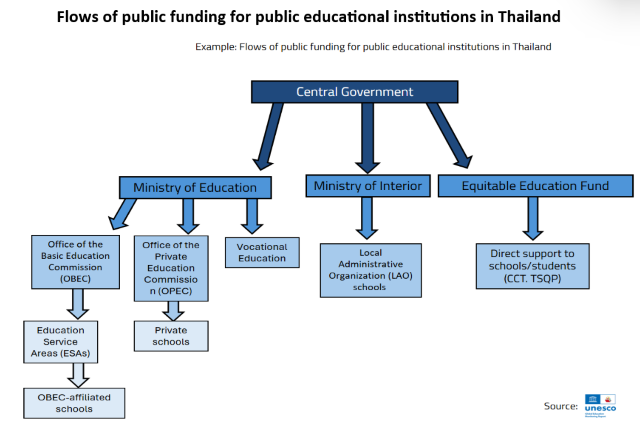
In Thailand, the 1999 National Education Act assigns the Ministry of Education responsibility for all levels and types of education, including resource mobilisation. The Ministry of Education and the Ministry of Interior both receive central government allocations for basic education. The Ministry of Education channels funding mainly through the Office of the Basic Education Commission for public schools and the Office of the Private Education Commission for private schools, while the Ministry of Interior allocates resources to Local Administrative Organisations that operate local public schools.
Basic education administration sits with the Office of the Basic Education Commission and is further decentralised to educational service areas, defined largely by the number of institutions and population size, alongside other relevant criteria. Local Administrative Organisations allocate funds directly to schools and may also finance essential community education services. Individual institutions manage their own daily operations and finances. Alongside OBEC-affiliated public schools, Thailand also oversees Local Administrative Organisation schools under the Ministry of Interior and private schools supervised by the Office of the Private Education Commission.
The Equitable Education Fund, established in 2018 under the 2017 Constitution, functions as an autonomous public organisation with a system-wide mandate to reduce educational inequality. It provides targeted programmes such as the Conditional Cash Transfer scheme for extra-poor learners identified through a Proxy Means Test and the Targeted School Quality Programme. These measures operate alongside the 15-year Free Education Programme, which offers per-student subsidies across OBEC schools, Local Administrative Organisation schools, and private schools. The programme is jointly administered by the Ministry of Education, through OBEC and the Office of the Private Education Commission, and the Ministry of Interior through Local Administrative Organisations.
1. Education resources to subnational governments
Area-Based Education Management Project for Educational Equity and Inequality Reduction
Thailand is currently in the process of implementing the Area-Based Education Management Project for Educational Equity and Inequality Reduction. This allows provincial and city-level management to take ownership of attempts to address the issue of education inequality in their areas. The project also seeks to set up provincial-level database systems to identify and assist beneficiary groups while advocating for awareness within the provinces. All areas can apply, though currently more than 15 are targeted.
Free Education Programme (FEP)
Thailand’s 15-year Free Education Programme (FEP) provides per-student subsidies that finance free basic education from Kindergarten 1 through Secondary 3. These allocations cover operational and learning-related expenses and are provided across all school types, including public schools under the Ministry of Education’s Office of the Basic Education Commission (OBEC), public schools under Local Administrative Organizations (LAOs) of the Ministry of Interior, and private schools. Personnel and capital expenditures are financed separately from the per-student subsidy.
The per-student subsidy reflects the estimated cost of delivering basic education, differentiated by level and types of education. Key cost considerations include basic school operating costs, additional curriculum allocation, and supplementary allocation for students and schools in need. Grants are distributed on an equal basis to education service areas, which allocate funds to schools within their jurisdictions. The funding covers school operating costs such as textbooks, learning materials and student uniforms.
The FEP formula comprises four components: (a) a basic per student allocation; (b) an additional curriculum/quality allocation; (c) a supplementary allocation for poor students; and (d) a supplementary allocation for small/isolated schools. Within the basic and quality allocations, schools receive five standard categories: (1) learning & teaching activities; (2) textbooks; (3) learning materials; (4) student development activities; and (5) uniforms.
2. Education resources to schools
Equitable Education Fund (EEF)
The Equitable Education Fund (EEF) is the central mechanism for equitable and inclusive access to education. Within the EEF, the School Self-Development Project (Teacher and School Quality Programme, TSQP) targets schools and teachers serving students from the poorest households and low-performing schools.
The EEF also funds schools in remote areas near the borders where it is difficult for local educational agencies to establish schools. These schools are established in cooperation with the Border Parol Police Bureau (BPPB). There are 220 Border Patrol Police schools as of 2024.
Strong “tambon” School Project
The Strong “tambon” School project is a project by the Ministry of Education to support the development of rural schools. The funds are used to renovate and repair their facilities, improve the landscape, and obtain instructional materials to support teaching-learning and activities. The project complements FEP operational subsidies by addressing infrastructure and equipment gaps.
3. Education resources to students and families
Equitable Education Fund (EEF)
The Equitable Education Fund implements the Conditional Cash Transfer programme and Equity Fund scholarships for learners classified as extra-poor, while the Office of the Basic Education Commission provides per-student subsidies under the Free Education Programme, which includes support for under-privileged pupils facing less severe hardship. CCT amounts vary by level and year; in 2024 the rate was THB 4,200 (USD 122) and is due to rise to reflect actual study costs. Eligibility is determined through a Proxy Means Test that identifies the poorest households by assessing income below THB 3,000 per person per month together with eight indicators: household dependency, housing, housing characteristics, agricultural land, drinking water source, electricity source, household vehicles and household items. Poverty scores are grouped into slightly poor, poor and extremely poor, with CCT reserved for the extra-poor. Recipients must also maintain good attendance and meet age-appropriate physical development standards.
Equity Fund scholarships cover four groups: low-income pupils from kindergarten to lower secondary levels in participating schools, pupils eligible for re-evaluation after previously failing screening, pupils funded for three consecutive years who must undergo re-screening in the first semester of 2024 and pupils transferring schools who must be re-screened because funding does not follow them. Government workers and teachers verify household situations, school boards and the EEF confirm beneficiary lists and both the school and the EEF carry out monitoring after payments. The Free Education Programme finances tuition, textbooks, uniforms and other essentials through per-student subsidy categories, while CCT alleviates household-level constraints for extra-poor pupils. In fiscal year 2022, elementary pupils received THB 1,900 for tuition, textbooks at specified rates, THB 360 for uniforms, THB 390 for learning equipment, THB 480 for student improvement activities, THB 1,000 for under-privileged pupils and THB 500 for small schools; lower secondary pupils received THB 3,500 for tuition, textbooks at level-specific rates, THB 450 for uniforms, THB 420 for learning equipment, THB 880 for student improvement activities, THB 3,000 for under-privileged pupils, THB 1,000 for small schools and THB 1,000 for opportunity expansion schools; upper secondary pupils received THB 3,800 for tuition (vocational levels 1 to 3 received THB 11,736), textbooks at separate rates, THB 500 for uniforms (THB 900 for vocational levels 1 to 3), THB 460 for learning equipment, THB 950 for student improvement activities and THB 1,000 per pupil for small schools.
Anywhere Anytime Project
In 2025, the cabinet approved a one-time budget for the Ministry of Education’s "Anywhere Anytime" project to procure teaching and learning equipment. Through this programme, 600,000 students will receive tablets.
4. Social policies and family support programmes
Thailand’s Child Support Grant
Thailand’s Child Support Grant provides a minimum level of social protection for children under 6 years of age. The programme began in 2015 and has since gone through two expansions. To qualify, families must have an average annual income of less than THB 100,000 per person per year. The Ministry of Social Development and Human Security is poised to expand the grant programme to cover all children in the country by 2026.
State Welfare Card
Since 2017, the government has implemented a large-scale unconditional cash transfer programme, the State Welfare Card, which provides a regular monthly allowance.
5. School meal programmes
Thailand provides two school feeding programmes. Thailand's school lunch programme, known as the Khrong kan Arhan KrangwanKhrong (School Lunch Programme), was first initiated in 1952 to address malnutrition among schoolchildren. This programme started as an effort by the Ministry of Education to provide lunch to children in need, especially in rural areas. It was not consistently funded in its earliest years, but significant government efforts to institutionalise and expand it came in 1987, when the Office of the National Primary Education Commission mandated that every school adopt a school meals programme. A formal legal foundation was established in 1992 with the Primary School Lunch Programme Fund Act, which provided funding for the programme. The programme has since become universal for pre-primary and primary school children, providing meals five days a week during the school year, with Local Administrative Organizations also able to allocate per-capita funds for school meals. Alongside this, the school milk programme started around the same time to complement nutritional support for children.
Local Administrative Organizations (LAOs) can also use their own per-capita funding to provide school meals to all students in their service areas.
This profile has been reviewed by national experts Wannaphong Durongkaveroj and Bernard Gauthier.










