
Financing for equity in primary and secondary education
1. Education resources to subnational governments
2. Education resources to schools
3. Education resources to students and families
4. Social policies and family support programmes
Introduction
In Costa Rica, the Ministry of Public Education (MEP) is structured in three levels. The central level brings together the offices and directorates that set national direction and provide support. The regional level is organised into three departments that put policies into practice and respond to the needs of communities. The institutional level is made up of schools and educational centres, where education is delivered daily.
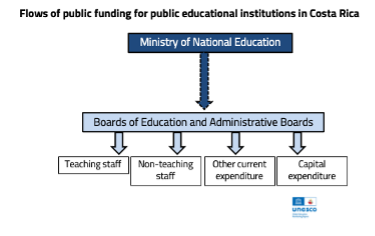
The Boards of Education and the Administrative Boards are auxiliary bodies that ensure schools operate effectively. They are overseen by the Executive Branch through the MEP, in line with Executive Decree No. 38249-MEP, to ensure their actions reflect national educational policy. Their responsibilities include working with school directors on projects and programmes, providing the goods and services required, preparing institutional budgets, and administering public resources.
Law No. 5622 on Social Development and Family Allowances assigns the MEP’s Directorate of Equity Programmes the task of leading initiatives that reduce inequality in education. This directorate oversees services such as school meals, transport, and scholarships, as set out in Executive Decree No. 38170-MEP. The prioritisation of beneficiaries is determined centrally by the Directorate, using criteria that reflect the vulnerability of students and the type of support required. The Boards of Education and Administrative Boards, as decentralised bodies, manage and execute the resources provided, but they do not define these criteria. In this way, the equitable formula is guaranteed through central policy, while the Juntas are responsible for its local implementation.
1. Education resources to subnational governments
The distribution of financial resources takes place at a decentralised level, bypassing subnational governments and going directly to educational institutions. The Ministry of Public Education administers this process by allocating a portion of the national budget to the Boards of Education and Administrative Boards, which then manage the resources in coordination with the institutions. No transfer of funds is made to regional entities, as they are assigned directly to each educational institution.
The Regional Education Directorates (DRE) act as the central authority’s territorial link within the ministerial structure, but they do not take part in financial allocation. Their purpose is to organise the provision of education services by geographic area and to ensure that the needs of educational communities are addressed. In total, 27 DREs have been established across the provinces of the country and are subdivided into a total of 206 scholar circuits, acting as immediate supervisors for academic and administrative affairs.
2. Education resources to schools
Costa Rica's Ministry of Public Education has implemented a decentralised model for managing educational centres, allowing local actors to make decisions, in a general common program of neccesities, on resource allocation to better meet students’ needs. Subnational local governments also contribute to educational institutions with direct transfer of resources, infrastructure support and donations.
Established under Law 6746 of 1982, the Fondo Juntas Educativas y Administrativas Oficiales finances the Boards of Education and Administrative Boards of public institutions. While teacher payroll is mostly managed centrally, most other budgetary programmes, including equity initiatives, are executed by the boards. Additional resources are targeted to specific territories or populations based on the socioeconomic indicators of the canton or zone where each school is located. The boards have “full legal personality, their own patrimony, and specific competencies and functions in the field of public education”. They operate under MEP policies and guidelines but are not hierarchically subordinated to the Ministry.
N.B.: Some educational institutions benefit from specific resources provided by special laws or access to grants from local governments. These schools typically have better budgets to improve service quality, such as: a) hiring more staff; b) building or repairing classrooms; c) offering better nutrition products. Additionally, although it is not legally allowed, these boards attempt to develop community fundraising activities throughout the year to expand their resources. They strive for budget income diversification to meet their needs.
3. Education resources to students and families
Programa de Transporte Estudiantil (Student Transportation Programme)
Since the 1960s, Costa Rica's Ministry of Public Education has provided student transportation to ensure rural students in basic education (public schools only) can access educational centres. The Student Transportation Programme offers economic support to students who face barriers such as distance, challenging terrain, or limited access to public transport. Assistance is targeted at students from low-income households, with a specific subsidy available for students with disabilities and nowadays has also coverage in urban communities.
4. Social policies and family support programmes
The Mixed Institute for Social Assistance (IMAS) leads the country's social policy, coordinating public and private efforts to provide services that improve the living conditions and capabilities of those in poverty and extreme poverty.
Avancemos (Let's Move Forward)
Avancemos is a Conditional Cash Transfer Programme established in 2006 under Executive Decree No. 33154-MP-MIDEPLAN-MEP-MTSS-MIVAH to promote the retention and reintegration of young people from families living in poverty or social vulnerability into the education system. The programme provides a cash transfer to the mother or, if of age, the student, conditional on regular school attendance and satisfactory academic performance, with a maximum of two course failures per year. Implemented by the Instituto Mixto de Ayuda Social (IMAS), it targets students aged 12 to 25 enrolled in secondary education from families classified as extremely poor, poor, or vulnerable according to the Target Population Information System (SIPO).
5. School meal programmes
School and Adolescent Food and Nutrition Programme (PANEA)
Since 1974, the School and Adolescent Food and Nutrition Programme (PANEA) has provided food to vulnerable students while promoting healthy eating, hygiene, and nutrition practices. The programme supports schools through food purchase subsidies, student employment, cafeteria equipment improvements, productive projects, and technical assistance for school gardens and health education. The Directorate of Equity Programmes (DPE) provides services to all preschool and elementary students enrolled in PANEA, while in secondary schools the programme prioritises specific beneficiaries, including students from low-income families, those with nutritional problems, students with special educational needs, pregnant or single mothers, and those at psychosocial risk. The use of the Regionalised Menu is mandatory, ensuring that all beneficiaries receive at least one full meal equivalent to lunch, and Boards of Education or Administrative Boards must provide additional resources if required to cover the actual cost alongside the PANEA subsidy.
School meals are declared an essential and fundamental right, both by law and the Constitutional Court. Costa Rica´s Ministry has the obligation to deliver this service during academic breaks, labor strikes and even during the pandemic; specially, regarding the meals for vulnerable scholar population. Also, authorized private food kiosks operate in some schools, but strictly regulated; they have are limited to sell healthy nutritional products.
This profile was reviewed by Jose Mario Achoy Sánchez, professor-researcher.