
Financing for equity in primary and secondary education
1. Education resources to subnational governments
2. Education resources to schools
3. Education resources to students and families
4. Social policies and family support programmes
Introduction
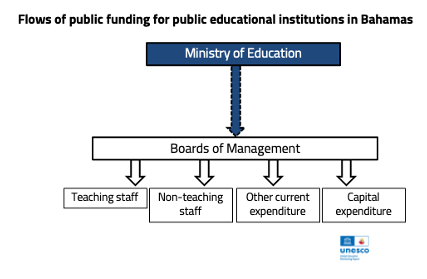
In The Bahamas, public education is centrally funded and managed by the Ministry of Education, Technical and Vocational Training, which allocates resources to all government-maintained schools, including teacher salaries, learning materials, and operational costs. Schools are organised into 13 districts, each headed by a district superintendent who reports to the Director of Education. While the Ministry administers funding centrally, the specific criteria or formula for distributing resources to individual schools are not publicly disclosed.
1. Education resources to subnational governments
The resources are managed centrally and allocated directly to the educational institutions.
2. Education resources to schools
In The Bahamas, the Ministry of Education allocates resources to schools through a centralised system; however, the specific mechanisms governing the distribution of funds to individual schools are not publicly detailed, and there is no clear evidence that allocations are based on equity considerations. Once disbursed, funds are managed locally by School Boards, which are established by the Minister and consist of between three and nine members. Where a School Board is not constituted, the local district council assumes responsibility for the maintenance and upkeep of public school buildings and grounds. Each Board submits annual estimates for school repair and maintenance, furniture, equipment, learning materials, and any planned improvements or extensions.
Staff members working in challenging or remote locations are eligible for various allowances, including the Hardship Allowance for public officers posted in designated Family Island hardship areas for up to five years, the Disturbance Allowance for those posted away from their place of domicile for more than three months, and the Geographical Posting Allowance.
Special Education
The Ministry previously implemented programmes to provide targeted resources to schools, particularly focusing on infrastructure. Special education is coordinated through the Marjorie Davis Institute, which offers interventions, training, diagnostic assessments, and research to support students with learning disabilities. The Special Education Unit comprises two Senior Education Officers, one school psychologist, three clerical staff, 128 special education teachers, and 44 teacher aides. The unit manages 16 self-contained classrooms (K–12), 10 resource/support programmes, six special schools, and eight alternative programmes, and delivers professional development to enhance inclusive teaching practices.
In January 2023, the School Public Busing System was introduced as a pilot on New Providence Island to provide safer and more efficient transportation for students attending 15 public junior and senior high schools. The programme allows students to access buses directly from school campuses, reducing risks associated with walking to public bus stops and helping to prevent after-school incidents. The initiative is managed collaboratively by the Ministry of Education, the Royal Bahamas Police Force’s School Policing Programme, the Road Traffic Department, and local bus unions. While students pay a fare to use the service, the primary objective is to improve safety and accessibility in student transportation.
3. Education resources to students and families
No programme providing educational resources to students and families with an emphasis on equity has been identified. The Ministry allocates resources exclusively to students and to programmes related to higher education.
4. Social policies and family support programmes
The RISE Programme (Renewing, Inspiring, Sustaining, Empowering), launched in 2015, is a conditional cash transfer initiative targeting low-income households. Beneficiaries receive monthly cash grants via prepaid debit cards. Eligibility is assessed through a Proxy Means Test and verified using a Management Information System (MIS). Households enrolled in the programme receive a base monthly benefit to support daily living expenses, while additional payments are provided upon meeting specific conditions. Pregnant women must satisfy health criteria, and households with children must comply with educational and health requirements. These criteria are developed collaboratively with the Ministry of Health and the Ministry of Education, Science and Technology to encourage behaviours that enhance educational and health outcomes.
The Ministry of Social Services and Community Development oversees programme implementation, working in partnership with multiple government agencies, including the Ministries of Health, Education, Finance, and Financial Services (Local Government), as well as the Department of Statistics, the Department of Information Technology, and the Bank of The Bahamas, to ensure smooth operation and effective delivery of benefits.
5. School meal programmes
National School Feeding Programme (NSFP)
The National School Feeding Programme (NSFP), established in 1987 and managed by the Ministry of Education, Technical andVocational Training, provides in-school meals and snacks five days a week throughout the academic year. The programme is designed to improve educational outcomes, support student health, and serve as a social safety net. Participation is not universal; students are selected based on a socioeconomic assessment of households. In 2018, coverage was expanded to include schools affected by Hurricane Dorian, and households receiving cash-transfer assistance from the Department of Social Services with school-aged dependents are automatically referred to the NSFP.
Meals are prepared off-site by private caterers and must meet nutritional standards set in collaboration with the Ministry of Health and the Food and Agriculture Organization (FAO). Nutritionists oversee menu planning, and food handlers receive specialised training to ensure health and safety compliance. In addition, the programme includes a mandatory nutrition curriculum, with food and nutrition education taught as a stand-alone subject and integrated across other areas of the school curriculum.