


Financing for equity in primary and secondary education
1. Education resources to subnational governments
2. Education resources to schools
3. Education resources to students and families
4. Social policies and family support programmes
Introduction
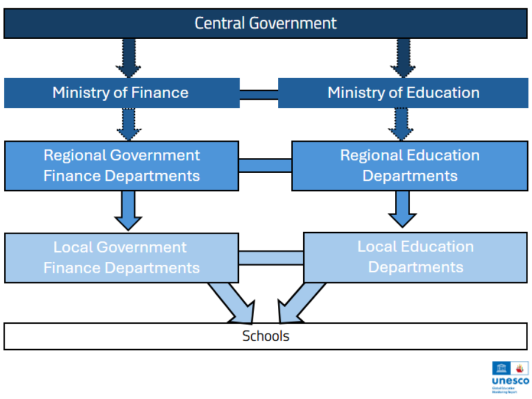
China follows a model of high fiscal decentralisation, with subnational governments accounting for about 70% of public spending. Compulsory education is managed through a three-tier system involving the central, provincial, and county levels. The central government transfers funds to provinces, autonomous regions, and municipalities, which then distribute them to counties and districts. Transfers take two main forms: general transfers, which aim to equalise resources across regions, and special transfers, which target specific projects or policy goals. General transfers mainly aim to equalise fiscal capacity between governments, while conditional transfers come with clear spending instructions and restrictions.
The Ministry of Education (MoE) provides overall supervision, setting standards for curriculum, school construction, and fiscal investment policies, while provincial governments adapt national policies to local contexts. County governments are the main financiers of compulsory education, accounting for about 65% of their total spending, and were formally assigned responsibility for primary and lower secondary education by State Council Circular No. 21 (2001). This was reinforced by China’s 2019 education fiscal division reform (State Council Circular No. 27), which emphasised ensuring adequate financing for rural schools.
Education funding is derived from national inputs (e.g., fiscal allocations), social inputs (e.g., donations), individual contributions (e.g., tuition fees), and other relevant educational resources. Finance and education departments at all levels jointly allocate resources, with the central government subsidising compulsory education and teachers’ salaries through the transfer system.
1. Education resources to subnational governments
The Chinese government prioritizes educational equity, ensuring school-age children’s equal access to basic education. Building on the achievement of balanced compulsory education development at the county level by the end of 2021, China is advancing quality-based and urban-rural integration in compulsory education. Policy measures are continuously refined to support localities in expanding quality educational resources and narrowing regional, urban-rural, inter-school, and inter-group disparities. Through major initiatives such as the "Improving Weak Links and Enhancing Capacity in Compulsory Education" project, central fiscal allocations exceeding 100 billion yuan have been provided to upgrade facilities in underserved schools.
Since 2001, China has relied on general transfer payments as the main mechanism to redistribute resources across regions. These transfers are not education-specific but cover all sectors. They are calculated by comparing a region’s standard expenditure needs with its revenue capacity, adjusted by a transfer coefficient. Distribution factors include the size of poor populations, ethnic minority status, per capita farmer income, local fiscal strength, per capita GDP, poverty reduction results, and climate conditions. Education is included within these standard expenditure needs, which are determined by multiplying the number of students at each level by a national per-student cost standard and a regional cost coefficient, aggregated across provinces, prefectures, cities, and counties. Under the 1984 Regional Ethnic Autonomy Law, ethnic minority areas receive preferential treatment in these allocations. According to education funding statistics, local governments accounted for 94.8% of general public budget education expenditures in 2019.
Alongside this, the central government provides special transfer payments dedicated to education. Operating funds for compulsory education are calculated locally, with provinces setting standards under the 2006 Compulsory Education Law, which requires higher per-student allocations for special schools or classes compared to mainstream schools. The centre then contributes a fixed share of these costs through the Public Fund Subsidy (公用经费补助). According to the 2019 Reform Plan (Circular No. 27), the central government covers 80% of costs in western provinces and autonomous regions such as Tibet, Xinjiang, and Ningxia; 60% in a second tranche of central provinces, including Hebei and Jiangxi; and 50% in wealthier provinces and municipalities such as Beijing, Shanghai, and Shenzhen.
In 2023, the national general public budget for education was CNY 4,081.392 billion. The central government spent CNY 590.753 billion, leaving CNY 3,490.639 billion for local education expenses. The central government budgeted almost CNY 100 billion specifically as part of the public fund subsidy and almost CNY 200 billion when including other relevant subsidies that go to local education departments.
In China, compulsory education expenditure is divided into personnel costs (teachers’ salaries and benefits) and public funds (gongyong jingfei, 公用经费), which cover non-salary recurrent costs such as textbooks, maintenance, and utilities. According to the Ministry of Finance’s National Education Expenditure Report (2023), public funds account for about 23 percent of total compulsory-education spending, while personnel costs make up roughly 70–75 percent.
Under the 2019 State Council Reform Plan (Circular No. 27), the central government subsidises these operating costs through the Public Fund Subsidy, covering 80 percent in the poorest provinces and autonomous regions, 60 percent in mid-income provinces, and 50 percent in wealthier regions. Applying the national distribution of provinces by income level gives an average central share of about 60–65 percent of public-fund spending. 23 percent (non-salary recurrent) × 0.6 ≈ 14 percent of total education expenditure financed through the central equalisation transfer system.
2. Education resources to schools
The framework for compulsory education funding is guided by the 2015 Notice of the State Council on Further Improving the Funding Guarantee Mechanism for Urban and Rural Compulsory Education (Guo Fa 2015 No. 67), which prioritises rural, minority, and other disadvantaged areas. Under the policy, it waives tuition and textbook fees for all students, providing living allowances granted to boarding students from economically disadvantaged families.The largest channel of resources is the Public Fund Subsidy (公用经费补助), distributed to schools according to national per-student funding subsidies based on benchmark quotas. These quotas with enhanced rates for boarding schools, small-scale schools, and schools in northern regions. In 2023, they were raised to CNY 720 per primary student and CNY 940 per junior high student, with funds co-financed by the centre and local governments, which are required to allocate them fully and promptly to schools.
Additional targeted programmes strengthen equity. The 2021–2025 Special Education Action Plan raised subsidies for students with disabilities in compulsory education to more than CNY 7,000 per student, with further support for teacher training, school construction, and home-based education. Teachers working in rural poor areas also receive living allowances, co-financed by the centre and local governments. Special education teachers also receive a special post subsidy.
3. Education resources to students and families
China provides extensive financial support to students, spending over RMB 341.211 billion annually to reach 150 million beneficiaries. In 2024, China’s student financial aid investment continued an upward trend, with over 68 million students in compulsory education, secondary vocational education (including technical institutes under the Ministry of Human Resources and Social Security), and general senior secondary education receiving support. That year, total funding exceeded 83 billion yuan. (Note: Excludes tuition fee exemptions, free textbooks in compulsory education, and the Rural Student Nutrition Improvement Program). Under China’s compulsory education policy, all students are exempt from tuition fees and receive free textbooks. The living support known as “one subsidy” (一补) policy, which offers living allowances to students from economically disadvantaged families. The national base standard is set at CNY 1,250 per student per year for primary students and CNY 1,500 for junior secondary students per year. For non-boarding students from disadvantaged backgrounds, the subsidy is set at 50% of the national base standard for boarding students. The costs are shared equally between central and local governments.
Student financial aid in secondary vocational education is primarily through the National Scholarship, National Student Grant, and tuition fee exemption programs, while in general senior secondary education, support focuses on the National Student Grant and tuition fee waivers for students from economically disadvantaged families. In 2024, over 13.6 million vocational students benefited from tuition exemptions, and 1.9243 million regular senior secondary school students received tuition and fee waivers. Additionally, nearly 20,000 secondary vocational education students were awarded National Scholarships, totaling approximately 120 million yuan; 3.0291 million secondary vocational education students received National Grants, amounting to 6.188 billion yuan; and 4.57 million regular senior secondary school students were provided with National Grants, totaling 9.383 billion yuan.
4. Social policies and family support programmes
There are several national subsidy programmes, such as the living allowance for people with disabilities, the “minimum livelihood security” (最低生活保障), which provides impoverished families with a basic income, and other relief and support policies for the extremely poor (特困人员救助供养) since 2000. Local governments are expected to complement these with their own measures.
5. School meal programmes
Nutrition Improvement Plan for Rural Compulsory Education Students
To continuously improve the nutritional health of rural students, the State Council General Office issued the Guidelines on Implementing the Nutrition Improvement Plan for Rural Compulsory Education Students, launched in 2011. Implementation is led by local governments at all levels: provincial governments are responsible for overall coordination and organization, municipal governments for coordination and implementation, and county-level governments serve as the primary actors and accountable bodies for carrying out the program. Education authorities take the lead in organizing and implementing the program, while schools are responsible for executing the specific tasks.
The programme targets primary and secondary students in selected underdeveloped rural areas. Under the national program, the nutritional meal subsidy is set at 5 yuan per student per day, calculated based on the number of students and the actual days of school attendance. The central government fully finances the subsidies. For local programs, the nutritional meal subsidy is covered by local governments, while the central government provides incentive-based subsidies on a per-student basis. Schools are required to provide safe, nutritious, and healthy hot lunches. Additionally, localities are encouraged to establish "farm-to-school" linkages and build direct-supply bases for high-quality agricultural products to ensure fresh, traceable ingredients.
Coverage has expanded steadily: As of 2024, the program benefits over 30 million students annually, effectively improving the physical health of rural students and reduce the incidence of malnutrition.
For more information, please refer to UNESCO’s Financing of Education in China document and the World Bank report on the Role of Intergovernmental Fiscal Transfers in Improving Education Outcomes.
This profile has been reviewed with the support of the Chinese National Commission for UNESCO and Yu Zhu, Professor of Economics at the School of Business, University of Dundee, United Kingdom.










