


Financing for equity in primary and secondary education
1. Education resources to subnational governments
2. Education resources to schools
3. Education resources to students and families
4. Social policies and family support programmes
Introduction
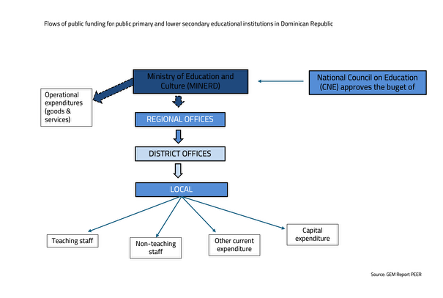
The education system in the Dominican Republic functions through both centralized and decentralised levels. The Ministry of Education and Culture (MINERD) is responsible for overall policy, budgeting, and administration. Alongside MINERD, the Consejo Nacional de Educación (CNE) serves as the highest decision-making body for educational policy, regulating resource allocation to ensure effective implementation.
The decentralised structure operates through regional, district, and local levels, each managing their respective budget. Regional offices oversee policy execution and budget management, district offices focus on local policy application and resource distribution, and schools, guided by administrative boards, manage community relations and resources.
MINERD allocates the annual education budget through both centralised and decentralised channels. Centralised funds primarily cover school operational expenses and procurement of goods and services managed directly by the ministry, while decentralised funds are transferred to schools, regions, and districts, allowing them autonomy to procure resources independently.
1. Education resources to subnational governments
Education (Ley No. 66-97) establishes an equity principle for allocating educational resources, considering both student enrollment and district-specific challenges. However, in practice, resource distribution is primarily based on enrollment figures, assuming uniform per-student costs across districts.
The National Office of Planning and Educational Development (ONPDE) determines the annual decentralised expenditure per student using a formula that incorporates equity measures for pre-university education funding. The transfer programme allocates human resources and salaries according to district enrollment, with additional funds directed to resource-poor districts facing greater challenges. Furthermore, the National Institute of Student Welfare (INABIE), a decentralised agency of the Ministry of Education (MINERD), receives an annual allocation to support vulnerable populations through social services and educational programmes, reinforcing the equity focus.
2. Education resources to schools
No specific initiative has been identified that transfers resources directly from MINERD to schools.
3. Education resources to students and families
Utilitaria Escolar (School Supplies Programme)
Established and funded by the National Institute of Student Welfare (INABIE), Utilitaria Escolar began in 2014 to provide school supplies to disadvantaged students in public schools. The programme targets children aged 5 to 16 who live in poverty, as identified by the Single System of Beneficiaries (SIUBEN) and the United Nations Development Programme’s Interactive Map of Human Development. Its goal is to support the retention and academic performance of these students by delivering kits containing school supplies and uniforms directly to them.
Ayuda Estudiantil (Student Aid)
Also established and financed by INABIE, Ayuda Estudiantil aims to directly cover the costs of supplies and services needed by students facing educational vulnerability. The programme targets public primary and initial-level students from low-income, rural areas. It supports students with needs in health rehabilitation, physical disabilities, school accident care, humanitarian assistance, and those requiring support for physical, mental, cognitive, or sensory educational challenges.
4. Social policies and family support programmes
Solidaridad/Progresando con Solidaridad/Supérate
From 2005 to 2012, the Dominican Government implemented the Programa Solidaridad under Law 536-05 as part of its social protection network, coordinated by the Social Policy Cabinet. The programme aimed to eradicate poverty and improve family income by linking extremely poor families to conditional cash transfers, targeted subsidies, socio-educational support, and access to public services for holistic family development. It operated through seven components focused on building skills, fostering values, empowering beneficiaries, and creating opportunities for income generation, employment, and entrepreneurship to promote full citizenship and better access to services. The programme was managed through a complex institutional framework involving key actors: SIUBEN identified eligible families; ADESS distributed subsidies; the Ministries of Education and Public Health provided essential services; and the Central Electoral Board verified beneficiary identities.
From 2012 to 2021, Progresando con Solidaridad (PROSOLI) also aimed to reduce poverty by linking vulnerable families to conditional cash transfers, targeted subsidies, socio-educational support, and improved access to public services. PROSOLI focused on promoting human capital accumulation, especially through education, health, and nutrition, by encouraging behaviors such as school attendance and health service use. It targeted extremely poor households identified through a quality-of-life index and involved multiple government agencies for implementation.
In 2021, the programme was renamed Supérate under Law 377-21, marking a strategic shift to a broader anti-poverty approach. Under the Supérate Programme are Incentivo a la Asistencia Escolar (ILAE) (Incentive for School Attendance) (now “Aprende”), and Bono Escolar Estudiando Progreso (BEEP) (School Bonus for Studying Progress) (now Avanza since 2017). ILAE provided monthly conditional cash transfers to families in extreme and moderate poverty with children aged 5 to 13 enrolled in primary education. Its goal was to reduce school dropout rates and increase the number of years students stay in school. In 2017, ILAE was replaced by Aprende. This updated programme supports vulnerable households with secondary public education students aged 11 to 21 by offering bimonthly conditional cash transfers. The amount depends on the number of students in the household and their grade level. Funds must be spent on food and priority goods at registered commercial outlets within the Red de Abastecimiento Social (RAS). Similarly, BEEP targeted families in extreme and moderate poverty with children attending secondary public education, providing bimonthly conditional cash transfers to purchase food and school supplies, aiming to reduce secondary school dropout rates. In 2017, it was replaced by Avanza, which shifts its focus to primary education, supporting vulnerable households with children aged 6 to 16. It now offers bimonthly conditional cash transfers that must be used to buy food and priority goods at RAS establishments, promoting increased years of schooling and preventing dropouts at the primary level.
Estudiantes Provistos Atención De Salud Integral Permanente A Estudiantes Preuniversitarios Del Sector Público Para Permanecer En El Sistema Educativo Público” (Students Provided With Permanent Comprehensive Healthcare To Ensure They Remain In The Public Pre-University Education System)
This policy, implemented by the National Institute of Student Welfare (INABIE), directs resources to support students and their families. Each year, it targets economically and socially vulnerable public pre-university students, providing them with comprehensive healthcare services. These include oral, visual, hearing, and preventive evaluations conducted through a surveillance and monitoring network. Services are delivered via fixed health modules established in all 122 educational districts nationwide, ensuring access and continuity of care.
5. School meal programmes
Programa de Alimentación Escolar (School Feeding Programme)
The Programa de Alimentación Escolar (PAE), led by the National Institute of Student Welfare (INABIE), ensures food security and supports educational outcomes for over vulnerable students in public primary and secondary schools. Originating with the School Breakfast Programme under the 1997 General Education Law (Article 178), it expanded in 2013 to include lunch and snacks for students in Extended School Day Centres (Jornada Escolar Extendida - JEE). Implemented through four modalities—urban, rural, border, and extended school day—the programme aligns with Law 589-16 on Food and Nutritional Sovereignty, which upholds access to food as a state responsibility. Food and Nutrition Education (EAN) is also integrated into the curriculum through INABIE and the General Directorate of Curriculum.










