


Financing for equity in primary and secondary education
1. Education resources to subnational governments
2. Education resources to schools
3. Education resources to students and families
4. Social policies and family support programmes
Introduction
In Rwanda, the Ministry of Education (MINEDUC) oversees the education sector, including policy development, planning, and coordination. At the national level, the development and implementation of these policies are coordinated by the affiliated agencies including Rwanda Basic Education Board (REB) for general basic education and Rwanda TVET Board (RTB) for Technical and Vocational Education and Training, and the National Examination and School Inspection Authority (NESA). At the local level, 30 district education offices are responsible for implementing these policies. Their duties include preparing budgets, managing capitation grants, and monitoring school financial reports, as well as overseeing the delivery of education services in schools.
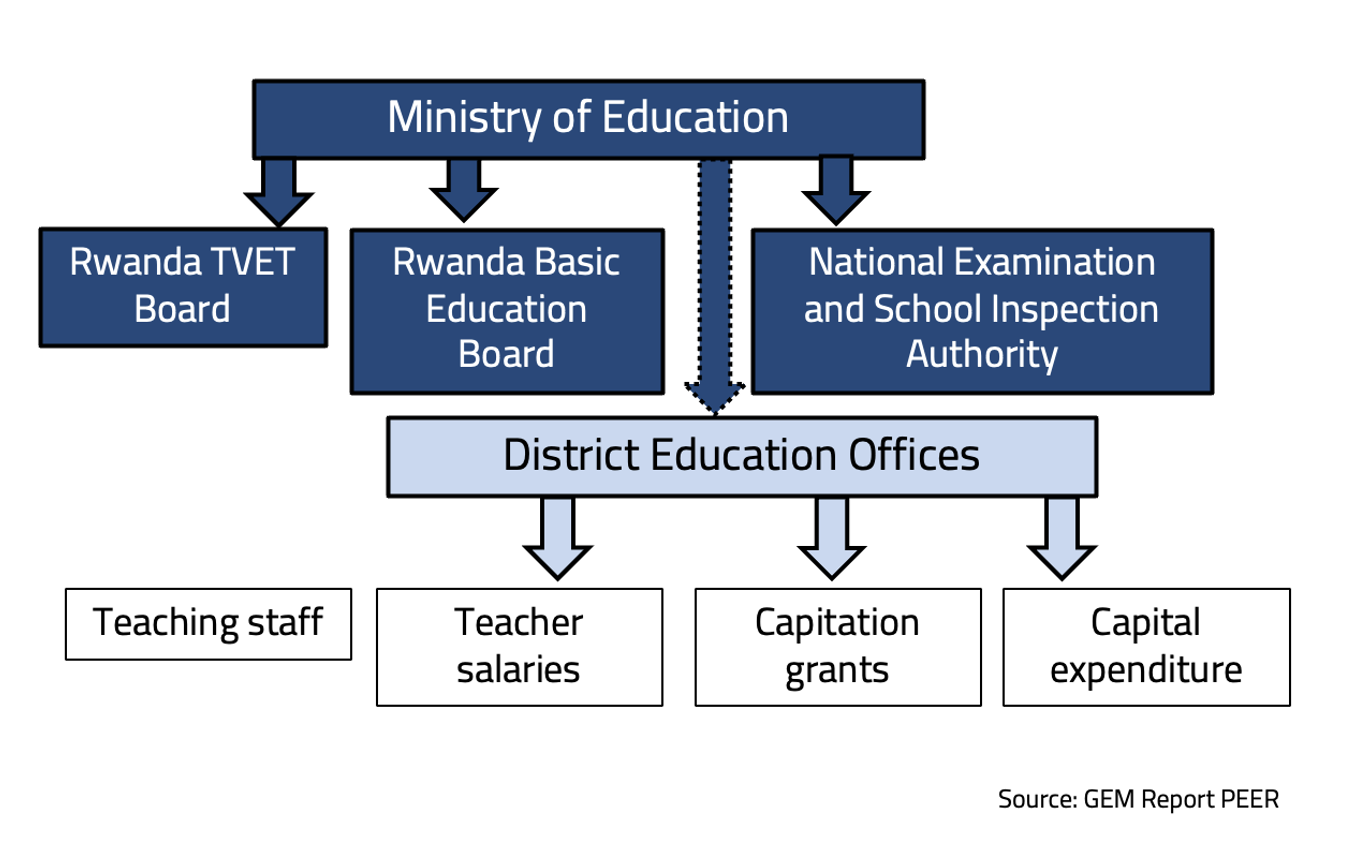
1. Education resources to subnational governments
Decentralisation reforms in Rwanda, begun in the early 2000s, gradually transferred decision-making and financial responsibilities to provinces and districts. The equitable distribution of education funds through an output- and need-based formula was formally introduced in the 2009 Ministerial Order.
Education financing is highly decentralised, with a large share of sector resources transferred to districts. In 2023/24, 65.6% of the total education budget was allocated to districts. The Ministry of Education, together with the Ministry of Local Government, monitors education service delivery at the decentralised level.
To promote geographical equity, the government allocates district education budgets using a formula based on the number of students, teachers, schools, and district-level poverty. A revised formula is currently being developed to ensure inclusive allocation to districts and schools. Most of the district budget is spent on recurrent costs, including salaries and other fixed expenditures such as school feeding.
2. Education resources to schools
Capitation Grants
Capitation grants, introduced in 2003 when school tuition fees were abolished, support general school operations and teaching resources. These grants are distributed through districts to public and government-aided pre-primary, primary, and secondary schools on a quarterly basis, according to the 2023/24 Earmarked Transfers Guidelines to Decentralised Entities with Legal Personality. Allocation is based on the number of children in each school. Capitation grants are used for pedagogical items (30%), running costs (60%), and school infrastructure (20%). Schools accommodating students with disabilities or special needs also receive additional resources to support inclusive learning. Disabilities include physical and motor challenges, specific learning difficulties, visual and hearing impairments, developmental challenges, speech, language and communication difficulties, multiple disabilities, intellectual disabilities, autism spectrum disorder, and emotional and behavioural disorders.
Support for Inclusive and Special Schools
The 2021-24 National Policy of Persons with Disabilities and Four-Year Strategic Plan allocate an annual budget within the education sector to improve enrolment, retention, and completion rates for all children with disabilities at the 12-Year Basic Education level. The funds are used to set standards and guidelines for special and inclusive schools; establish and equip resource rooms or centres; integrate procedures for assessment, referral, and support of students with special educational needs; identify inclusive schools of excellence and provide necessary accommodations; establish at least one new special school in sectors where needed; and create special units within inclusive schools of excellence.
Support for Girls’ Education
As part of the 2023/24 Education Sector Gender Budget Statement, public and government-aided secondary schools are provided with sanitary facilities and sanitary pads to make schools more gender-friendly. This support helps girls manage their menstruation, remain in school, and contributes to their retention and academic performance.
3. Education resources to students and families
Scholarships are mainly provided by the Ministry of Education at the higher education level. There is no specific government provision for scholarships or bursaries at the primary or secondary level.
4. Social policies and family support programmes
The social protection sector is coordinated by the Ministry of Local Government (MINALOC), with support from other ministries and agencies, including the Ministry of Education (MINEDUC) and the Rwanda Basic Education Board (REB).
Genocide Survivors Support and Assistance Fund (FARG)
The Genocide Survivors Support and Assistance Fund (FARG), coordinated by the Ministry of Local Government since 1998, supports vulnerable genocide survivors, including orphans, elderly people, and adults with disabilities. Its education support scheme helped survivors access secondary and higher education by covering tuition and related costs. This education component has since been phased out as survivors completed their studies, with the last inclusion in the 2017/18 Earmarked Transfers Guidelines to Decentralised Entities, when vulnerable secondary school students received financial support for tuition and school materials.
The responsibilities of FARG were transferred to the Ministry of National Unity and Civic Engagement (MINUBUMWE) under the department of National Unity & Community Resilience. The department still supports some eligible survivors especially those who were not able to complete their education due to various reasons (drop out), those with social cases, those wishing to do short courses, and those wishing to go to TVET secondary schools.
5. School meal programmes
National School Feeding Programme
Rwanda’s National School Feeding Programme provides hot meals to all students in public and government-aided pre-primary, primary, and secondary schools, following the 2019 National Comprehensive School Feeding Policy which aims for universal coverage. The programme follows a minimum school feeding package, and the Ministry of Education, with a Nutrition and Food Technologist, has developed a menu guide to ensure meals provide sufficient carbohydrates, protein, fat, and essential micronutrients.
According to the 2024 National School Feeding Programme Financing Strategy, the government contributes 32% of the programme’s total cost, while parents contribute 7%, based on the maximum amount determined by the government. The 2022 Guidelines on the Contribution of Parents to Pre-Primary, Primary and Secondary Education cap parental contributions to 975 RWF per term in pre-primary and primary schools to reduce disparities that can limit access for families with fewer resources. For those who cannot get 975 RWF, contributions can also be in form of labor, firewood, or food.
The programme is also strengthened by the Dusangire Lunch campaign (Let’s share Lunch) which was launched in 2024 to raise the school feeding funds by engaging the private sector and community. The campaign aims to complement parental contributions, increase community awareness and commitment to ensure that every Rwandan child attending school receives a nutritious meal every day.
The government’s main partner in the programme is the World Food Programme, which provides both technical and financial support. School feeding costs include food, transport, programme implementation, infrastructure investments, programme management at national and district levels, monitoring, reporting and evaluations, and capacity strengthening. In line with its universal coverage target, the programme has increased the number of supported students from around 600,000 in 2019 to 4 million in 2024.
This profile has been reviewed by Associate Professor Philothere Ntawiha.










