


Financing for equity in primary and secondary education
1. Education resources to subnational governments
2. Education resources to schools
3. Education resources to students and families
4. Social policies and family support programmes
Introduction
In Monaco, the Department of National Education, Youth and Sports, under the Department of Home Affairs, is responsible for implementing the Government’s policy on the organisation and administration of public primary, secondary, technical, and higher education, with school financing managed at the central level. Public institutions are accredited as “French establishments abroad”, where the head of the school prepares the budget and the Internal Board determines the allocation of the operating budget. Private educational establishments may apply for a contract of association with the State if they meet a recognised educational need and comply with requirements relating to institutional longevity, teacher qualifications, student enrolment, and the health and safety of premises. Once approved, these institutions may receive state financial aid, the level of which varies according to the number of enrolled students and the type of training offered.
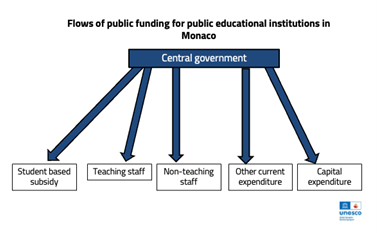
1. Education resources to subnational governments
Resources are directly distributed to educational establishments.
2. Education resources to schools
Special Education
Specialised provision exists for children with special needs through units and classes integrated within the education system. Since 2015, the Unités Localisées pour l'Inclusion Scolaire (ULIS) have been established at primary level (“ULIS École”) and in secondary schools (“ULIS Collège” and “ULIS Lycée”), while additional options include “Adaptation” classes in junior high up to 9th/10th grade. There are also general and vocational programmes for students with special needs in grades 6 to 9/10, as well as Professional Discovery (DP) classes for grades 8 and 9/9 and 10. Since 2007, legislation has required the state to provide adapted spaces for children with disabilities, ensuring they can access appropriate pedagogical support. These programmes cater particularly to students with cognitive disorders and learning difficulties, combining digital tools, workshops, and internships to help them acquire skills and prepare for a professional future despite academic challenges.
3. Education resources to students and families
Scholarships
Since 1994, Monaco has operated a scholarship programme offering financial assistance to students according to academic performance, family situation, and socio-economic criteria. The amount of support is determined by the costs associated with the student’s field of study, the location of the educational institution, and individual needs, taking into account household resources and employment status. Fixed reference amounts for travel, accommodation, and enrolment fees are set by the Government Council, which applies a percentage to establish the final grant. Eligibility extends to Monegasque nationals, foreign nationals married to Monegasque citizens, students with a Monegasque parent, residents of Monaco or nearby French départements, as well as dependents or orphans of long-serving State or Commune employees and foreign students who have lived in Monaco for at least ten years. Scholarships may be awarded at different educational levels, including primary and secondary education under special circumstances, vocational education, level 3 (CAP) and level 4 (Baccalauréat) diplomas from non-French ministries, and higher education studies.
4. Social policies and family support programmes
Responsibility for implementing public policies related to labour, social insurance in both the private and public sectors, public health, social action, family services, and support for the elderly and disabled lies with the Department under the authority of the Government Councillor, the Minister of Social Affairs and Health. Benefits and resources in these areas are managed and paid through the Caisses Sociales de Monaco (CSM).
Family Benefits
Family benefits are funded by the social action fund and provide support for households with students. These benefits are granted to the head of the household who is employed or who habitually provides for the maintenance of a child under the age of 21, whether the child resides at home or is placed elsewhere for reasons of health, further education, or institutional care. Children between the ages of 6 and 16 must comply with compulsory schooling requirements, while those over 16 must be studying, undertaking an apprenticeship, seeking employment, or unable to pursue studies or professional activity.
The schooling bonus assists families in covering the cost of books and school supplies. It is paid annually for children attending school from the last grade of pre-primary to twelfth grade (aged 5 and over by 31 December). To qualify, households must have received family allowances from the compensation fund for at least one of the last four months of the year or for seven months in the calendar year. The allowance amount varies according to the child’s grade level and school location and is disbursed at the end of October.
The end-of-year bonus is granted to families who have received benefits from the Social Services Compensation Fund for at least four months during the calendar year, including the last three months, and whose family quotient does not exceed €1,232 for 2024. The amount is determined annually by the CCSS Committees and is fixed, regardless of the child’s age.
The means-tested back-to-school allowance is available to households with one or more dependent children eligible for family allowances, provided that family allowances were received during July and the total family income does not exceed €1,232 for 2024. The amount varies according to the child’s age and is disbursed at the end of August.
5. School meal programmes
School Canteens
Families typically cover the costs of school meals. Since 2015, however, the Directorate of National Education, Youth and Sports has provided a school canteen allocation, which can be disbursed either directly to families or, upon request, to schools or catering companies, contingent on the submission of receipted invoices. This allocation is awarded based on academic, familial, and socio-economic criteria, as established in Ministerial Decree No. 2024-532 of 2024. At least one nutritionist oversees school feeding, and foods from school gardens are distributed to students. Certain foods are restricted for health and sanitation reasons, and the programme incorporates measures to prevent or reduce overweight and obesity, including nutritional requirements for school meals, food and nutrition education, health education, and physical education.










