
Financing for equity in primary and secondary education
1. Education resources to subnational governments
2. Education resources to schools
3. Education resources to students and families
4. Social policies and family support programmes
Introduction
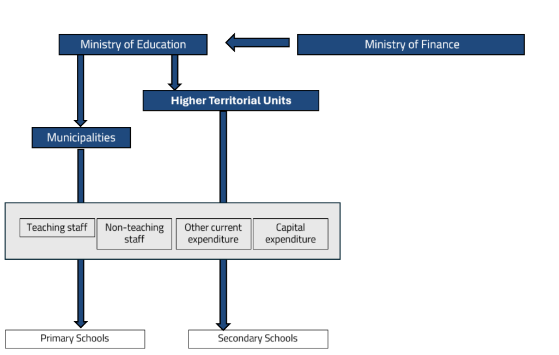
In Slovakia, education funding is a shared responsibility between the Ministry of Education, Science, Research and Sport of the Slovak Republic (MŠVVaŠ SR), the Ministry of Finance, municipalities, and self-governing regions. The Ministry of Education defines national education policy and sets funding norms, while the Ministry of Finance allocates resources through the state budget. These funds are then transferred to local governments—municipalities handle pre-primary and primary education, and higher territorial units oversee secondary education—who manage the distribution and operation of schools. Financing is based on a normative system that calculates budgets according to student enrolment, staffing needs, and operational costs. The actual breakdown and allocation of finances are governed by several legislative acts, including Act No. 597/2003 on the financing of primary and secondary schools, Act No. 564/2004 on the distribution of tax revenues to local administrations, and Government Regulation No. 630/2008, which provides detailed guidance on financial distribution from the national budget.
Source: PEER team
1. Education resources to subnational governments
The normative per-pupil funding model distributes education funds from the central government to subnational entities (municipalities for primary schools and higher territorial units for secondary schools), where allocations are primarily based on student enrolment numbers and adjusted by specific factors recognizing local needs and characteristics. The funding formula includes additional weightings or adjustments to address special needs such as pupils from socially disadvantaged backgrounds, pupils with disabilities, and schools in smaller or remote areas to ensure adequate resources where additional support is required.
2. Education resources to schools
Resources for schools are allocated primarily through the normative principle, which bases funding on the number of pupils, staff, and operational needs of the educational process. Public schools receive funding from the state budget, municipal budgets, and higher territorial units, while additional sources include revenue from renting facilities, business profits, donations, and—in the case of private or church schools—tuition fees. The process is governed by laws such as Act No. 597/2003 on school financing and Government Regulation No. 630/2008, which details budget allocations.
The Constitution of the Slovak Republic (1992) ensures the rights of minorities to be educated in their mother tongue (Article 34). This right is systematically fulfilled through national minority education, which consists of a network of schools which provide instruction in minority languages.
The financing of national minority schools is part of the normative system of financing regional education. When determining the distribution of funds, the specificities of educating minority children are considered, taking into account linguistic and organizational requirements. This is reflected in higher allocations for minority language schools compared to schools instructed in Slovak. In addition, schools instructed in minority languages are entitled to a higher allocation for textbooks and didactic materials.
In addition to this systemic provision, the Slovak Republic has also focused on targeted interventions in the field of education for Roma children since the early 2000s, when the Ministry of Education, in cooperation with the PHARE program, strengthened efforts to respond to persistent barriers faced by Roma students in particular – including segregation, early school leaving and limited access to bilingual education.
In 2002–2007, the PHARE program, “Better Conditions for Roma – Self-Realization in the Education System,” brought a set of practical measures to support inclusion and education in the mother tongue. Key elements included the introduction of Roma pedagogical assistants, introductory or ‘zero’ grades, and targeted teacher training. These measures aimed to provide personnel, financial, and capacity resources to improve school readiness, reduce early school leaving, and prevent the incorrect placement of Roma students in special schools. Although PHARE funding ended after Slovakia joined the EU, several support measures remained part of the national system. Availability continues to vary significantly across regions.
Special Needs Education Initiative
Slovakia’s special educational needs (SEN) system within mainstream education ensures inclusive support for children with health disadvantages (such as disabilities and chronic illnesses), social disadvantages (economic, family, cultural challenges), and gifted pupils. The system serves both schools and families, legally requiring schools to admit SEN pupils from their districts and provide tailored support like individual education plans, specialised teaching methods, psychological assistance, adapted assessments, and compensatory tools. Integration can happen in regular or special classes, with parental consent and professional recommendations. Support is provided based on assessments by teachers or specialists from counselling centres. These assessments decide what kind and level of help students and schools need and help create personalised education plans. A range of support options is available, delivered by school teams made up of special teachers, psychologists, social workers, and assistants.
3. Education resources to students and families
Both initiatives mentioned in the above section have components that serve as direct interventions to pupils and families.
4. Social policies and family support programmes
The Child Allowance, managed by the Ministry of Labour, Social Affairs and Family, is a long-term financial support programme designed to promote education and help cover school-related expenses for dependent children. Eligibility includes children engaged in full-time study, those unable to study or work due to illness, children exempt from school attendance, or those in specialised schools due to disabilities. The allowance is paid monthly to parents, guardians, or, in some cases, the child, providing EUR 60 per month and a one-time additional payment of EUR 102.50 when a child starts primary school for the first time. The amount of the child allowance is set by Act no. 600/2003 Coll. on child allowance.
5. School meal programmes
Slovakia has a long tradition of school meals, with a universal free lunch programme expanded in 2019 to include all final-year kindergarten and primary school children. Before this, state subsidies targeted low-income children since the early 2000s. In 2021, the policy shifted back to focusing on low-income families to improve spending efficiency. The government-funded programme covers pre-school to secondary students, mainly providing lunch but also breakfast, snacks, and take-home rations in some cases. Eligibility now depends on income and socioeconomic status. The programme follows national nutritional guidelines set by the Ministry of Education, overseen by trained nutritionists who ensure food safety and healthy menus, with at least ten government-employed nutritionists involved in 2020–2021.
As of 2025, financial support for school meals is provided under Act 544/2010 Coll., available universally to all primary pupils (or those in the final year of pre-primary education) upon submission of a formal application by a parent to the school. Eligibility continues to reflect family income and socioeconomic status, ensuring targeted support while promoting healthy eating habits across the student population.
This profile was reviewed by the Ministry of Education, Research, Development and Youth of the Slovak Republic and Mgr. Miroslav Štefánik, PhD, Director of the Institute of Economic Research at the Slovak Academy of Sciences, Slovakia.