


Financing for equity in primary and secondary education
1. Education resources to subnational governments
2. Education resources to schools
3. Education resources to students and families
4. Social policies and family support programmes
Introduction
There are three parallel public education systems in Andorra at the basic education level: 1) the Andorra system, 2) the Spanish system, and 3) the French system. The government of Andorra finances the Andorran system as well as Spanish congregational schools. The remaining Spanish and French schools are financed by Spain and France respectively. This profile covers the Andorran system supported by Andorran public funds.
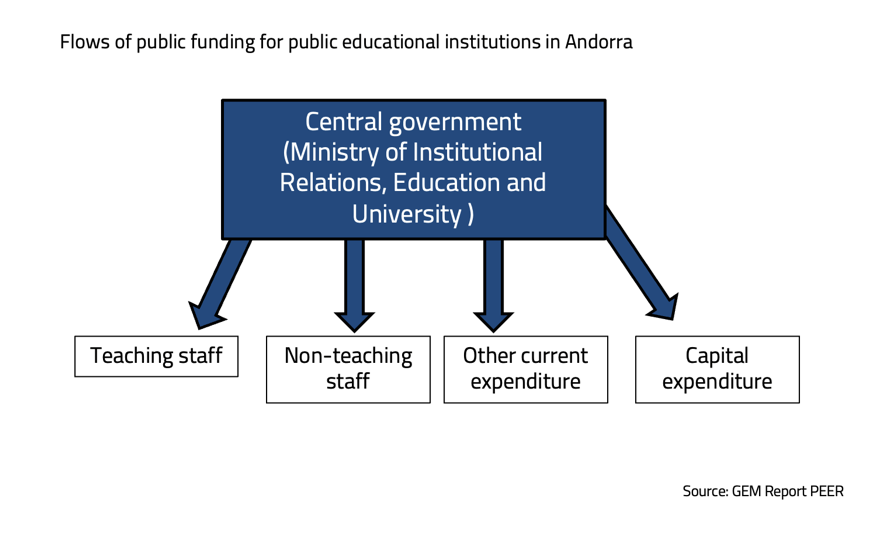
In Andorra, education financing and governance are highly centralised under Decree No. 240/2024. Responsibility for education rests solely with the central government, without involvement from local authorities. The Ministry of Institutional Relations, Education and University oversees the entire education budget, receiving funds from the Ministry of Finance and managing allocations across all levels. It operates through four specialised departments: Educational Systems and International Relations, which finances study grants; Andorran Schools, Andorran Education and Vocational Training; Inspection, Educational Quality and Human Resources; and Higher Education, Research and Technological Innovation. While the central government retains exclusive control over schools, services, and support programmes, local councils (Comuns) play a complementary role by providing financial aid for nurseries, playrooms, and extracurricular activities.
1. Education resources to subnational governments
No financial mechanism exists for transferring funds from the central government to local governments that includes equity considerations.
2. Education resources to schools
No financial mechanism exists for transferring funds from the central government to local governments with equity considerations. However, the Meritxell Specialised School represents an important publicly funded resource. Managed by the Patronat, it operates at both primary and secondary levels, providing dedicated services for students with special educational needs. In addition to running its own centre, the school also supports mainstream institutions when such students are enrolled. As a resource aimed at reducing educational inequalities, the Meritxell School constitutes a key instrument through which the Government provides targeted support in such cases.
3. Education resources to students and families
Study Aid System
The Ministry of Education of Andorra has established the Study Aid System (Ajuts a l’estudi) as its main programme to support compulsory education. First introduced in 1992, it was expanded in 2002, 2014 and most recently updated in 2021 through Decree 10/2021. Under the current law, Article 9 specifies six types of scholarships (or grants) available through the system: material grant, school transport grant, school lunch grant, maintenance grant, extracurricular skiing scholarship, and tuition grant.
The scholarships can be combined, except for the dining and maintenance grants. Each has specific eligibility requirements. For instance, the material, lunch, and skiing grants are available to students in compulsory education from households earning less than €18,720 annually. The school transport grant supports students who live at least 1,000 meters from their school or outside public transport areas, covering pre-primary to secondary students and some post-compulsory students in remote locations. Finally, the tuition grant is awarded based on academic performance and family income under €18,720, with priority given to orphans, students with disabilities, and families with dependents or unemployed members.
Moreover, Decree No. 10/2021, in its Articles 9 and 10, regulates special education with a particular focus on financial aid.
4. Social policies and family support programmes
Prestació familiar per fill a càrrec (Family Allowance for Dependent Children)
Established by Law 6/2014, the Family Allowance for dependent children is a social benefit managed by the Ministry of Social Affairs to help families cover essential child-related costs, including education, housing, food, and health. The allowance is paid monthly and equals 10% of the official minimum wage (LECS) per child. From the second child onward, a 15% supplement is added, and children with disabilities receive an extra 20%. Eligibility is determined using the LECS, which is adjusted based on the number of adults and children in the household, with higher allowances for single-parent families and those with members with disabilities.
5. School meal programmes
School Canteen Grant Programme
The School Canteen Grant Programme provides full lunch meals five days a week during the academic year for students from pre-primary to secondary education. Targeted at low-income families, the programme is led and financed by the Ministry of Education, with implementation shared between central and local authorities. Individual schools handle food procurement. The meals include a balanced variety of grains, dairy, proteins, fruits, vegetables, and beverages, with student preferences considered in menu planning. Staff also receive training in nutrition, portioning, and menu development, ensuring nutritional standards are maintained.
This profile was reviewed by Alexandra Monné Bellmunt, Professor at the University of Andorra.










