


Financing for equity in primary and secondary education
1. Education resources to subnational governments
2. Education resources to schools
3. Education resources to students and families
4. Social policies and family support programmes
Introduction
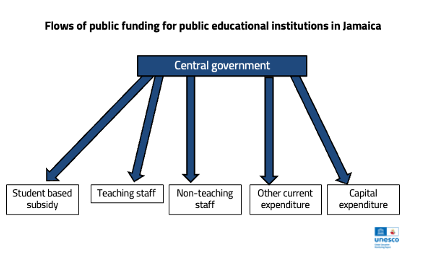
In Jamaica, school financing is highly centralised. Subnational authorities—including parishes, municipalities, and regional or local education bodies—play a supporting role in fund management, while the Ministry of Education, Youth & Information (MOEYI) oversees the allocation of funds for school maintenance and operations, approves teacher appointments, and transfers salaries directly to teachers’ accounts. Monetary transfers are primarily determined on a per-student basis.
The Education Act of 1980 sets out statutory and operational responsibilities, with Part III, Section 90 specifying that the Minister, after consulting the Board of Management of a public educational institution, shall determine the grants paid to that institution. In 2018, MOEYI introduced a new funding approach to ensure a more equitable distribution of resources. Under Bulletins 90/2018 (for infant, primary, all-age, and junior high schools) and 91/2018 (for secondary schools), allocations now consider student numbers, age, prior attainment, and socio-economic status, moving beyond the previous per-capita formula.
1. Education resources to subnational governments
Resources are allocated at the central level.
2. Education resources to schools
Jamaican schools primarily receive funding from two sources. First, government transfers, including tuition grants and PATH (Programme of Advancement Through Health and Education) allocations, which cover services such as meals for PATH students. Second, private contributions, mainly the School Support Contribution from parents, alongside voluntary donations, fundraising proceeds, and other school-generated income.
Special Needs Education
Before the introduction of the current funding formula, the Special Needs Education Services programme, established in January 1989 within the Ministry of Education, received the most resources. This programme supports children aged 4–21 with physical, intellectual, or multiple disabilities, emotional-behavioural disorders, and learning difficulties. The government also provides support to non-governmental organisations offering special education programmes.
2018 Funding Formula
Since 2018, government transfers are determined by a funding formula designed to promote equity, taking into account students’ academic performance and socioeconomic background. Students are categorised based on their PEP exam results (or GSAT prior to 2019), with additional resources allocated to the lower two performance groups to support skill development.
The formula provides a basic level of funding for all students, with extra support for those from disadvantaged backgrounds, students with lower literacy or numeracy skills, and students with special education needs. Schools offering technical, vocational, or STEM programmes receive additional funds due to higher costs. Dedicated funding also covers school meals and maintenance. Smaller primary and infant schools receive a fixed amount, whereas larger schools receive funding per student. Secondary schools receive higher per-student allocations than primary schools, with additional funds for PATH students to cover school trips and other activities. Funds are disbursed in four instalments throughout the year to ensure steady support.
Teacher Allowances
Teachers in rural or hard-to-staff schools receive a volatile/remote allowance, providing additional compensation of 13% of the average base salary for teachers and 18% for principals and vice-principals.
3. Education resources to students and families
No programme has been found.
4. Social policies and family support programmes
Programme of Advancement Through Health and Education (PATH)
The PATH launched in 2001, provides nationwide social and education support through two main grants. The education grant is contingent on children aged 6 to 17 attending at least 85% of school days each month. The social assistance grant supports economically disadvantaged pregnant or lactating mothers, elderly individuals, and poor, disabled, or destitute adults under 65. PATH funds are intended to help cover the cost of daily meals for participating students. In addition to cash transfers, PATH provides free access to school lunches and community health services. During the COVID-19 pandemic, the programme increased total grant amounts by 50%, provided internet data grants for virtual learning, and distributed laptops and tablets to students. PATH also offered nutritional support for students unable to attend schools during the pandemic and delivered financial assistance to students returning to school under PATH and the Poor Relief programme to purchase school supplies.
5. School meal programmes
The National School Feeding Programme, established in 1939, is Jamaica’s oldest and largest government social protection initiative and underpins the National School Nutrition Policy. It provides students in Basic, Infant, Primary, All-Age, and Secondary Schools with at least one cooked meal per day. The programme aims to reduce hunger, promote consistent school attendance, and provide nutritional support to the most vulnerable students in public institutions.
The School Feeding Unit manages the programme, delivering meals and Nutribun snacks to enhance attendance and learning outcomes. Implementation is carried out in collaboration with Nutrition Products Limited (NPL), an agency under the Ministry of Education.
This profile was reviewed by Stacey N. J. Blackman, PhD, Professor of Inclusive Education & Disability Studies at the School of Education, University of the West Indies.










