


Financing for equity in primary and secondary education
1. Education resources to subnational governments
2. Education resources to schools
3. Education resources to students and families
4. Social policies and family support programmes
Introduction
In Italy, education financing and governance combine centralized and decentralized responsibilities.
At the central level, the State has exclusive legislative authority over the general organization of pre-primary, primary, and secondary education, including funding. These responsibilities are mainly handled by two ministries: the Ministry of Education and Merit (MIM), which oversees compulsory education, resource allocation, curriculum, teacher qualifications, school network organization, and national policies; and the Ministry of University and Research (MUR). Since 2022, the former Ministry of Education, University and Research (MIUR) was split into these two separate ministries.
Regions hold exclusive legislative power over vocational education and share responsibilities in other education areas. They plan the school network, set the academic calendar, and ensure the right to university education. Italy has 20 regions, with the most populous being Lombardia (Milan), Lazio (Rome), and Campania (Naples). Provinces manage upper secondary education aspects such as school buildings and support services.
Municipalities handle school meal services, infrastructure, transportation, and free textbooks at the primary level. They may also manage schools directly if delegated by regions and provinces.
Funding flows from central ministries to regions and municipalities, which co-finance services through local taxes. In this multilevel system, the State provides the legal and financial framework, while local authorities deliver education services and infrastructure (Figure 1).
Figure 1. Italy: Overall financing systems of primary and lower secondary education schools
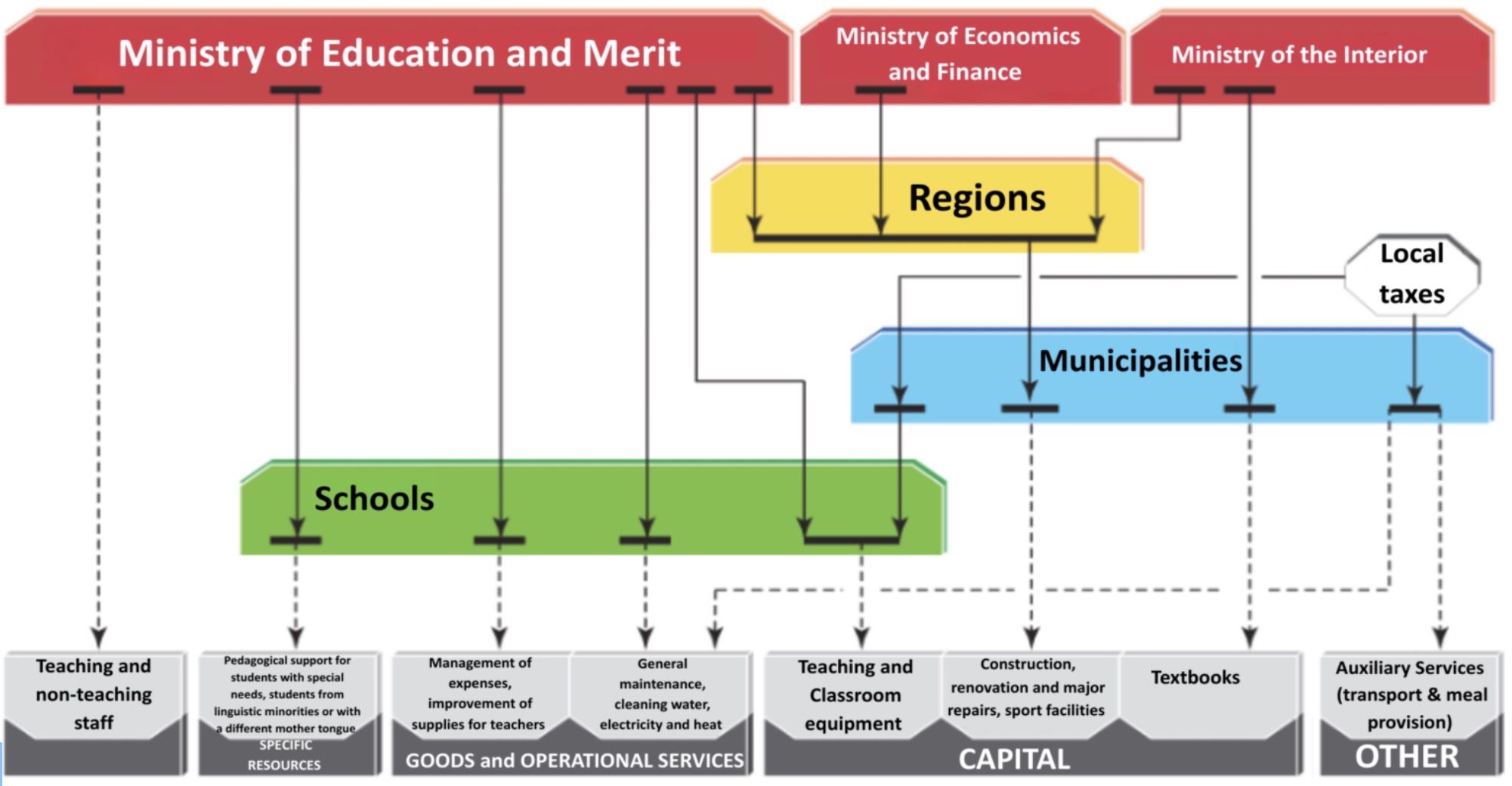
Source: European Commission (2014) adapted and translated by GEM Report Team
1. Education resources to subnational governments
The government allocates education funding to regions, provinces, and municipalities through three main ministries: the Ministry of Education and Merit (MIM), the Ministry of Economy and Finance (MEF), and the Ministry of the Interior. Regions and municipalities then manage infrastructure projects—such as school construction, renovation, and equipment—as well as transportation and auxiliary services like school meals and free textbooks.
Article 119 of the Italian Constitution outlines the principles for transferring financial resources from the central government to regional, provincial, and municipal authorities. It establishes an equalization fund designed to reduce disparities between regions with varying fiscal capacities. This fund, financed through national tax revenues and without restrictions on its use, ensures comparable standards in essential services like education. It also gives local authorities the flexibility to address specific territorial needs, including education infrastructure and services.
2. Education resources to schools
Programma Operativo Nazionale (PON) scuola “ Competenze per lo Sviluppo” 2007-2013 (National Operational Programme school “Skills for Development” 2007-2013)
In 2007, the Ministry of Education, University and Research (MIUR) launched the “Skills for Development” project as part of the National Operational Programme. Co-funded equally by the Italian Government and the European Social Fund, the project aimed to enhance students’ skills, support the professional development of teachers and staff, promote digital inclusion, and encourage lifelong learning. A key objective was to foster social inclusion and equality by reducing school dropout rates, particularly in vulnerable regions. MIUR allocated funds directly to schools through a public call for proposals; eligible schools then designed and implemented targeted initiatives to lower dropout rates.
Piano “Agenda Nord” & Piano “Agenda Sud”
In 2023, the Ministry of Education and Merit (MIM) launched two programmes—Agenda Nord and Agenda Sud—with the shared goal of reducing school dropout rates, closing learning gaps, and promoting social equity and inclusion in schools. These initiatives are part of the broader Piano Nazionale (PN) 2021-2027 and the Programma Operativo Nazionale “Per la scuola – Competenze e Ambienti per l’apprendimento” 2014-2020. Agenda Nord targets vulnerable schools in northern regions, including Emilia-Romagna, Friuli-Venezia Giulia, Lazio, Liguria, Lombardy, Marche, Piemonte, Toscana, Umbria, and Veneto. Agenda Sud focuses on southern regions such as Abruzzo, Basilicata, Calabria, Campania, Molise, Puglia, Sardegna, and Sicily. Both programmes allocate funds directly to eligible schools through a public call for proposals. Selected schools are responsible for designing and implementing initiatives to reduce dropout rates.
Local Funding to Support Inclusion (regional funding)
Some regions provide additional funds to schools to support specific inclusion goals. For example, the Autonomous Province of Trento allocates special funding to all educational institutions to promote full participation, especially for students needing extra support. Schools with students who have sensory disabilities receive particular attention, with grants ranging from €1,200 to €6,100 depending on size and needs, and a standard allocation of €3,500 per school for those with at least one student with a visual or hearing disability.
3. Education resources to students and families
School Textbooks for Disadvantaged Students
In 2023, the Ministry of Education and Merit (MIM) established a programme through Decree MIM. 30/03/23, prot n.425 to allocate funds to Italy’s 20 regions to support students from disadvantaged socio-economic backgrounds by providing school textbooks. Families in vulnerable economic situations—defined as having an ISEE (Indicator of Equivalent Economic Situation) below 15,493.17 euros—must apply through their municipality of residence on behalf of the student. Regions allocate the funds to municipalities, which then distribute the resources directly to the families.
Fondo Unico per Welfare dello studente e per il diritto allo studio (Single Fund for Student Welfare and the Right to Education)
In 2017, the Ministry of Education and Merit (MIM) established the “Fondo Unico per welfare dello studente e per il diritto allo studio,” which was implemented in 2022. This fund provides scholarships to disadvantaged secondary school students with an ISEE (Indicator of Equivalent Economic Situation) below 15,748 euros. The scholarship helps students purchase school textbooks, supports mobility and transportation to school, and facilitates free access to cultural goods and services. The amount, determined by each region, ranges from 150 to 500 euros per student. Eligible students must apply to their region of residence, which is responsible for awarding the scholarships.
Assistance for School Trips and Outings
For the 2023/2024 school year, the Ministry of Education and Merit (MIM) launched a programme to support socio-economically vulnerable families—those with an ISEE below 5,000 euros—by providing a contribution of 150 euros per student to help cover the costs of school trips and educational outings included in the curriculum. The initiative aims to ensure that students from disadvantaged backgrounds can participate in these valuable experiences, promoting equal educational opportunities.
4. Social policies and family support programmes
Fondo Unico per L’inclusione delle Persone con Disabilità (Single Fund for the Inclusion of Persons with Disabilities)
In 2023, the Ministry for Disabilities established the Single Fund for the Inclusion of Persons with Disabilities through decree n. 213. The programme allocates resources to support initiatives that promote the inclusion of persons with disabilities. These initiatives include enhancing school support services, developing inclusive and digital infrastructure (including sports and recreation), assisting individuals with neurodevelopmental and autism spectrum disorders, fostering social inclusion of deaf and hard-of-hearing people through sign language and innovative communication technologies, and funding national or local projects led by or involving Third Sector organizations, following the principle of subsidiarity.
Fondo Periferie Inclusive (Inclusive Suburbs Fund)
The Fondo Periferie Inclusive, established by the Ministry of Disabilities through decree n. 197, aims to promote social inclusion and counter marginalization of persons with disabilities in the outskirts of major cities. Managed by the Presidency of the Council of Ministers, it targets municipalities with over 300,000 residents to support educational projects that enhance inclusion and autonomy for persons with disabilities in peripheral urban schools.
Regional Funds for the Freedom of Educational Choice (regional)
Some regional governments have established specific funds to support the educational inclusion of students with disabilities. For example, under its "funding for equity" framework, the Veneto Region’s Buono-Scuola initiative offers targeted financial aid to families of students with certified disabilities. Eligible families with an ISEE up to €60,000 can receive up to €15,000 to cover school-related expenses, including individualized support services. This measure aims to reduce educational barriers and promote inclusive access to quality education.
Local Funds for Free Transportation (local)
Local governments also provide free transportation services for disadvantaged students. For instance, the Municipality of Milan offers free home-to-school transport for students with certified disabilities (Law 104/1992, art. 3.3). This service ensures daily accessibility and includes accompaniment by dedicated staff when needed, helping to remove logistical barriers and support inclusive education.
5. School meal programmes
School meal programmes in Italy are available in primary education but are not free and are managed by municipalities rather than nationally or regionally. In 2022, the Ministry of Education and Merit (MIM) allocated about 105 million euros for these programmes, distributed to municipalities based on equity. The three largest municipalities received the following: Milan (€2.25 million), Rome (€5.06 million), and Naples (€1.64 million), which they allocateto local schools.
Each municipality applies equity-based criteria for free school meals. Milan offers free meals to students from families with an ISEE below €2,000, children in foster care, and those facing certified socio-economic hardships. Rome provides free meals to families with an ISEE below €5,165. Naples targets students with certified severe disabilities or recognized disabilities from households with an ISEE up to €24,000, as well as students from households with an ISEE up to €2,500 facing severe hardship. Families with an ISEE below €500 pay a reduced fee of €0.75 per meal.
This profile was reviewed by Dr. Tommaso Agasisti, Professor of Public Management, Department of Management, Economics and Industrial Engineering, School of Management, Politecnico di Milano.










