


Financing for equity in primary and secondary education
1. Education resources to subnational governments
2. Education resources to schools
3. Education resources to students and families
4. Social policies and family support programmes
Introduction
In France, the education system is centralised, with the Ministry of Education managing most of the education budget. However, local authorities are responsible for school buildings, canteens, transportation, and non-teaching staff.
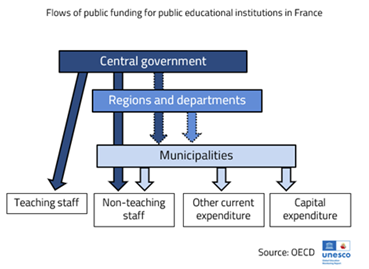
1. Education resources to subnational governments
In France, the central government allocates funds to local governments through the “modèle d’allocation des moyens” (EPLE), which considers both the number of students and the socio-economic context of each school. A key tool in this process is the Indice de Position Sociale (IPS), a statistical measure that evaluates schools’ needs based on parents’ socio-professional status and other socio-economic factors.
To address educational inequalities, France has a longstanding tradition of providing additional resources to disadvantaged areas. This began with the establishment of zones d’éducation prioritaire (ZEP) in 1981, which were replaced by réseau d’éducation prioritaire (REP) in 1999 and reformed in 2015 to better target support where it’s most needed.
2. Education resources to schools
Réseau d'Education Prioritaire (REP and REP+)
France’s priority education policy began in 1982 with Zones d’Education Prioritaire (ZEP) to support disadvantaged pupils by allocating more resources to needy areas. Schools are classified by a “social index” based on parents’ socio-professional status, student grants, students living in priority urban neighbourhoods (QPV), and grade repetition rates before sixth grade. Students in these schools benefit from smaller classes (max 25), targeted support, project funding, school trips, and sometimes local boarding. Teachers in these areas receive annual bonuses (€1,734 in REP and €5,114 in REP+) and have access to special working conditions to support group work and ongoing training.
Territoires éducatifs ruraux - TER (Rural Educational Territories)
Launched in 2021, the Territoires éducatifs ruraux (TER) programme aims to enhance educational support for children and youth before, during, and after school, using strategies tailored to rural areas. By 2022, it was implemented in 67 TERs across ten academies, as identified by academic authorities.
Cités éducatives (Educational Cities)
Launched in 2019, the Cités éducatives program targets 80 disadvantaged urban areas to support young people aged 3 to 25. It promotes cooperation between schools, families, and local actors to improve academic outcomes and reduce inequalities.
Positions for assistants supporting students with disabilities
In 2023, 4,000 new AESH positions (assistants supporting students with disabilities) were created to meet increasing needs and advance toward a fully inclusive school system.
3. Education resources to students and families
Middle and high school scholarships
Middle and high school scholarships are awarded annually and vary by financial need: three levels for middle school and six for high school, based on the income of the student’s guardians and number of dependents. Scholarships are paid in three instalments and require proof of income and dependents via tax returns.
These need-based scholarships can be supplemented by merit scholarships for students who earn a “mention bien” or “très bien” on the brevet exam. Additionally, scholarship holders may receive a boarding allowance based on social criteria and an equipment grant for those in technological programmes.
Decree No. 59-39 of January 2, 1959 establishes the procedures for awarding national scholarships for secondary education in secondary and final classes.
Vacances apprenantes (Learning Vacations)
The “Vacances apprenantes” programme supports learning and personal development through supervised cultural, sports, and leisure activities, including open schools and summer camps focused on education, culture, sport, and sustainable development. Targeting children and youth aged 3 to 17, it prioritises those from disadvantaged urban or rural areas, single-parent or low-income families, children with disabilities, essential health workers’ families, and those with limited internet access, with special attention to minors under child protection. In 2023, this initiative was merged with the “école ouverte” programme.
4. Social policies and family support programmes
The social fund, established in 1998, helps families cover schooling and school-related expenses such as transportation, school trips, dental care, glasses, hearing aids, textbooks, and school supplies. Support can be provided as cash or in-kind benefits. It targets specific groups mainly through school-based eligibility criteria rather than a strict formula based on income or other social characteristics. To benefit from the fund, the child must be enrolled in certain educational structures: public or private under contract middle schools or high schools, distance learning classes at CNED, or specialized regional adapted education establishments (EREA). Importantly, the child does not need to be a scholarship holder to qualify. The aid
Allocation de rentrée scolaire (Back-to-School Allowance)
The Allocation de rentrée scolaire (ARS) is a means-tested benefit paid to families with at least one child in school aged 6 to 18. It is designed to help families finance back-to-school expenses.
Allocations familiales (Family Allowances)
Family allowances are benefits paid to families living in France with at least two dependent children under 20. The amount depends on the number of children and household income, helping to partially offset the costs of raising and educating children.
5. School meal programmes
In France, school canteen services are available to all children where such facilities exist, with management decentralised across regions, departments, and municipalities. In primary schools, local authorities typically oversee canteen services, setting family contributions based on income, while families facing financial difficulties can seek support from local social workers. In secondary schools, meal prices are determined by the relevant local authority, and a social fund is available to assist families in need.
Since 2019, targeted initiatives have aimed to improve access to school meals for disadvantaged students. The School Breakfast Programme was introduced primarily in priority education networks (REP/REP+) and urban priority neighbourhoods, providing morning meals to support children’s learning and well-being. Additionally, the State began supporting social pricing in school canteens that same year, allowing children from the most disadvantaged families to pay no more than €1 per meal, ensuring affordable access to nutritious food.
This profile was reviewed by Dr. Léonard Moulin, Tenured Researcher at INED, Associate Researcher at Érudite, and Academic Editor at PLOS ONE.










