


Financing for equity in primary and secondary education
1. Education resources to subnational governments
2. Education resources to schools
3. Education resources to students and families
4. Social policies and family support programmes
Introduction
In the United Arab Emirates, the financing of education is primarily overseen by the Ministry of Finance (MoF), which allocates the national budget, and the Ministry of Education (MoE), which is responsible for managing and distributing the education budget across the country. The federal government plays a central role in overseeing and financing basic education, especially in the northern emirates. In contrast, certain emirates such as Abu Dhabi and Dubai exercise a degree of financial and administrative autonomy through local education authorities like the Abu Dhabi Department of Education and Knowledge (ADEK) and the Knowledge and Human Development Authority (KHDA).
The core financing mechanism operates through a centralised budget allocation process. Each year, the MoF prepares the federal budget, from which a designated share is allocated to MoE. This last then distributes funds to regional education zones/entities based on specific criteria such as student enrollment numbers, school needs, and national education priorities. These regional offices further allocate funds to individual public schools, primarily for operational expenses. While schools manage day-to-day expenditures, teacher salaries and major infrastructure investments are handled centrally. Financial flows are monitored through internal ministry mechanisms and subject to federal audit to ensure transparency and accountability throughout the system.
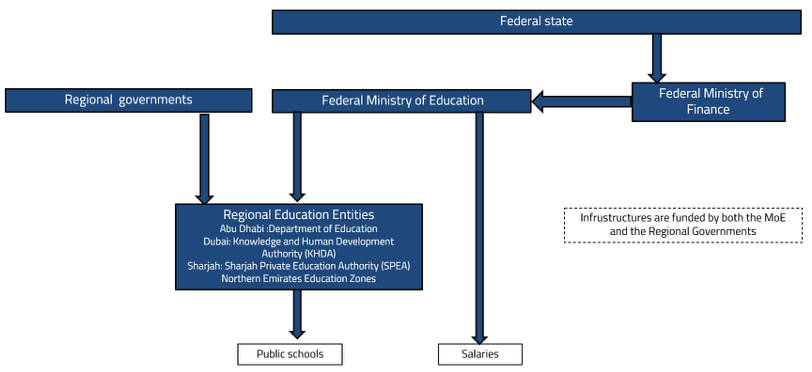
Source : PEER Team
1. Education resources to subnational governments
Education funding follows a semi-centralized model, where the federal government allocates resources to subnational education entities. While the MoE redistributes the federal education budget to regional zones based on factors such as enrollment, school types, staffing needs, and national priorities, levels of decentralization vary by emirate, particularly in Abu Dhabi and Dubai. These regional entities manage federal public schools but operate under federal oversight. Currently, there are no specific mechanisms in place to allocate funds based on equity considerations across regions.
2. Education resources to schools
School funding is centrally managed by the Ministry of Education, which allocates resources to regional education zones based on enrollment, school size, staffing, and priorities. These zones provide schools with operational budgets for daily needs, while major expenses like salaries and infrastructure are covered centrally. Schools have limited financial control and must report to both the zones and the Ministry.
The "Madrasat Fareejna" Initiative
The "Madrasat Fareejna" initiative, launched by the Emirates Schools Establishment during the 2023–2024 academic year, aims to transform public school campuses into community hubs operating beyond school hours and during holidays. Part of the federal government’s performance agreements, it maximises the use of school facilities like labs, sports areas, and theatres. Targeting students, families, local communities, and public-private partners, the initiative follows a universal access model to ensure equitable participation and supports the identification of 1,000 gifted students in science, culture, and sports. Aligned with the national vision "We the UAE 2031," it promotes an inclusive, participatory approach to education and is overseen by the Ministry of Education with support from various strategic partners.
“School For All” Inclusive Education Initiative
The “School for All” initiative, launched in 2010 and reinforced by the 2020 Inclusive Education Policy, mandates integrating students with disabilities—including visual, hearing, physical, intellectual, and developmental challenges—into mainstream schools. It requires schools to provide Individualised Educational Plans (IEPs), support services, assistive technologies, and licensed specialists. Student eligibility is determined by multidisciplinary assessments through nationwide support centres offering diagnosis, referrals, and parent guidance. Although there is no formal equity-based funding, the Ministry of Education supplies public schools with specialised staff, therapies, assistive tools, and accessible infrastructure at no cost. These services span all school levels and were expanded during the COVID-19 pandemic with digital learning, remote assessments, and virtual therapy.
The government may invest in private educational institutions.
3. Education resources to students and families
The Education Support Fund, established in 2019 and repealed in 2023, was the Ministry of Education’s main program to financially assist disadvantaged students and families, especially students of determination and low-income households. It aimed to support public, higher, and charitable education by promoting quality, innovation, and inclusive access. Funded through donations, grants, and endowments, resources were allocated by a management committee based on needs and national priorities, including educational remediation, student activities, and partnerships with charities. Allocation considered family socioeconomic status, students’ special needs, and alignment with national education goals.
4. Social policies and family support programmes
Family Allowance Programme (2019)
The Family Allowance Programme provides monthly cash benefits to Emirati citizen families, including child allowances and other family related support. Eligibility is citizenship based, with no means testing, and benefit levels vary according to family composition and number of dependents. The programme was operationalised in 2019, following the introduction of Federal Law No. 7 of 1999 on social assistance (legal basis), building on the existing social assistance legal framework. Children are covered as dependents generally up to age 21 if in education, with extended coverage for girls until marriage and children with disabilities without a strict age limit. Non-citizens are excluded.
A federal program for support and social empowerment provides monthly support to low-income Emirati families, with the aim of enhancing their stability and economic empowerment. The program focuses on the protection of the most needy groups such as orphans, people with disabilities, unemployed, and single mothers who have faced difficulties.
Benefits include monthly allowances specific according to different family categories, in addition to supplementary allowances such as the housing allowance for families who did not receive government housing support, and the higher education academic excellence allowance granted to children who are a part of the beneficiary family.
5. School meal programmes
In the 2023-2024 academic year, the National School Meal Initiative began its pilot phase, with plans to fully launch in 2024–2025. Funded by the federal government and coordinated by the Ministry of Climate Change and Environmentin partnership with other national bodies, the programme will offer free, nutritious meals to every student in public schools across the UAE. The meals will follow national nutrition standards and aim to support children’s health and development, with expert oversight to enhance learning outcomes. Beyond the initial announcement, no additional details on the programme’s rollout are currently available.










