


Financing for equity in primary and secondary education
1. Education resources to subnational governments
2. Education resources to schools
3. Education resources to students and families
4. Social policies and family support programmes
Introduction
In Barbados, education at the primary and secondary levels is primarily overseen by the Ministry of Educational Transformation (MOET). The MOET collaborates with other government ministries and stakeholders on key aspects such as financing, curriculum and pedagogy, entry and exit requirements, equity, and personnel management. Policy direction is set by the political directorate and implemented by a technical team led by the Chief Education Officer, alongside an administrative team headed by the Permanent Secretary, who also serves as the Chief Accounting Officer. Financial responsibilities are shared with other ministries, including the Ministry of Finance and Economic Affairs, which manages pensions for retired government teachers, and the Ministry of Labour, Community Development and Sports, which contributes to vocational training expenditures.
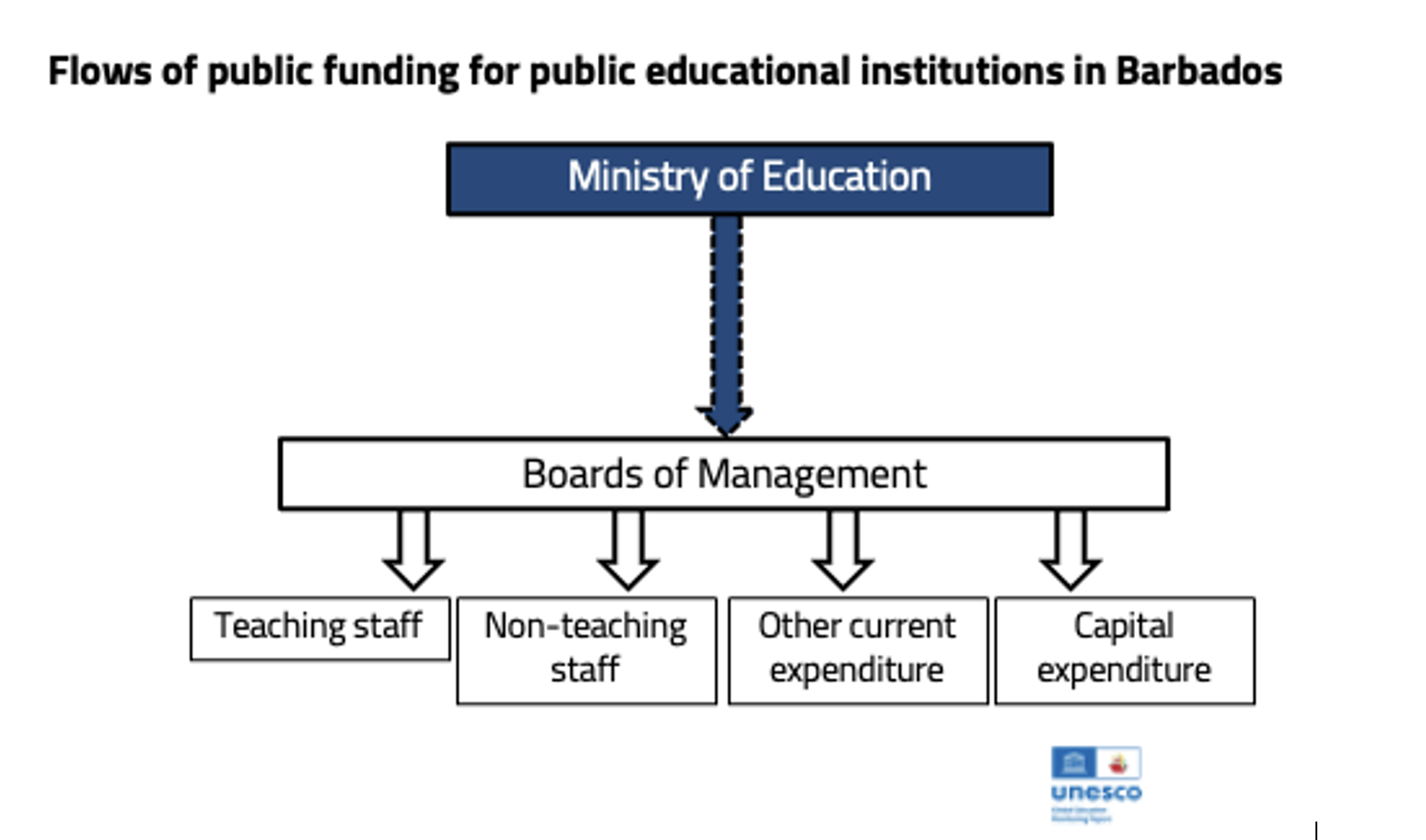
Funds for education are allocated as grants to school Boards of Management, which are responsible for managing and distributing these resources. According to the Barbados Education Act (1997), Boards of Management are authorised to receive, disburse, and account for all funds to the Minister of Education. Part II, Division 3, Section 18 of the Act specifies that the funds and resources of the Boards consist of money voted by Parliament and any money or property payable to or vested in the Boards in relation to their functions. However, the legislation does not clearly define the criteria used for determining how funds are distributed to individual schools. At the end of each fiscal year, Boards are required to submit revised estimates of income and expenditure, which include salaries and allowances for all teaching and non-teaching staff, as well as fees payable by pupils.
1. Education resources to subnational governments
The resources are managed centrally and allocated directly to educational institutions.
2. Education resources to schools
The allocation of budgets to schools is determined centrally and outlined in the annual national budget, after which funds are distributed directly to educational institutions. Certain institutions, such as Special Schools, the Jean and Norma Holder Hospitality Institute, and the Edna Nicholls Centre for children considered “at risk”, operate specialised programmes designed to support vulnerable students and receive additional grants to subsidise these initiatives.
Special Education
Special education, established under the 1987 Education Act, is primarily funded by the Ministry of Education. The government allocates resources for special schools and units within public institutions, covering costs for specialised staff, equipment, and adapted curricula. Funding supports reduced teacher–student ratios, teacher aides, and Individualised Education Plans (IEPs). While public provision remains the main source, some private schools operate special education programmes financed through tuition fees and private contributions, supplementing state support.
3. Education resources to students and families
Starting September 2023, parents and guardians could claim financial assistance for the Primary School Textbook Grant. The grant gives $100 to each student for the purchase of textbooks. Parents/guardians were able to apply for this grant online.
4. Social policies and family support programmes
National Assistance Programme (NAP)
Established in 1969, the National Assistance Programme (NAP) provides financial support to vulnerable populations and represents Barbados’s largest non-contributory social protection initiative. It offers both direct cash assistance to households and in-kind support to individuals and families in need.
Administered by the Welfare Department, the NAP functions as a key safety net for at-risk groups, particularly low-income households. The programme is structured to provide regular financial support to those affected by economic hardship or natural disasters. Efforts are ongoing to strengthen its shock-responsive capabilities, enabling faster and more predictable assistance following events such as hurricanes or economic crises.
The monetary assistance component of the programme identifies twelve specific beneficiary groups. Target populations include children under the age of sixteen, children over sixteen who remain in school, special case children (both under and over sixteen), persons with disabilities, and other vulnerable groups such as the severely disabled.
In terms of in-kind assistance, all individuals identified as vulnerable are eligible beneficiaries. This support includes items such as spectacles, dentures, furnishings, clothing, hearing aids, food vouchers, housing and land rent assistance, diapers, utility bill payments, and educational support. Applicants seeking rent assistance must provide a valid rent receipt. The educational assistance component is designed to cover school-related costs and fees.
5. School meal programmes
School Meals Programme
The school meals programme was first established in 1963 to serve primary school children. The programme, managed by the School Meals Department under the Ministry of Educational Transformation, has expanded to include preschool and selected secondary school students. The programme provides hot or cold lunches to preschool, primary and selected secondary schoolchildren (a four-week menu cycle is currently being developed). The department also provides a milk drink during the morning break to all children attending pre-primary and primary schools, five days a week. Students can also purchase food from tuck shops, vending machines and food vendors operating both in and around schools. Pupils contribute a small sum per week towards the meals, though a child is not denied a meal if they cannot afford to pay for it.
The programme is designed to include all students enrolled in primary and special schools, who are eligible to receive school meals. For students attending secondary schools, meal provision is determined on a case-by-case basis, guided by assessments of individual needs conducted by school guidance counsellors.
In 2022, Barbados launched its School Nutrition Policy, developed in collaboration with the Ministry of Health and Wellness and the Pan American Health Organisation (PAHO). The policy establishes nutrition standards for all foods and beverages available in schools, restricts the marketing of unhealthy options, and promotes a supportive food environment. It applies to all public and private educational institutions, from preschool through tertiary level. The Barbados School Nutrition Policy replaces the nutritional and practical guidelines for healthy foods in schools that were developed in 2015 by the National Nutrition Centre.
This profile was reviewed by Stacey N.J Blackman, Professor of Inclusive Education & Disability Studies, School of Education, University of the West Indies, Cave Hill Campus.










