


Financing for equity in primary and secondary education
1. Education resources to subnational governments
2. Education resources to schools
3. Education resources to students and families
4. Social policies and family support programmes
Introduction
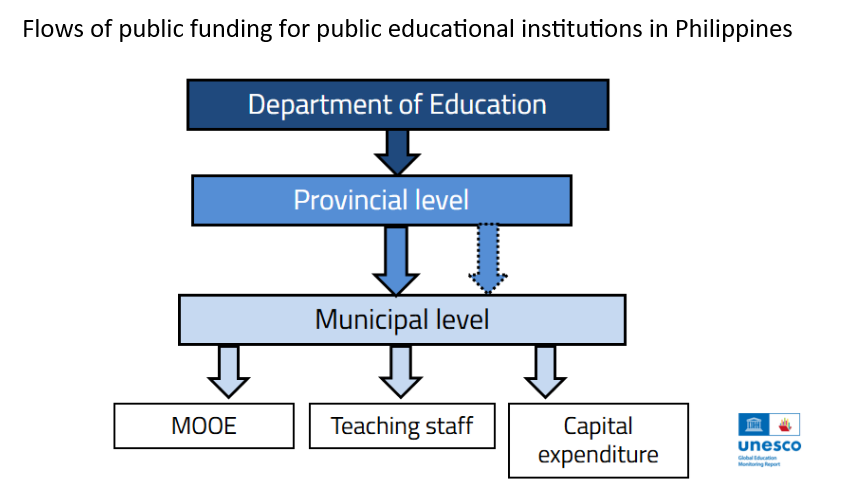
The Department of Education (DepEd) in the Philippines is responsible for basic education. The Department of Budget and Management works alongside DepEd for the financial management of national education funds. Local Government Units (LGUs) are administrative authorities at the provincial, city, municipal and barangay levels. LGUs are responsible for the distribution of funds at subnational levels.
In 2024, the National Expenditure Programme (NEP) earmarked PHP 924.7 billion for the education section, equivalent to 16% of total government expenditure for the year. Of this amount, PHP 758.6 billion is allotted for the Department of Education (DepEd) which is responsible for pre-school to upper secondary education. Education expenditure is further separated into three categories: 1) Personal services referred to as salaries and other benefits; 2) Maintenance and other operating expenses (MOOE); 3) Capital outlays used for construction projects and equipment.
1. Education resources to subnational governments
Local Government Units set their budget and expenditure plans which are then sent to the Department of Budget and Management. Once the Department of Education (DepEd) has been authorized to use their budget, DepEd transfers the specific amounts to the LGUs.
The Department of Education is responsible for determining schools' maintenance and other operating expenses (MOOE). These funds are determined through a funding formula based on the Boncodin formula which considered factors such as the number of learners, teachers, classrooms, and graduates; but does not consider equity.
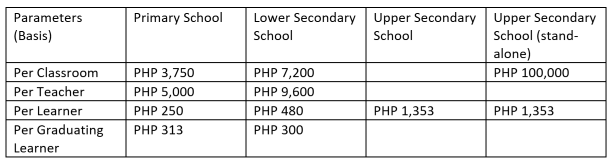
School’s MOOE = Fixed amount + (allowable amount for a classroom x number of classrooms) + (allowable amount for a teacher x number of teachers) + (allowable amount for a learner x number of learners) + (allowable amount for a graduating learner x number of graduating learners)
The most recent adjustment through the MOOE Budget Proposal (BP) FY 2019 allows for a fixed amount of PHP 50,000 for primary schools, PHP 96,000 for lower secondary schools, PHP 100,000 for standalone upper secondary schools. The variable costs are as follows:
As of 2024, the Department of Education has started the process of creating and transitioning to a new formula which includes 27 cost drivers.
2. Education resources to schools
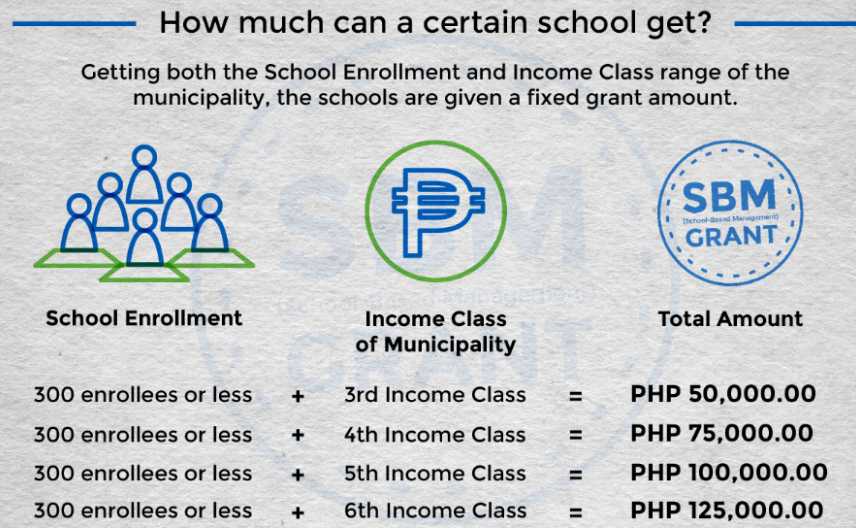
Since 2006, disadvantaged elementary and secondary schools in the Philippines are entitled to receive School-Based Management (SBM) Grants. These grants are funded by the Department of Education with previous support from the World Bank and AusAID.
In 2024, DepEd Order No. 007, s. 2024 revised the implementation framework of the School-Based Management (SBM) System, strengthening coordination across governance levels. The new policy clarifies that schools are responsible for self-assessment and improvement planning; Schools Division Offices provide technical assistance and monitor school performance; Regional Offices oversee and evaluate divisional implementation; and the Central Office ensures national policy consistency and integrates SBM into the broader education monitoring framework.
According to DepEd Order No. 45, s. 2015, schools must have 300 students or less and come from a 3-6th income class municipality based on the National Statistical Coordination Board (NSCB). The grants were provided as follows:
The Last Mile Schools Programme aims to address the gaps in resources and facilities of schools that are in geographically isolated and disadvantaged areas. These schools are usually those with less than four classrooms and may be makeshift and nonstandard; no electricity; no funds for repairs or new construction projects in the last four years; and a travel distance of more than one hour away from the center, accessible only through difficult terrain. The schools also have multi-grade classes, 75% of whom are indigenous people.
The programme began in 2020 and has transforms makeshift classrooms into standard ones, installs solar panels in those areas where electrification has not been provided, and deploys teachers to provide quality and sustainable education for the disadvantaged Filipino learners living in the most isolated and conflicted areas of the country.
3. Education resources to students and families
The 1987 Constitution of the Republic of the Philippines provides for a system of scholarship grants, student loan programmes, subsidies, and other incentives for deserving students in both public and private schools, especially to the under-privileged.
The Department of Education (DepEd) funds “Government Assistance and Subsidies” (GAS) programmes which provide financial assistance to those entering junior and senior high schools, respectively, in private schools.
Under the Education Service Contracting (ESC), certified private junior high schools are contracted by the DepEd to allocate slots for students, particularly incoming Grade 7 learners, to study there. Students receive grants to aid in tuition and fee coverage. The programme aims to decongest overcrowded public schools and give public school students the exposure to study in private schools where there may be better or more complete facilities. For SY 2023-2024, there were 3,632 ESC-participating schools nationwide. The amount students receive depends on their location. Those in the National Capital Region receive, per year, receive PHP 13,000; those in highly urbanized cities receive PHP 11,000; and those in all other locations receive PHP 9,000.
The Senior High School Voucher Programme (SHS-VP) is a program under the further expanded Government Assistance to Students and Teachers in Private Education (GASTPE) which provides financial assistance in the form of tuition subsidies for qualified grade 10 completers entering senior high school. The SHS-VP was first introduced as a financing arrangement under the Enhanced Basic Education Act of 2013 or Republic Act 10533 (RA 10533), which expanded the length of schooling in basic education from 10 years to 12 years (known as the K-12 program) but left the system struggling to adjust to the new influx of students and student needs. Clearer implementing guidelines of the SHS-VP were issued through a DepEd order in 2015. . The program enabled Grade 10 completers that the public school system cannot absorb to enroll in private schools at the expense of DepEd. For SY 2023-2024, students received a maximum of PHP 14,000-22,500 per school years for up to two years. The amount depends on the student's location, similar to the ESC programme, and additionally considers whether or not they have received support in the past.
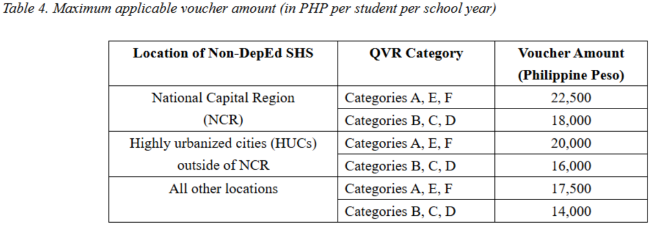
Source: DepEd Order No. 020, s. 2023. Note: Categories A, E, F are considered students who have not received prior financial assistance, while those in Categories B, C, D have received prior financial assistance.
GAS programmes are aimed at ensuring quality education is accessible and affordable to all, especially for students from underprivileged backgrounds. However, in practice, 61% of the funds for ESC in School Year (SY) 2020-2021 and 53% for SHS-VP in SY 2021-2022 went to non-poor beneficiaries. In this light, DepEd has committed to revise the guidelines to ensure prioritization of underprivileged learners.
The Alternative Learning System (ALS) is an adaptive education system established for Filipinos aged 18 years and older who were unable to attend and finish formal basic education. ALS targets out-of-school youth due to economic, geographic, political, cultural, or social barriers, learners with disabilities, indigenous peoples, children in conflict with the law, learners in emergency situations, and other marginalized sectors, but also meets the needs of other disadvantaged populations such as those who do not have schools in their communities. ALS instruction may occur on school campuses outside regular school hours, or within the community- at community learning centers, barangay multi-purpose hall, libraries or at home. While non-formal education has existed in the country since 1948, ALS was established in 2004. While ALS was reported to have more than 4-million out-of-school youths and adults enrolled during the Duterte administration, it has been documented to have encountered problems of low completion, budgetary constraints, and lack of teacher support.
Within ALS, there are several more targeted programmes such as the Indigenous Peoples Education (IPEd) programme, which was added in 2015. The IPEd supports education initiatives in key indigenous areas with emphasis on continuing indigenous knowledge systems and practices, languages, and learning systems.
4. Social policies and family support programmes
The Pantawid Pamilyang Pilipino Programme (4Ps), launched in 2008 and institutionalized in 2019, is a Conditional Cash Transfer Programme run by the Department of Social Welfare and Development (DSWD). Part of the conditions for the cash transfer is that households who participate must ensure that all children 3-18 years old must enroll in school. Those in elementary and high school must have 85% class attendance in the school year.
Beneficiaries are households that are classified as poor and near-poor based on Standardized Targeting System and the poverty threshold issued by the Philippine Statistics Authority (PSA). Households must have members who are 0-18 years old or have members who are pregnant at the time of registration.
Despite concerns on impacts, targeting, and administrative costs, the 4Ps program has been documented to improve school enrollment rates of beneficiary children (particularly aged 12-17), lower dropout rates, and has previously reduced incidence of child labor.
5. School meal programmes
DepEd first began providing school feeding programmes in 1997. The current iteration, the School-Based Feeding Programme (SBFP), and the recently-expanded SBFP, are anchored on Republic Act No. 11037 and are used to provide nutritious food products to all Kindergarten students (not just undernourished ones), and learners in Grades 1 to 6 who are considered “wasted, severely wasted, stunted, [or] severely stunted” as determined by the DepEd in its reports; pupils-at-risk of dropping out; indigenous people learners; and those coming from indigent families. At present, the Marcos administration has significantly increased the budget from PHP3.3 billion in 2022 to PHP11.77 billion for 2025 and a proposed PHP14 billion in 2026, and extended the number of feeding days to cover the full school year (increased from 120 to 2020 days).
The Department of Social Welfare and Development (DSWD) also implements food and nutrition-related programs but its Supplementary Feeding Program (SFP) is the one focused on school-aged children. It seeks to improve the health and nutrition of children aged 2-5 years old in Child Development Centers and Supervised Neighborhood Play Groups. This also seeks to build knowledge and behavior on proper nutrition. This aligns with the thrust of the government’s Early Childhood Care and Development program to combat malnutrition. It seeks to provide milk and hot meals for 120-days. While the DSWD also implements other food and nutrition-related programs such as the Food Stamp Program and the Enhanced Partnership Against Hunger and Poverty, Additionally, the 4Ps programme provides a rice subsidy of PHP 600 per month for active and compliant households.
This profile was reviewed by Christopher James R. Cabuay, Associate Professor at Carlos L. Tiu School of Economics, De La Salle University.










