


Financing for equity in primary and secondary education
1. Education resources to subnational governments
2. Education resources to schools
3. Education resources to students and families
4. Social policies and family support programmes
Introduction
South Africa’s education system operates within a highly decentralised governance framework comprising national, provincial, and local spheres. The National Department of Basic Education (DBE) is responsible for overall policy development, oversight, and coordination of basic education from pre-primary to grade 12. Implementation, including the financing and direct management of schools, is primarily the responsibility of provincial education departments.
Flows of funding to public educational institutions in South Africa
1. Education resources to subnational governments
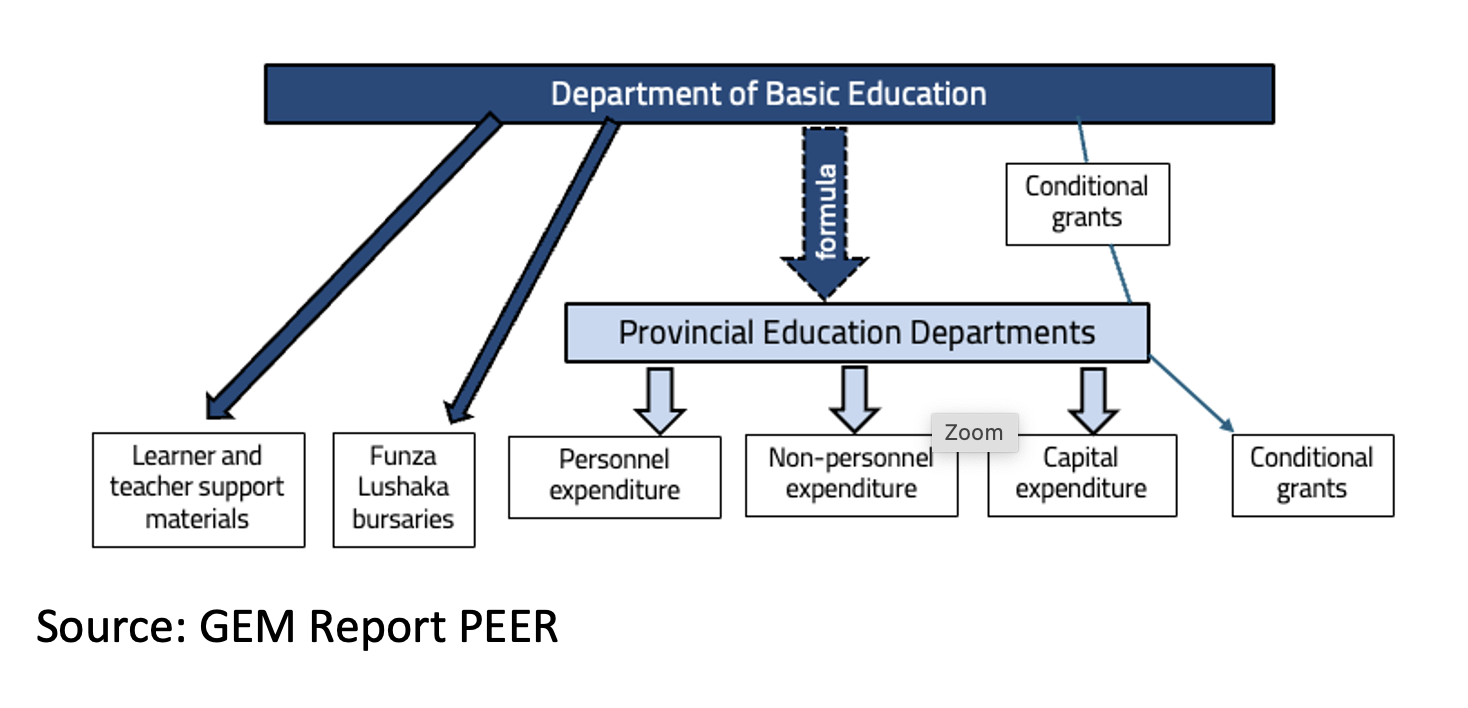
Education financing mechanisms are highly decentralised. The National Department of Basic Education (DBE) consumes only 2% of the overall resources, with just under half going to learner and teacher support materials directed at schools and Funza Lushaka bursaries for teachers. Most spending (97%) in the basic education sector is from the budgets of the 9 provincial education departments.
Transfers to Provinces and Local Government
Transfers are made through two main mechanisms. Equitable shares are unconditional transfers determined by formulas accounting for population size, poverty, and economic activity. The Provincial Equitable Share (PES), introduced in 1997/98, constitutes the main revenue source for provinces. Conditional grants are allocated for specific objectives or programmes and require provinces and municipalities to meet criteria when spending these funds.
Provincial Funding for Education
Basic education services are almost entirely provided by provincial governments, funded through the PES and DBE-administered conditional grants. Education forms the largest component of the PES formula (48% in 2023/24), with allocations based on the number of school-age children aged 5–17 and learners enrolled in Grades R–12 in public schools. The formula does not account for differences in rural and urban costs, the proportion of schools in poor quintiles, historical underfunding, or the relative burden of poverty, although there is a separate poverty component. Provinces determine their own allocation priorities for education relative to other sectors.
Conditional Grants
Conditional grants, administered through the DBE, supplement the PES and are earmarked for nationally prioritised programmes. The conditional grants in education include the education infrastructure grant (54%); national school nutrition programme grant (37%; see section 5); early childhood development grant (5%); maths, science and technology grant (2%); HIV & AIDS (life skills grant) (1%); and learners with profound intellectual disabilities grant (1%) (see section 2).
2. Education resources to schools
The Quintile System
Public schools receive per-learner funding based on the Quintile System, as defined in the National Norms and Standards for School Funding. Schools are categorised into five quintiles according to the socio-economic status of the communities they serve. Introduced in 1998 and restructured in 2005, the system guides provincial education departments in allocating non-personnel funds, including textbooks, stationery, laboratory equipment, school maintenance, IT and internet access, and essential services, as well as identifying schools that may not charge fees.
Schools in quintiles 1–3, serving low-income communities and representing around 74% of public school learners, are classified as ‘no-fee schools’ and receive a minimum per-learner allocation for non-personnel costs, known as the ‘no-fee threshold’. Quintile 4–5 schools, in more affluent areas, are fee-paying, with families contributing to school costs, though learners still bear costs for uniforms, stationery, and transportation.
Each year, provinces publish the list of no-fee and fee-paying schools in the provincial gazette. Funding allocations are determined using a resource targeting list, a table of school allocation targets, and a national poverty distribution table. In practice, an average of 73% of learners received their expected financial allocation in 2021, while in the Eastern Cape only 20% of learners received the expected allocation.
Learners with Profound Intellectual Disabilities Grant
The Learners with Profound Intellectual Disabilities Grant aims to provide support, resources, and equipment to care centres and schools serving children with severe to profound intellectual disabilities. The grant ensures that these learners have access to quality publicly funded education and appropriate support.
‘Profound intellectual disability’ is defined in the 2016 Policy for the Provision of Quality Education and Support for Children with Severe to Profound Intellectual Disability across three domains: the conceptual domain (conceptual skills), the social domain (very limited understanding of symbolic communication in speech or gesture), and the practical domain (dependent on others for all aspects of daily physical care, health, and safety).
3. Education resources to students and families
School Fee Exemptions
Education in South Africa is not free by law, and school fees are set annually by school governing bodies, with parents voting on the amount to be paid in schools not classified as no-fee schools. The South African Schools Act requires governing bodies to take reasonable measures to supplement state funding to improve education quality. Fee-paying schools rely on these fees as they receive limited funding for resources.
Families unable to pay school fees may apply for conditional, partial, or full exemptions. Since 2006, full exemptions are granted if school fees exceed 10% of the family’s combined annual gross income. Automatic exemptions apply to orphans in orphanages, child-headed households, learners whose parents receive the Child Support Grant, and learners under foster care. Partial exemptions are available when fees represent 3.5% to 10% of parental income, calculated using a standard formula.
Learners cannot be excluded from school due to non-payment of fees. Fee-paying schools are generally not compensated for admitting fee-exempt learners, though some provinces provide partial compensation. Non-paying learners are effectively subsidised by learners whose parents can afford to pay.
Introduced in 2007, South Africa’s No-Fee Schools Policy removes school fees for learners in the poorest 40 percent of public primary and secondary schools (Quintiles 1–3), based on community poverty levels. These schools receive a per-learner allocation from the education budget to cover operating costs, allowing them to stop charging families. The policy is fully domestically financed and directly reduces education expenses for low-income households.
4. Social policies and family support programmes
South Africa allocates approximately 15.4% of government spending to social assistance programmes, though none include a dedicated education component.
Child Support Grant (CSG)
The Child Support Grant (CSG), introduced in 1998 and administered by the South African Social Security Agency, provides ZAR 460 per month to children from poor households up to 18 years of age. While the grant does not have a specific education component, it has been associated with positive educational outcomes, including improved school attendance, completion rates, and learning achievements.
5. School meal programmes
National School Nutrition Programme
The National School Nutrition Programme, established in 1994, is South Africa’s second largest conditional grant in education and is managed by the Department of Basic Education. It provides daily nutritious meals to learners in poorer communities, supporting health, school attendance, and academic performance. The programme targets quintile 1–3 public primary and secondary schools, as well as selected special schools, in line with the Conditional Grant Framework.
Meals are provided in partnership with the Departments of Health, Agriculture, Land Reform and Rural Development, Trade and Industry, and the National Regulator for Compulsory Specifications. The programme follows the National School Nutrition Programme Food Specifications to maintain food safety and quality standards.
Provincial governments manage and finance the programme within their jurisdictions.
This profile has been reviewed by Dr. Martin Gustafsson, Stellenbosch University and Professor Rajkumar Mestry, University of Johannesburg.










