


Financing for equity in primary and secondary education
1. Education resources to subnational governments
2. Education resources to schools
3. Education resources to students and families
4. Social policies and family support programmes
Introduction
In Sudan, education management is shared across federal, state, and local levels of government. The decentralisation process has delegated responsibilities to sub-national governments. According to the Interim National Constitution of 2005 (Article 24-B), sub-national governments are obliged to provide social services, including education. The Constitution mandates that states are responsible for the provision and financing of secondary education, while localities manage basic education.
The Federal Ministry of Education oversees the sector, setting standards, developing curricula, and mobilising resources from both internal and external sources. However, provision of pre-school, basic, and secondary education is decentralized to the states. Consequently, states receive transfers from the federal government that are designed to correspond to the resources for education needs across states. Because of a strong dependence on federal transfers as well as the impact of federal policies on salaries and teacher employment, the fiscal autonomy of the states is limited. The assignment of education financing roles varies between states, reflecting differences in their capacity to raise revenue and implement policies.
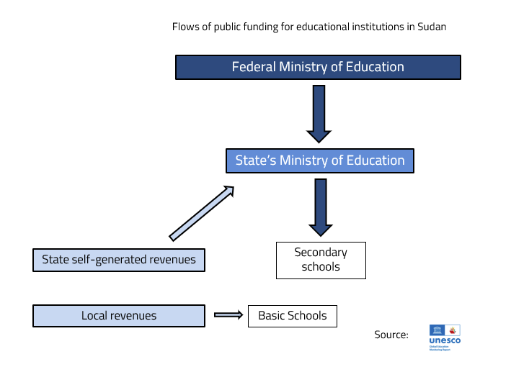
1. Education resources to subnational governments
In Sudan, financial resources for education are transferred from the federal government to the states through four main mechanisms. The first consists of current transfers, which are distributed according to a horizontal allocation formula developed by the Fiscal and Financial Allocation and Monitoring Commission (FFAMC). These are the main vertical transfer from the National Revenue Fund, allocated through the FFAMC’s formula. They are non-earmarked, assumed to finance recurrent costs like teacher salaries. This formula assigns weights to eight factors: population size and density, agricultural needs, security, education levels, health, financial performance, distance from the centre and the port, and revenue excluding transfers. The second mechanism is state development transfers, which are linked to the implementation of planned, ongoing, or completed development projects. Third, specified transfers are directed to particular institutions that receive direct federal support. Finally, special transfers are provided for defined programs.
These transfer mechanisms are based on the Wealth Sharing Protocol established under the 2005 Comprehensive Peace Agreement (CPA), which sought to reduce disparities in revenue generation among states. The current criteria, however, used to allocate education funds are allocated using criteria such as the student–population ratio, the teacher–student ratio, and the total number of students. While these indicators capture aspects of education demand and staffing, they do not take into account other equity dimensions, such as out-of-school children or differences in access by gender and by location between urban and rural areas.
2. Education resources to schools
The state government is responsible for the construction of secondary schools, while localities are responsible for the construction of preschool and basic education schools. State Ministries of Education and State Ministries of Finance are also responsible for the recruitment and transfer of teachers for secondary education. Although localities are responsible for the recruitment and transfer of teachers for basic education level, most states carry out this role, especially when localities have limited capacity.
The Federal Ministry of Education General Education Sector Strategic Plan 2018/19 – 2022/23 prioritises the construction of dormitories in selected basic schools to accommodate nomadic children.
However, no information was found regarding specific funding schemes that allocate resources to disadvantaged schools or those serving target groups.
3. Education resources to students and families
Conditional Grants to Poor Households for School Enrollment and Completion
The Federal Ministry of Education’s General Education Sector Strategic Plan 2018/19 – 2022/23 prioritises conditional grants to poor households to ensure children enroll and complete school. These grants support the purchase of school supplies and provide assistance to households with children engaged in child labour. They also address humanitarian commitments by supporting refugee host communities with facilities that promote integration. Grants are channelled through households, which must guarantee their children’s continuous school attendance.
4. Social policies and family support programmes
Sudan operates a Social Safety Net programme; however, this programme does not include an education component.
5. School meal programmes
The school feeding programme in Sudan was launched in 1969 with support from the World Food Programme (WFP). Implementation is managed by the State Ministries of Education, while funding is entirely provided by international donors. Targeting of school meals is based on geographic criteria, using a Vulnerability Assessment Mapping (VAM) approach. Additionally, nutritionists are engaged to support the programme’s nutritional objectives.










