
Financing for equity in primary and secondary education
1. Education resources to subnational governments
2. Education resources to schools
3. Education resources to students and families
4. Social policies and family support programmes
Introduction
In Libya, education financing is primarily managed by the Ministry of Education (MoE) and the Ministry of Finance, with the MoE responsible for planning, fund allocation, and oversight, and the Ministry of Finance providing funding through the national budget. While basic education remains largely centralized, local Education Oversight Offices (Muraqabat al-Ta’leem) handle operational school management at the municipal level.
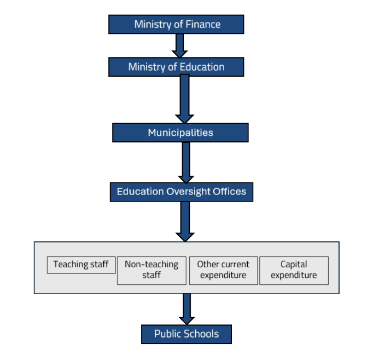
Funding flows top-down: the Ministry of Finance disburses funds to the MoE, which delegates financial authority to these local offices, often via financial advances (عهد مالية) to schools. The Education Oversight Offices coordinate with the MoE’s Administrative and Financial Affairs Department to receive and manage their allocated funds.
Source: PEER team
1. Education resources to subnational governments
Education funding is centralized: the Ministry of Finance allocates funds to the Ministry of Education, which then delegates budgets (تفويضات مصلحية) to municipal Education Oversight Offices (مراقبات التعليم). These offices receive financial advances (عهد مالية) to cover school expenses like supplies and maintenance. In the same context, the report recommends measures such as account freezes and investigations in cases of irregular spending from local education accounts, which reveals that the Education Oversight Offices act as the de facto executing and managing bodies for centrally transferred education funds at the municipal tier.
2. Education resources to schools
Resources are allocated to schools through Education Oversight Offices, which receive financial advances (عهد مالية) from the Ministry of Education via budget delegations (تفويضات مصلحية). These offices distribute funds to public schools based on factors such as operational needs, school size, and infrastructure conditions. While schools have some level of financial management, allocations are not currently based on a formal per-student or equity-driven funding formula.
The "No Difference" (La Faraq) Project
Launched in 2022 by the Ministry of Education in partnership with UNICEF, this national initiative supports the inclusion of children with special needs in general education. In its first phase, it targets 12 public schools across 6 education directorates, aiming to enhance school infrastructure, teacher training, and specialised services. Key activities include making facilities accessible for students with physical disabilities, creating Montessori rooms for those with learning difficulties, providing professional development on inclusive education, and exchanging knowledge with other Middle Eastern education ministries to share best practices.
3. Education resources to students and families
No information was found.
4. Social policies and family support programmes
Law No. 6 of 2021 on a Support Grant for Libyan families
Law No. 6 of 2021 in Libya establishes a monthly support grant for families with children under 18, prioritizing vulnerable and low-income households. Administered by the Ministry of Social Affairs using civil registry data, the programme aims to reduce financial burdens and promote social protection. However, the grant does not include any requirements or conditions related to schooling or educational participation.
5. School meal programmes
The World Food Programme (WFP) launched its school meals programme in 2019 in Libya and currently reaches over 43,000 schoolchildren with daily meals. This programme is coordinated with the Ministry of Education and aims to improve child nutrition, encourage school attendance, and support vulnerable populations impacted by conflict and crises.
A pilot government-run school meal programme is underway, while existing food provisions have been limited to small-scale distribution of snacks or fortified biscuits, mainly by humanitarian organizations like the World Food Programme (WFP). These efforts target vulnerable groups, including internally displaced children and students in food-insecure regions. International agencies primarily finance and implement these initiatives.