


Financing for equity in primary and secondary education
1. Education resources to subnational governments
2. Education resources to schools
3. Education resources to students and families
4. Social policies and family support programmes
Introduction
In Lebanon, the financing of public basic education is highly centralised and managed by the Ministry of Education and Higher Education (MEHE), with the Ministry of Finance (MoF) providing the approved national budget. MEHE prepares its budget in response to a national budget call circular issued by MoF and according to macro-fiscal guidelines. MEHE’s budget is consolidated with the budgets of other ministries into the national budget and reviewed by the Council of Ministers. MEHE is responsible for overseeing all aspects of education financing, including staff salaries, operational costs, infrastructure investments, and subsidies to affiliated bodies.
The flow of funds from MEHE to schools follows a top-down process. For salaries, MEHE prepares and submits payroll lists to the Ministry of Finance, which then disburses salaries directly to civil servants and contractual teachers. In-kind support, such as textbooks or materials, is either procured by MEHE or delivered through donor-funded programmes.
Operating funds intended for minor school expenditures are approved by MEHE and transferred to designated school accounts managed by School Fund Committees. These funds are not determined through a per-student financing formula and are not linked to performance, equity, or school improvement plans.
Education directorates, operating as regional administrative offices of the Ministry of Education and Higher Education (MEHE), serve primarily as intermediaries within the system. While they do not manage budgets or disburse funds, they are responsible for reviewing and endorsing school funding proposals, validating local needs—such as staffing and maintenance—and ensuring compliance with MEHE policies. Additionally, the directorates facilitate communication between schools and the central ministry, ensure compliance with regulations, and collect school-level data to inform financial and strategic planning.
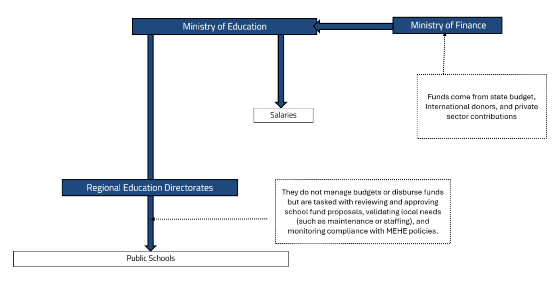
Source: PEER Team
1. Education resources to subnational governments
Education funding is fully centralized under the Ministry of Education and Higher Education (MEHE) with budget approval from the Ministry of Finance. MEHE retains full control over resource allocation without transferring budgets or financial authority to subnational governments. Regional education directorates function solely as administrative units, supporting communication and needs validation, but do not receive or manage funds independently. All financial resources flow directly from the central ministry before reaching local schools.
This centralised structure does not allow systematic fiscal transfers or redistribution of resources form central to subnational governments. Through administrative data collected and validated by regional education offices, the central ministry identifies areas with higher concentrations of vulnerabilities and subsequently directs additional resources to these locations.
2. Education resources to schools
School funding is centrally managed by MEHE, with salaries paid directly by the Ministry of Finance. Operational costs are allocated top-down to schools through School Fund Committees, without per-student or performance-based formulas. Major, centrally managed initiatves such as infrastructure rehabilitation, second-shift schooling, textbook provision, and contractual teacher deployment prioritise vulnerable school populations in accordance with national priorities.
Educational Development Project (EDP – 2005 to 2009)
Launched in 2005 by MEHE with World Bank funding, the project aimed to improve Lebanon’s public school sector, focusing on construction, equipment, and operation of schools in underserved and disadvantaged areas. By 2009, it achieved key goals including school infrastructure development, approval of a national education strategy, and internal ministry restructuring. While lacking an explicit equity funding formula, resources prioritized regions with inadequate educational infrastructure to support lower socio-economic and remote communities. The initiative also included a leadership development programme for public school principals to strengthen school management, indirectly benefiting disadvantaged schools by enhancing administrative capacity.
D-RASATI Project (2010 to 2015)
Launched in 2010 and funded by USAID, the Developing Rehabilitation Assistance to Schools and Teachers Improvement (D-RASATI) project, implemented by MEHE over five years, aimed to improve learning outcomes in Lebanon’s public schools, focusing on disadvantaged, underperforming, and underserved areas. Although it did not use a formal equity-based funding formula, school selection was based on geographic, infrastructural, and performance criteria. The project included teacher assessments and targeted training to improve English, science, and math instruction, especially for schools struggling with language proficiency. Additionally, the School Improvement Programme provided technical and training support to enhance institutional performance and school climate in eligible schools.
Second Educational Development Project
Launched in 2012 with World Bank support, Lebanon’s Second Education Development Project (EDP-II) aims to enhance the quality and governance of public schools, with a particular focus on disadvantaged and vulnerable populations. While it does not introduce a formal equity-based funding formula, EDP-II promotes equitable access by distributing free, updated textbooks to all public school students and providing ongoing leadership training for principals, particularly in underperforming schools.
Reaching All Children with Education (RACE II – 2016 to 2021)
Launched in 2013 and expanded through 2021, Lebanon’s Reaching All Children with Education (RACE) initiative, led by MEHE with international support, aimed to improve equitable access to formal education for Syrian refugee and disadvantaged Lebanese children. RACE II focused on scaling access via school shifts, rehabilitating infrastructure, hiring additional contractual teachers, and providing learning materials and psychosocial support within public schools. While targeting the urgent needs caused by the refugee crisis, the programme emphasized inclusiveness and system strengthening. Some components, such as the second-shift system and school-based supports, remain active under new funding coordinated by MEHE and international partners.
Multi-Year Resilience Programme (MYRP – 2022 to 2024)
The Multi-Year Resilience Programme (MYRP) was launched in 2022 with Education Cannot Wait and under the leadership of the Government of Lebanon. It aimed to address the complex education crisis affected by regional conflict and widespread poverty. The programme worked toward system-strengthening and advancing access to gender-responsive, inclusive, relevant, and quality education for children affected by crisis. MYRP has mobilized additional resources and civil society partnerships to scale implementation.
Since 2013, the Ministry of Education and Higher Education (MEHE), with support from UNHCR and other international partners, has implemented a second-shift system in public schools to accommodate Syrian refugee students through afternoon classes following the national curriculum. Funded by international donors, the programme provides textbooks, infrastructure improvements, and contractual teachers, with a focus on schools in areas with high refugee populations. As of 2025, the initiative continues in select public schools, supporting refugee and other vulnerable children who face barriers to accessing regular morning education.
3. Education resources to students and families
Cash Transfer Programme
Launched in February 2018 by MEHE and UNICEF, this programme provides vulnerable families with $20 monthly cash assistance per child enrolled in the second shift of public schools. The flexible cash support helps cover costs like transportation and school supplies. It is part of a broader education support package that includes school supplies, heating fuel, teacher training, and fee waivers, addressing barriers faced by Lebanese, Syrian, and Palestinian students. UNICEF and Caritas Lebanon closely monitor attendance and intervene when needed to ensure the programme’s effectiveness. The initiative targets Syrian refugee children with disabilities, those at risk of dropping out, living in remote or unsafe areas, and economically disadvantaged families, with eligibility based on vulnerability assessments and regular school attendance.
4. Social policies and family support programmes
The National Poverty Targeting Programme (NPTP)
Launched in 2011, Lebanon’s National Poverty Targeting Programme (NPTP) is the country’s only nationwide social safety net specifically for extremely poor Lebanese households. Administered by the Ministry of Social Affairs and the Prime Minister’s Office, the programme uses Proxy Means Testing (PMT)—a statistical method based on over forty socio-economic indicators—to assess eligibility objectively. Social workers at Social Development Centres collect data and verify applicants, who must submit official documents. Eligible families receive the "Hayat Card," which provides free access to public education and healthcare, helping children attend school without fees or related costs.
In early 2020, UNICEF introduced a complementary cash assistance programme to address Lebanon’s economic crisis. This initiative, implemented alongside the NPTP and partners including MoSA and WFP, provides cash support based on the number of children per household. It aims to help families keep their children in school and avoid harmful coping strategies such as child labour or dropout. While initially an emergency response, the programme aligns with the long-term goals of the NPTP to support vulnerable families.
Lebanon Emergency Crisis and COVID 19 Response Social Safety Net (ESSN)
The Lebanon Emergency Crisis and COVID 19 Response Social Safety Net Project (ESSN) was launched in 2021 with World Bank financing. It was an attempt to scale up the Government of Lebanon’s NPTP programme and aimed to improve access to social services for vulnerable families affected by compounding economic and COVID crises. The programme combatted school dropout through top-up cash transfers to at-risk students ages 13-18 that cover the costs of general and vocational education, including supplies, transportation, and school fees.
5. School meal programmes
The main school feeding initiative is run by the World Food Programme (WFP) in coordination with the Ministry of Education and Higher Education (MEHE). Launched in 2016, the programme provides nutritious snacks—not full meals—to selected schools based on need. Schools are chosen using criteria like geographic vulnerability, student population, and whether they run double shifts, which often indicate higher demand and disadvantaged communities. All students in these schools, regardless of nationality, receive the snacks.
The programme is fully donor-funded, with Italy as a major contributor, and is overseen by nutrition specialists to ensure the snacks are balanced and support children’s dietary needs. While not universal or targeting individual children, the initiative focuses on vulnerable areas, including both Lebanese and Syrian students. WFP works with technical partners to maintain quality and meet nutritional standards within the scope of a snack programme.
In 2023, the Government of Lebanon joined the global School Meals Coalition as a step toward developing a national school meals policy and programme.
This profile was reviewed by the Permanent Delegation of Lebanon to UNESCO.










