
Financing for equity in primary and secondary education
1. Education resources to subnational governments
2. Education resources to schools
3. Education resources to students and families
4. Social policies and family support programmes
Introduction
Albania’s pre-university education system consists of 15 years of schooling from pre-school through primary, lower secondary, and upper secondary school. The public education system is funded primarily through central funds, with additional contributions from local funds and smaller contributions in the form of donations, sponsorships and revenues generated by educational institutions.
Responsibility for pre-university education lies with the Ministry of Education, which sets national education policy, curriculum standards, strategic priorities, and quality assurance mechanisms. The ministry coordinates implementation of education policy across the country through its subordinate bodies, including the National Agency for Pre-University Education (AKAP) and the Regional Pre-University Education Directorates (DRAP), which manage local education offices and support schools.
Under the current government, pre-school education has administrative responsibility at the Local Government Unit (LGU) level as part of the country’s ongoing decentralization reforms. LGUs are responsible for provision and management of pre-school services, using funds allocated by the central government along with locally sourced revenues. LGUs are responsible for capital investments (such as school buildings, renovations, and infrastructure) and for financing non-teaching staff using their own budgetary resources alongside central transfers.
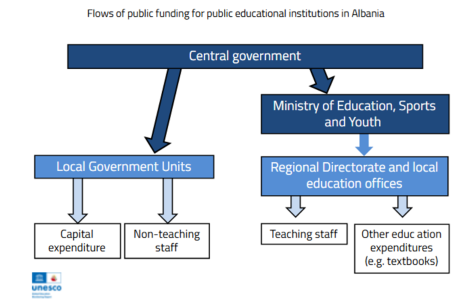
Schools receive no discretionary funding from central or local levels. However, all schools were granted approval to open bank accounts in 2018 to manage the funds they can raise from parents and private donors.
Equitable programmes targeting vulnerable children accounted for 7.1% of the education budget in 2019.
1. Education resources to subnational governments
There are two main ways in which education financing flows from the central level to local levels.
-
The Ministry of Education, Youth, and Sports distributes funds to regional directorate and local education office budget accounts to cover most educational services such as teacher salaries and operational costs. Capital expenditures are typically the responsibility of Local Government Units (LGUs), not the Ministry. There is currently no formal per-student funding formula guiding the allocation of funds by the Ministry of Education, Youth, and Sports to regional or local education offices, despite the framework provided by the Law on Local Self-Government Finance (2017) and the ongoing decentralization reforms. Regional directorates/local education offices choose how to allocate funds among the schools they manage. The main education directorate produces a karta e performancës (“performance card”), which collects data and ranks schools based on a series of indicators such as the school’s drop out rate. These indicators may inform decisions on how to allocate funding.
-
The central government directly distributes funds to Local government units (LGUs) which are responsible for functions related to construction, infrastructure, maintenance and utilities. These unconditional transfers are designed to help close the gap between LGU’s independently generated revenue and the cost of exercising their functions. It is also weighted based on the number of students in each level of education and the level of income in the LGU. LGUs can also apply for competitive government grants and utilize funds derived locally. LGUs choose how to allocate these funds. However, in practice, regional and local education offices often allocate funds to schools without transparent criteria, leading to variability in resource distribution and potential inequities across schools.
There is no funding mechanism for transferring funds to local governments that take equity into consideration.
2. Education resources to schools
Pre-university education schools are primarily funded through direct transfers from the state budget, which are managed by the Ministry of Education, with Local Education Offices (ZVA) and the Regional Directorates of Pre-University Education (DRAP) operate as subordinate institutions without independent budgetary autonomy. Funding from the state budget is planned on a ‘per student’ formula based on education levels and the education institution’s condition.
The funding formula is based on:
- The current number of students, according to the Pre-University Education Management Information System (SMIP).
- The personnel funding needs, calculated based on the approved staffing levels for each Local Education Office.
- Funds for teaching activities, covering the operational costs of schools.
- Transportation for students from rural areas.
- Student scholarships, allocated according to Decision of the Council of Ministers (DCM) 666/2019.
The Ministry of Education may also finance projects for school reconstruction, prioritizing schools based on the number of students/teachers, the physical condition of the school, the quality of the project submitted by the Local Government Unit, the need for intervention in educational facilities, and the expected impact on the community.
The LGUs are responsible for the continuous improvements or capital expenditures of educational institutions. This division of responsibilities often leads to coordination challenges between LGUs and the Ministry of Education, Youth, and Sports.
School Development Grants
The School Development Grants programme operated in Albania from 2015-2021 and served as a targeted financing mechanism aimed at supporting quality improvements in schools, particularly in disadvantaged and rural areas. These grants were implemented under the framework of the Albania Education Excellence and Equity Project (EEE-P) and the Education Reform Project, both supported by the World Bank and executed by the Ministry of Education, Sports and Youth (MASR). Schools receiving grants were required to prepare School Development Plans aligned with national quality standards, focusing on enhancing teaching quality, student learning conditions, and school governance. The program aimed to increase school autonomy, encourage strategic planning at the school level, and reduce disparities in learning conditions across regions.
Schools who meet the criteria can receive ALL 855,500-1,426,100 (USD 9,000-15,000) or ALL 950,600 (USD 10,000) depending on competition. The programme lasted from 2015-2021 and delivered grants to a total of 240 schools.
3. Education resources to students and families
The Ministry of Education, Youth, and Sports (MoEYS) provides scholarships and payments for qualifying students in pre-university education institutions. According to the 2019 Decision No. 666, scholarships may be provided to students who live rural areas and meet the economic criterion, children of families in need who are enrolled in basic education but do not attend, orphaned students, disabled students, students who are victims of human trafficking, and students with single parents. Additionally, Roma and Egyptian minority students in secondary vocational education qualify for support. Female students who follow specific study programmes such as mechanics may also qualify.
The economic criterion depends on the number of family members and is as follows:
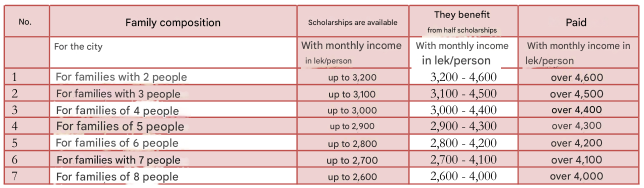
The list of qualifying students in each school is prepared by the Local Government Units (LGUs), and other relevant ministries. The majority of these students’ scholarships are covered by the MoEYS, who drafts a plan for the distribution of scholarships and sends it to the LGUs. LGUs distribute the scholarships and report back to the MoEYS. Students who qualify for the scholarship by economic hardship receive ALL 7,055 per month (USD 74). Orphaned students receive ALL 17,617 (USD 185) to cover food, clothing, and other educational needs.
Furthermore, many of these students receive additional in-kind aid such as clothing, books, and notebooks to reduce barriers to educational participation. The Ministry of Education covers 100% of the textbook costs for students in grades 1-5, the textbook costs every three years for students in grades 6–9, and for certain protected categories in grades X–XII. The Ministry of Education also provides support to students who travel more than 2 km, fully financing their transportation. In 2019, the government spent ALL 230 million (USD 2.4 million) in scholarships and ALL 8 million (USD 84,100) in providing free textbooks.
The 2021-2025 National Action Plan for Equality, Inclusion, and Participation of Roma and Egyptians in the Republic of Albania includes multiple forms of support for students including free tuition, scholarships, transportation to schools, subsidies, and textbooks.
4. Social policies and family support programmes
The main cash assistance scheme in Albania is the Ndihma Ekonomike (NE) programme, regulated by Law No. 57/2019. The programme provides full or partial financial aid, and from 2019 uses a unified scoring formula that assesses household income, assets, and other vulnerability factors. Beneficiaries include families in need with no or insufficient income, orphans outside residential care, parents with multiple children born at the same time, victims of trafficking, domestic violence under a protection order, and other vulnerable groups. As additional supplements the new programme provides an education top-up (ALL 300–500 (USD 3-5) per child per month during the school year) for children who attend and progress in compulsory education.
To benefit, families with children must provide a certificate of school attendance and a certificate of academic progression, while compliance with vaccination schedules may also be required. Finally, a novelty with the new law is the inclusion of a one-off payment for newborns, ALL 40,000 for the first child, ALL 80,000 for the second child, and ALL 120,000 for the third child.
In 2022, the NE programme covered 64.000 families, or 226,530 individuals, equivalent to 9% of the population. In addition, 4.348 families benefitted from the 6% local government fund. According to the Albanian Statistical Institute (INSTAT), in 2020 the programme reached 37% of households in the poorest income decile and 25.8% of those in the lowest income quintile, with 45.2% of total NE spending going to the poorest decile and 61.5% to the poorest quintile.
A significant share of low-income households remained outside its coverage (more than 63% in the poorest decile), and only 3% of the population was lifted out of poverty through social transfers, including NE. These figures indicate that its overall impact on reducing poverty risk remains limited.
5. School meal programmes
According to the 2019 Decision No. 666, students and teachers of special education institutions are provided a daily lunch of up to ALL 150 (USD 1.5) per day. Students of pre-university education, who reside in rural areas that do not have a 9-year school within a radius of 5 km and who are accommodated in public dormitories, are granted a scholarship in the form of a food quota. School lunches are also provided to children from poor or vulnerable families.
As of February 2025, the prime minister has announced plans to provide free lunch for all students in the nine-year schools in Tirana from September 2025. The initiative also aims to extend to the school day to support working parents.
This profile was reviewed by Dr. Eglantina Hysa, Full Professor in Development Economics and Enkelejda Havari, Associate Professor of Economics at IESEG School of Management, Paris Campus, and by the Albanian Ministry of Education.