


Financing for equity in primary and secondary education
1. Education resources to subnational governments
2. Education resources to schools
3. Education resources to students and families
4. Social policies and family support programmes
Introduction
In Peru, public funding for basic education is primarily provided by the national government through the Ministry of Education (MINEDU). At MINEDU, the Office of Strategic Planning and Budgeting negotiates the sector's budget with MINEDU directors and MEF. At the regional level, the governor, supported by the Social Development Management Office, negotiates the education budget. MINEDU is responsible for funding educational innovations, with Strategic Programs managed at regional and local levels. Most resources are allocated at the national level before being transferred to regional governments.
The MINEDU comprises two deputy ministries (VGP). The General Directorate of Regular Basic Education is organized by levels (preschool, primary, and secondary, along with physical education and sports), while the General Directorate of Alternative Basic Education, Intercultural Bilingual Education, and Rural Educational Services (DIGEIBIRA) oversees rural education.
Under DIGEIBIRA, the Directorate of Intercultural Bilingual Education (DEIB) manages bilingual schools at the preschool and primary levels; the Directorate of Rural Educational Services (DISER) oversees multigrade primary schools and alternative secondary education models; and the Directorate of Alternative Basic Education (DEBA) is responsible for Alternative Basic Education Centers (CEBA).
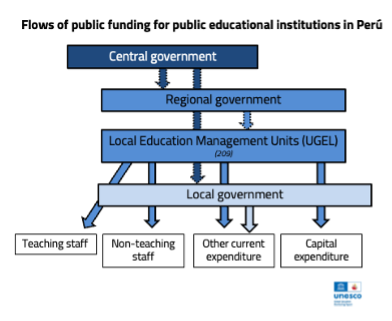
Regional governments receive the bulk of central transfers and manage the distribution of funds to schools within their territories. Allocations are guided by benchmarks such as class size, enrolment rates, and infrastructure needs. Regions oversee financial flows to ensure resources reach schools efficiently and according to national standards.
Local education management units, operating under regional governments, distribute resources directly to schools and supervise their implementation. Municipal governments also contribute through local funds such as FONCOMUN, which target development priorities based on poverty levels, rurality, and community needs.
1. Education resources to subnational governments
The 2002 Constitutional Reform and the Ley de Bases de Descentralización strengthened the transfer of responsibilities from the central to regional and local governments. The 2003 General Education Law further advanced this process by defining the functions of each level of government. Under this framework, regional governments assumed primary responsibility for education management, while local governments took on an articulating role.
The law established Local Education Management Units (UGELs) as regional management bodies within the Regional Directorates of Education (DREs). These units are responsible for ensuring the provision of educational services, providing technical and administrative support to local educational centres, disbursing teachers’ salaries, and supplying educational materials. Regional Education Directorates promote and evaluate educational development in coordination with the UGELs.
Resource Transfer and Funding Mechanisms
The central government, through the Ministry of Education and, in some cases, the Ministry of Economy and Finance, transfers resources to implementing units to ensure the system’s operation. In specific cases, the Ministry of Education allocates funds directly to schools for designated purposes, such as the maintenance of school facilities. Funding generally occurs in two phases: from the central government to regional governments, which oversee and manage the UGELs, and then from UGELs to educational centres to cover salaries and other expenses.
The Ministry of Finance is progressively implementing a results-based budgeting model to enhance territorial relevance and equity. At present, budget allocations continue to rely on historical expenditure to determine funding levels for the following year.
2. Education resources to schools
Strategic Programmes, or special programmes operated by MINEDU, constitute parallel lines of work. These programmes constitute MINEDU's working routes with the DRE and UGEL, parallel to the GORE.
Programa Presupuestal 090 Logros de Aprendizaje De Los Estudiantes De Educación Básica Regular – PELA (Budgetary Program 090 Learning Achievement of Students in Regular Basic Education)
The PELA is a nationwide initiative led by the Ministry of Education in coordination with the Office of Strategic Planning and Budgeting (OPEP) and the Office of Monitoring and Strategic Evaluation (OSEE), implemented regionally. The programme focuses on the efficient use of public budgets to enhance learning in public educational institutions, prioritising communication and mathematics.
PELA aims to improve coverage and performance for children aged three to five, enhance education quality in the first and second grades, and strengthen secondary school students’ skills. This is achieved through teacher training, pedagogical support, educational materials, and feedback on evaluations. The programme targets students from public educational institutions or programmes from the second to the seventh cycle of Regular Basic Education whose learning achievements are low. The programme also seeks to upgrade infrastructure for kindergartens and schools and to enhance results-oriented educational management.
3. Education resources to students and families
PéruEduca (Péru Educates)
PéruEduca is a digital programme established in 2001 and incorporated into the Plan de Cierre de Brecha Digitalthrough Ministerial Resolution No. 438-2022. Its objectives are to bridge the digital divide, ensure equal access to technology, enhance digital skills for learning, promote inclusion and equity, and encourage educational innovation.
The programme provides Digital Educational Resources for kindergarten, primary, secondary, rural, intercultural bilingual, and alternative basic education. Some resources are limited to students in the third, fourth, and fifth grades of secondary school and the fourth grade of EBA from public and private schools. Resources are organised by educational level and adapted to the socio-cultural context of students in urban and rural (Amazonian and Andean) areas. These include platforms for virtual courses, training programmes, communities, digital educational materials, websites, and tools. Plans exist for portable content for offline use and resources tailored for students and teachers to enhance learning experiences based on their context.
4. Social policies and family support programmes
JUNTOS, the National Programme of Direct Support to the Poorest, is a conditional cash transfer programme implemented by the Ministry of Development and Social Inclusion. Its pilot phase began in September 2005 in Chuschi, Ayacucho, covering 70 districts in the poorest areas. By 2006, the programme expanded to 320 districts across nine departments. By December 2007, it reached 14 departments, and by December 2008 it served 638 districts, with 96% of households led by women. By the end of 2016, JUNTOS operated in 1,290 districts, equivalent to 68.8% of districts nationwide.
Eligibility requires households to reside in a district with a poverty rate above 40% and be classified as poor by the Household Targeting System (SISFOH). Households must have at least one target member, such as a pregnant woman, child, or adolescent up to the completion of secondary education or age 19, whichever comes first. Once enrolled, households receive an initial membership payment, after which target members must meet commitments related to health, nutrition, education, and citizen development, monitored quarterly. In education, children aged six to 14 must maintain at least 85% school attendance.
5. School meal programmes
Wasi Mikuna
Wasi Mikuna, formerly the Qali Warma National School Feeding Programme (PNAEQW) established by Supreme Decree No. 008-2012-MIDIS on 31 May 2012, is a Social Programme of the Ministry of Development and Social Inclusion. The new Wasi Mikuna Community School Feeding Model replaces Qali Warma and involves parents in its board of directors alongside representatives from five ministries: Development and Social Inclusion, Education, Health, Agricultural Production and Development, and Irrigation. The service covers early childhood through secondary education in indigenous Amazonian communities under various modalities.
The programme aims to provide a progressive, sustainable, and healthy food service for public school students through participatory management. Parental inclusion strengthens participation in strategic decisions, enhancing the quality of the food service. Management is further supported by the collaboration of parents and School Food Committees (CAE) to ensure transparency and effectiveness.
Wasi Mikuna follows national nutritional guidelines and technical specifications established under Qali Warma, with oversight by nutritionists and food specialists. The system ensures that school meals are nutritionally adequate, regularly monitored and adapted to local cultural and dietary contexts.
This profile was reviewed by Ricardo Cuenca, PhD, Professor and Senior Researcher at Universidad Nacional Mayor de San Marcos.










