


Financing for equity in primary and secondary education
1. Education resources to subnational governments
2. Education resources to schools
3. Education resources to students and families
4. Social policies and family support programmes
Introduction
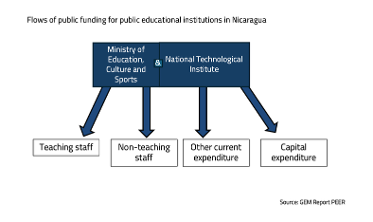
In Nicaragua, Law No. 582 of 2006 centralises education organization, administration, and financing under the Ministry of Education, Culture and Sports and the National Technological Institute. These bodies manage and fund public education, directly financing schools and paying teachers’ salaries in subsidised centres. Public primary and secondary schools are prohibited from charging fees or accepting voluntary contributions. The law requires the non-higher education budget to increase by 20% of national tax revenue to expand access, improve infrastructure, and raise staff salaries.
The Regional Autonomous Education Subsystem (SEAR) in the autonomous regions of the Caribbean Coast organises education for the holistic development of indigenous peoples, people of African descent and ethnic communities. It is based on principles such as autonomy, interculturalism, quality and equity; it upholds regional values and promotes sustainable development, gender equality and the rights of children and young people.
1. Education resources to subnational governments
The education system is centralised and a majority of spending is financed directly from the Ministry of Education to schools. Although a small portion and not possible to breakdown the amount, the Ley 466 created the intergovernmental transfer which is a general municipal transfer. It is paid by central government to municipalities. It prioritises municipalities with lower revenue capacity, municipalities may use the funds for a variety of functions (including education projects).
In parallel with the basic education system, the Regional Autonomous Education Subsystem (SEAR) is a decentralised education system based on the principles of autonomy, interculturalism, quality, and equity for indigenous people and people of African descent, and forms part of the national education system. Due to its regional nature, the SEAR is managed in a decentralised manner in coordination with the Caribbean's autonomous regional governments. This entails regional governments planning and implementing education spending, with financial responsibility shared between central and regional levels.
2. Education resources to schools
Since 2007, the Ministry of Education has ended direct fund transfers to schools, shifting from a decentralised to a centralised financial management system to improve resource administration, as outlined in the Strategic Education Plan 2011–2015.
Education Sector Support Project (PASEN II)
In 2012, Nicaragua’s Ministry of Education and the World Bank launched PASEN II to improve primary school retention and education management in disadvantaged areas. This built on the PASEN I project of 2004 – 2011, funded by USD 15m concessional loan and USD 0.7m government component. Resources were allocated based on enrollment, location, and vulnerability, with centralised oversight. The project provided bilingual and multigrade materials, furniture, and infrastructure support, focusing on the North Atlantic Autonomous Region (RAAN) and South Atlantic Autonomous Region (RAAS), home to most indigenous people. Over 2,000 multigrade teachers received training and support, with their salaries covered by the Ministry after certification. The project ended in 2017.
3. Education resources to students and families
Solidarity Packages Programme within PASEN II Project
The Solidarity Packages Programme, part of the PASEN II Project (2012–2016), aimed to boost student retention in disadvantaged rural areas by distributing around 50,000 packages. Each package included a backpack, school supplies, and shoes for eligible children selected based on geographic, socio-economic, and educational vulnerability, focusing on early primary grades with high dropout and repetition rates. In 10 municipalities linked to the World Bank’s Social Protection Project, household-level targeting using vulnerability indicators was applied. The project concluded in 2016.
This programme supplies notebooks, pencils, rulers, erasers, sharpeners, coloured pencils, and backpacks to low-income families in rural communities. In 2019, it planned to distribute 755,200 packages—covering 34% of the school-age population—with an estimated cost of USD 8.3 million (NIO 276.6 million).
Bono Presidencial Escolar (Presidential School Bonus)
In 2025, the Ministry of Education launched the Bono Presidencial Escolar to support vulnerable families with children in pre-primary, first and second grades of primary education and all students from special education. It provides a one-time conditional cash transfer of C$2,000 to help cover back-to-school costs like uniforms, supplies, shoes, and backpacks.
4. Social policies and family support programmes
Red de Protección Social (RPS)
The Red de Protección Social (RPS) was a conditional cash transfer programme run by the Ministry of the Family (MIFAMILIA) from 2000 to 2006. Funded mainly by the Inter-American Development Bank, with support from the World Bank and the Central American Bank for Economic Integration, RPS had three parts: an education grant of US$15 every two months per child aged 7–13 plus US$25 annually for school supplies; a food security grant of US$42 every three months; and a health grant of up to US$90 per year per family. Transfers were made to female heads of households and required school enrolment, attendance, and health check-ups. Eligibility used geographic and household targeting, with proxy means testing in less poor areas.
5. School meal programmes
The Comprehensive School Nutrition Programme (PINE), created in 2007 by Nicaragua’s Ministry of Education, aims to improve the education, nutrition, and food culture of children and youth in public and subsidised schools. It includes the School Snack Programme (Merienda Escolar), which provides a daily meal covering 30% of students’ energy needs to support retention, attention, learning, and community involvement. The programme also promotes School Gardens, where students grow fruits, vegetables, and medicinal plants using eco-friendly methods to encourage dietary diversity and agroecological education. Additionally, School Kiosks and Canteens offer safe, healthy food, emphasizing the use of local produce and fostering values of nutrition, hygiene, and cultural food practices. Food and Nutrition Security Education is integrated into the curriculum to teach students about food security, community opportunities, and the importance of preserving traditional food culture. Nicaragua does not have specific laws or national nutritional guidelines for school feeding.










