


Financing for equity in primary and secondary education
1. Education resources to subnational governments
2. Education resources to schools
3. Education resources to students and families
4. Social policies and family support programmes
Introduction
In Cuba, the Ministry of Education centrally manages national policies and budgets within a unitary government system. Its central office sets curricula, defines institution types, approves legal and methodological standards, oversees teacher training, encourages family and community involvement, and controls the opening or closing of schools.
Provincial directorates supervise educational services (excluding higher education) in their regions, reporting methodologically to the Ministry and administratively to provincial assemblies. Municipal directorates perform similar roles locally, accountable to provincial and municipal authorities.
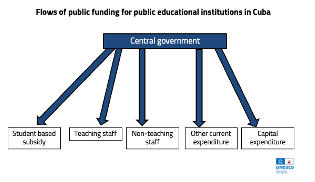
Education funding and programmes are fully administered by the Ministry, which allocates resources directly to schools. Law 157 of 2023 mandates prioritizing social programmes in the state budget, directing municipal funds toward community development, housing solutions, and focused support for vulnerable groups, with active citizen participation in decision-making.
1. Education resources to subnational governments
No information was found regarding the existence of a funding mechanism for transferring funds from the central government to local governments.
2. Education resources to schools
Although Law 157 emphasises prioritising vulnerable populations in state funding, information on equity in resource allocation remains limited.
Special Education
Since 1959, special schools in Cuba’s Special Education system have followed the basic General Education curriculum, serving primarily as transitional centres that support students’ comprehensive development and integration into mainstream education. These schools offer personalised, differentiated instruction and promote active student participation, while fostering collaboration with families and communities to enhance learning outcomes. Tailoring education to students’ needs involves improving learning conditions, teaching methods, and school organization through coordinated efforts among students, educators, families, and community groups. Additionally, hospital and outpatient educational care provide classroom, bedside, or home instruction to children with long-term or chronic illnesses, ensuring educational continuity and supporting their quality of life despite health challenges.
3. Education resources to students and families
Hogares de Menores sin Amparo Familiar (Homes for Children without Foster Care)
In 1984, Decree Law 76 created a national network of social assistance centres in Cuba to house minors without family protection, providing family-like living conditions. The Cuban educational system prioritizes their well-being, supporting 33 homes for children aged 6 to 18 who continue their education within the National Education System. Children are admitted due to orphanage, abandonment, parental imprisonment, or medical conditions such as psychiatric illness or parental alcoholism. Upon turning 18, local authorities help them find housing or integrate into the workforce. While in these homes, minors receive medical and educational care, lodging, food, clothing, school uniforms, footwear, and a stipend for personal expenses, all supplied by the Ministry of Education.
4. Social policies and family support programmes
Prestaciones sociales (Social Assistance Regime)
Cuba's Social Assistance regime, established in 1979, provides support to workers and families who do not qualify for social security pensions or receive inadequate subsidies, especially those affected by illness, disability, or work-related conditions. Benefits are initially granted for up to one year but can be extended if needs are permanent, with amounts varying based on household dependents and whether the primary earner completed General Military Service. The policy also promotes the reintegration of young people and pregnant teenagers in education, facilitating their return to school while ensuring maternity benefits for a designated working family member caring for the child during their absence.
5. School meal programmes
Programa de Alimentación Escolar (School Feeding Programme)
In Cuba, school meals are constitutionally recognised as part of the right to food, ensuring all children receive at least one nutritious daily meal to support learning, local food system transformation, and gender equality. Universal school feeding programmes operate at preschool and primary levels, while Resolution 143/2020 regulates school snacks in secondary education, offering daily menus approved by the Ministry of Commerce. In 2021, the Ministry of Education promoted a healthy eating day and introduced behaviour change initiatives to boost nutritional awareness and local food procurement. Cuba’s Food Sovereignty and Nutrition Education Plan (SAN Plan), approved in 2020, fosters a healthy food culture through education and stakeholder collaboration. That year, MINED’s Resolution 67 reinforced the School Feeding Plan, engaging students, families, and communities in nutrition education, with ongoing support from FAO and the World Food Programme.










