


Financing for equity in primary and secondary education
1. Education resources to subnational governments
2. Education resources to schools
3. Education resources to students and families
4. Social policies and family support programmes
Introduction
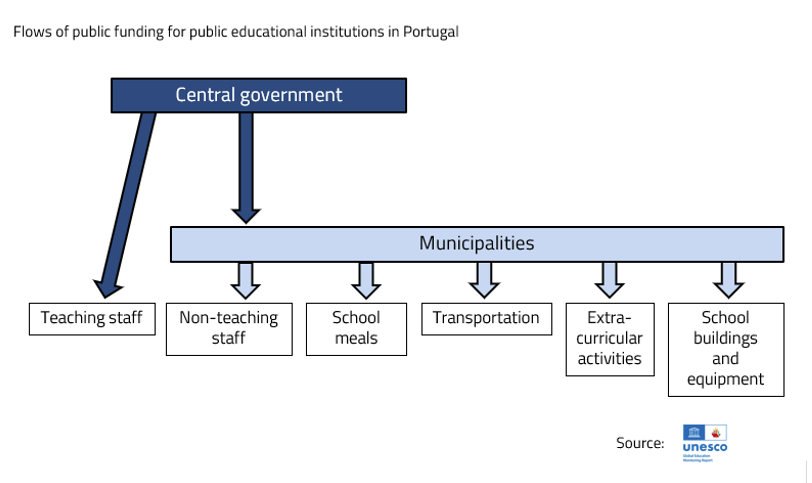
In Portugal, the Ministry of Education, Science and Innovation is responsible for allocating and overseeing education budgets. The central government manages responsibilities for basic education, while municipalities handle the salaries of non-teaching staff, food provision, transportation—particularly in rural areas—extra-curricular activities for pre-primary and primary education, and the maintenance and equipment of school buildings.
The education budget is calculated and managed centrally, then distributed through various funding channels. The Ministry of Education, Science and Innovation oversees the payment of teachers’ salaries and transfers an annual budget allocation to each school. Municipalities also receive funds to allocate to schools, reflecting their growing responsibilities under the decentralisation process. These responsibilities include managing non-teaching staff, school meals, transportation, extra-curricular activities, and building maintenance.
Under the Political-Administrative Statute of the Autonomous Region of the Azores, established by Law No. 39/80 and subsequent revisions, education—including preschool, school, and extracurricular activities—is an exclusive competence of the region, allowing it to legislate and manage the sector independently. The Autonomous Regions of the Azores and Madeira finance their educational services and establishments using their own resources or through budgetary transfers from the State.
1. Education resources to subnational governments
Fund for Financing Decentralisation
The main mechanism for transferring funds from the central government to the local level in Portugal is the Fund for Financing Decentralisation (Fundo de Financiamento da Descentralização), which includes a specific sector dedicated to education. According to Law No. 21/2019, municipalities must ensure “territorial equity and inter-municipal and inter-regional solidarity in the planning of education and training offers and in the allocation of public resources, within the framework of correcting local and regional inequalities and asymmetries.”
Previous Funding Arrangements
Before the establishment of the Fund for Financing Decentralisation, Portugal’s mechanisms for transferring education funds from the central to the local level were more centralised and did not explicitly promote equity through decentralisation.
2. Education resources to schools
Priority Intervention Educational Territories Programme (TEIP)
The Territórios Educativos de Intervenção Prioritária (TEIP) is a national programme managed by the Directorate-General of Education, launched in 1996. It has been implemented through four phases: TEIP1 (1996–2005), TEIP2 (2006–2011), TEIP3 (2012–2021), and TEIP4 (from 2024 onwards).
Within this framework, participating schools receive an increase in allocated hours, which expands their financial capacity to hire additional human resources, including teaching and non-teaching staff such as psychologists, mediators, and social workers. Schools have autonomy to recruit the necessary staff to implement the strategic actions outlined in their action plans. These additional funds also support the monitoring and evaluation of the plans, in collaboration with higher education institutions, and enable diversification of educational provision.
To qualify for the programme, schools must be located in territories with a high concentration of children and young people at risk of social vulnerability. This condition is determined regionally based on data from the Directorate-General for Education and Science Statistics, using three social indicators: the percentage of students benefiting from the school social action scheme, the percentage of students whose mothers have an education level below the 12th grade, and the percentage of migrant students.
Inclusive Education
Decree-Law No. 54/2018, amended by Law No. 116/2019, reinforced Portugal’s commitment to inclusive education. It embraces a broad concept of inclusion, ensuring that all students can access the curriculum without being categorised according to special needs. Learners with such needs are integrated into mainstream classrooms and learn alongside their peers.
Funding for inclusive education is organised into three categories: universal support measures (general funding), selective support measures (targeted funding), and additional support measures (individualised funding). The latter focuses on students requiring intensive assistance and is often linked to special educational needs, as it involves specialised and personalised support.
The Ministry of Education, Science and Innovation dedicates substantial resources to special education through three main channels: financing private special education institutions, associations, cooperatives, and social solidarity organisations; covering salaries for special needs teachers; and supporting the Resource Centres for Inclusion (CRIs).
The Resource Centres for Inclusion are staffed by specialised professionals who provide targeted services and develop resources that promote the effective inclusion of students with special needs.
3. Education resources to students and families
School Social Assistance (Ação Social Escolar – ASE)
The School Social Assistance (Ação Social Escolar – ASE) was established in 1971 to prevent social exclusion and reduce school dropout. It provides support to families according to income brackets, offering free or subsidised school meals, textbooks, and study trip costs for students in brackets A and B. In 2022, bracket A included families earning less than EUR 3,071 per year, while bracket B covered those earning less than EUR 6,143 per year.
Income thresholds are determined by the Social Support Index (Indexante de Apoios Sociais – IAS), which was initially linked to the national minimum wage but has since been revised to reflect changes in GDP and inflation. Household income is assessed on a per capita basis, considering the number of children in the household, and classified into three levels: A, B, and C.
4. Social policies and family support programmes
Family Allowance (Abono de Família)
The Family Allowance (Abono de Família) is a monthly cash transfer designed to offset family expenses related to the living and educational costs of children and young people. It is available to households whose income falls below a defined maximum limit. Families with young people aged 16 to 24 must provide proof of school or university enrolment to receive the allowance. The programme is overseen by Social Security (Segurança Social), under the Ministry of Work, Solidarity and Social Security.
Family allowance levels 1, 2, and 3 correspond to ASE categories A, B, and C, respectively and provide financial support. Level 4 is eligible for support only until the child reaches six years of age (72 months), while level 5 is not entitled to any assistance. Decree-Law No. 56/2022 revised the eligibility criteria and extended coverage to foreign minors not born in Portuguese territory.
Children and young people are entitled to the family allowance until the age of 16, with eligibility extended to 24 for students or those with disabilities. Students in categories A and B receive additional benefits, including support for schoolbooks and study trips. Merit scholarships are also available under the ASE framework in accordance with Decree-Law No. 55/2009.
5. School meal programmes
School Canteens (Cantinas Escolares)
School canteens are available to all students from primary to secondary education nationwide. Order 13914/2022 establishes how financial transfers from the Fund for Financing Decentralisation are calculated for local authorities to manage the provision of meals in primary and secondary school canteens.
Families contribute a partial or reduced price for school lunches, with support from the School Social Assistance (Ação Social Escolar – ASE) based on income brackets. Students in bracket A are entitled to a free meal, while those in bracket B pay half price.
In 2021, the government published A Strategic Vision for School Feeding in Portugal, outlining how the school feeding programme contributes to improving eating habits, particularly for future generations.
This profile was reviewed by Licínio C. Lima, Professor Eméritus from the University of Minho Institute of Education and by Pedro Luis Silva, PhD in Economics, University of Nottingham and Assisant Professor at Universitat Autònoma de Barcelona and CIPES.










