
Financing for equity in primary and secondary education
1. Education resources to subnational governments
2. Education resources to schools
3. Education resources to students and families
4. Social policies and family support programmes
Introduction
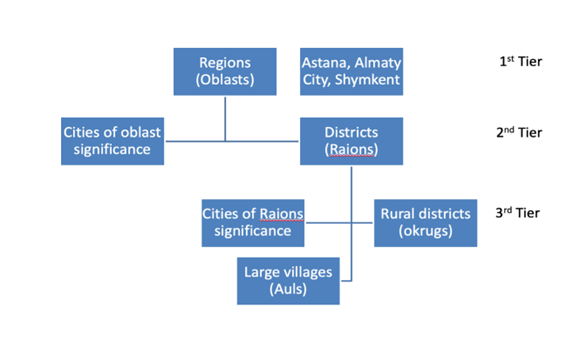
Pre-primary to secondary education is free and compulsory in Kazakhstan. The Ministry of Education/Enlightenment, which was restructured in 2022 from the former Ministry of Education and Science (MES), now oversees pre-primary to secondary education. Meanwhile, the newly established Ministry of Science and Higher Education is responsible for tertiary education and scientific research. The Ministry of Education/Enlightenment works in conjunction with three tiers of subnational administration and individual schools.
Source : GEM Report PEER
As per the 2008 Budget Code (amended in 2021), oblasts are tasked solely with overseeing technical and vocational training. Raions and cities with oblast significance manage preschool, primary, and secondary education. Meanwhile, okrugs and villages handle student transportation to the nearest rural school (the responsibility for primary and secondary education has since shifted to the oblast/Republic city level).
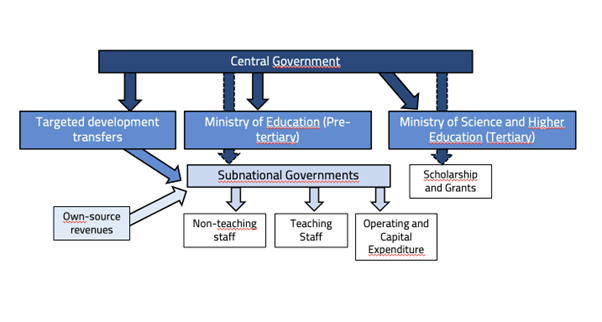
The country employs several mechanisms to finance its education system:
-
Republican budget allocation (central government): The central government primarily finances national-level extracurricular activities, higher education and postgraduate studies in state institutions, retaining of personnels, and the procurement and distribution of textbooks for state secondary educational institutions.
-
Local budget allocation: Local/subnational governments are responsible for financing educational institutions within their jurisdictions. They handle expenditures related to school maintenance, teacher salaries, and the implementation of regional educational programs.
-
State grants system: For tertiary education, the government provides scholarship award as well as social support provision to students of higher and (or) post-graduate education organizations.
-
Per capita financing (PCF) system (first mentioned in the 2011-2020 State Program of Education Development and formally introduced in 2013), where funding is allocated based on student enrolment and school-specific factors. This system allows schools greater autonomy in managing their finances while addressing disparities in per-student funding across different regions and districts. However, to prevent overcrowding-driven financial incentives, a correctional coefficient reduces funding for schools exceeding their physical capacity, ensuring resources are directed toward maintaining education quality rather than inflating student numbers.
Source: GEM Report PEER
1. Education resources to subnational governments
The allocation of education resources to local/subnational governments in Kazakhstan follows a structured fiscal transfer system, primarily composed of subventions and targeted transfers. Subnational governments derive spending largely from two sources: regional general revenue from taxes such as personal income tax (PIT) and social tax, and subventions from the central government that cover the gap between expected regional tax revenues and expenditure needs.
The state is responsible for funding several key areas, including ensuring the accessibility of preschool education and training, providing access to quality school education, and supporting the professional development of teachers. This includes advanced training for teachers of state preschool educational organisations as well as for teachers of state secondary educational institutions.
2. Education resources to schools
Per-Capita Financing System
The main mechanism for distributing education financing to schools is through the per-capita financing (PCF) system. The PCF formula includes a component for the depreciation of expenses related to new construction, capital repairs, and asset acquisition, encouraging private sector participation in school expansion. To incorporate equity, the government has considered introducing an equity coefficient into the PCF formula, which would provide additional financial support to schools serving disadvantaged students, those with lower academic performance, and students with special educational needs. Additionally, funding models factor in variations in unit costs across regions, the proportion of students in small schools, poverty levels, and other regional disparities to ensure a more balanced distribution of education resources.
2020–2025 State Programme for the Development of Education and Science
The programme outlines major investments to modernise and expand Kazakhstan’s education infrastructure, with a strong emphasis on improving school conditions, eliminating educational disparities, and ensuring universal access. Funding for the programme comes from the republican budget, local budgets, the World Bank, and private investment. The programme supports rural schools by providing staff, materials, and equipment to improve quality and narrow the urban-rural education gap. It also includes the construction of 114 boarding schools under the Auyl – El Besigi initiative, specifically targeting rural basic schools. Subject classrooms, including physics, chemistry, biology, and STEAM laboratories, are being equipped with modern educational tools, and digital equipment is being provided to ensure 100 per cent coverage in classrooms. School infrastructure development addresses shortages, three-shift operations, and district-level management issues. Kindergarten development aims to expand access and improve quality for children aged 3-6, including through private partnerships. Teacher training in schools and colleges forms part of the broader educational salary increase plan.
Nazarbayev Intellectual Schools
Established by the Government of the Republic of Kazakhstan, Nazarbayev Intellectual Schools (NIS) function as an autonomous educational organization with a special legal regime, according to the 2011 Law on the Status on Nazarbayev University, Nazarbayev Intellectual Schools and Nazarbayev Fund. This status allows NIS to receive targeted transfers from the Ministry of Education, distinguishing its funding mechanisms from other educational institutions. There are 21 NISs in the country and 19,340 students in these schools.
3. Education resources to students and families
State Educational Accumulative System (SEAS)
The State Educational Accumulative System (SEAS), introduced under the 2011–2020 State Programme of Education Development, encourages families to save for their children’s future education by providing an additional interest premium on educational savings accounts. This initiative is designed to promote long-term financial planning for education and reduce dependency on immediate state funding.
Educational Grants for Vulnerable and Special Groups
For the 2024–2025 academic year, the government has allocated a total of 94,250 educational grants. These include awards for 412 children from socially vulnerable backgrounds, 382 children with disabilities, 3,576 children from large families, 933 children from single-parent households, and 437 children from families raising children with disabilities. In a notable policy adjustment, 1,604 Kandas students, ethnic repatriates, received grants due to changes in the admission process. The government also extended special support to students from disaster-affected regions, awarding 5,112 grants specifically to children impacted by recent floods. Additional funding has been provided from various sources, including local executive bodies, which allocated more than 2,000 additional grants.
4. Social policies and family support programmes
No information was found.
5. School meal programmes
Since 1 September 2023, primary school students in Kazakhstan have been provided with free meals. The programme is universal for all primary school pupils and specifically targets children from socially vulnerable groups, ensuring equitable access to nutritious meals.
The school meal programme adheres to the National Nutritional Standards in Healthcare and Education Organizations, as approved by the Minister of Healthcare’s order in 2020. Daily monitoring is conducted to ensure the quality of meals, supported by constant oversight from interdepartmental expert groups. In accordance with the standards, suppliers are required to obtain a sanitary-epidemiological conclusion before commencing operations. To enhance transparency and safety, video surveillance is mandated in food service areas.
This profile has been reviewed by Kamila Rollan.