


Financing for equity in primary and secondary education
1. Education resources to subnational governments
2. Education resources to schools
3. Education resources to students and families
4. Social policies and family support programmes
Introduction
Egypt’s public education system operates through two main parallel structures: the national general system managed by the Ministry of Education, and the Al-Azhar system, overseen by the Supreme Council of Al-Azhar Institutions. Schools overseen by the Ministry of Education are secular, while schools in the Al-Azhar system provide Islamic education. Both provide free education and are supervised by the Egyptian government.
General education financing for public secular schools in Egypt is managed by the Ministry of Education and the Ministry of Finance. Al-Azhar education is financed through the budget of Al-Azhar Al-Sharif, which consists of the general budget of the Egyptian state, and Al-Azhar endowment investments in addition to the contributions of some civil society institutions. The competent authorities at Al-Azhar Al-Sharif are responsible for setting the necessary budgets for this sector of Al-Azhar education.
For secular schools, the Supreme Council for Pre-University Education, chaired by the Minister of Education, oversees planning, policymaking, and the development of educational programmes, with representatives from various community sectors contributing to decision-making.
The mechanism for disbursing the budget for pre-university education in Egypt consists of two main frameworks:
-
In the first and centralised framework, the Ministry of Finance prepares the general state budget according to priorities and public policy, while adhering to constitutional deadlines (such as submitting it to parliament three months before the fiscal year under Article 124 of the Constitution), and requiring parliamentary approval for any off-budget funding (Article 127).
-
In the second framework (partial decentralization), the Ministry of Education prepares a draft budget based on planned goals and submits it to the Ministry of Finance six months in advance. According to Article 11 of Education Law 139/1981 and Local Administration Law 43/1979, governorates are responsible for school construction, equipment, and management under the ministry’s supervision—except for experimental schools and training centers, which remain centrally managed. Governorates may also set up local education funds to support community initiatives, with the Minister of Education’s approval as required by Article 11 of the Education Law.
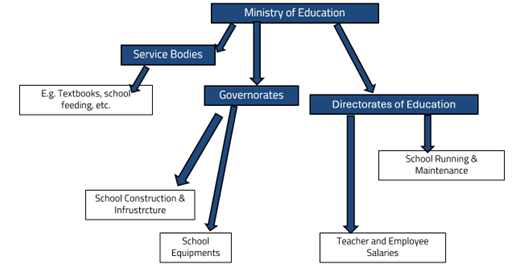
Source: GEM Report PEER team.
Note: Directorates of Education receive most of the funds. Administratively, they report to the governorates, but financially, they are managed by the central government.
1. Education resources to subnational governments
The Ministry of Finance first allocates a lump-sum appropriation within the state budget, which the Ministry of Education then disaggregates into functional and economic categories and regional envelopes; these envelopes are distributed to each governorate’s Directorate of Education in proportion to its school-age population (i.e., “aggregate demand”), ensuring that directorates serving more students receive larger shares. Under Local Administration Law No. 43/1979, governorate authorities oversee capital works, school construction and equipping, using local budgetary allocations for infrastructure projects.
The main equity‐driven transfer from the central Ministry of Education to each governorate’s Directorate of Education is a per-capita allocation based on the number of school-age children (i.e. “aggregate demand”). Specifically, after the Ministry of Finance earmarks the total education appropriation, the Ministry of Education disaggregates it into governorate envelopes in proportion to each governorate’s share of the national school-age population. Furthermore, the central government's strategic plans and resource allocation decisions often prioritize capital investment in school facilities in the neediest areas (e.g., Upper Egypt and frontier Governorates) to address geographical disparities. This ensures that the funding formula is supplemented by equity-driven capital spending, and as a result, schools in underserved areas receive significant investment above the standard per-capita allocation.
2. Education resources to schools
Egypt’s pre-university education system is centrally managed, with ministerial decisions regulating budget allocations, tuition fees, and funding mechanisms. Schools do not get direct budgets from the central government. Instead, the Ministry of Education (MoE) divides its approved budget among the governorate-level Directorates of Education, based on the number of school-age children in each area. These directorates handle staff salaries, provide lump-sum funds for supplies and maintenance, and rely on MoE services like textbook printing and school meals. Major capital projects, such as new buildings, renovations, and equipment, are funded separately through local governorate budgets, as outlined in Law 43/1979.
The five-year Education Sector Plan 2023-2027 identifies students, teachers, and classrooms as the key components determining funding requirements, implementation gaps, and investment priorities. Expenditures are categorized into recurrent and capital costs for each educational sub-stage. Recurrent expenses include teacher and faculty salaries and allowances, teacher training, textbooks and other learning materials, school meals, operational costs such as utilities and office supplies, and digital devices and equipment. Capital expenditures encompass the construction of new classrooms and facilities, maintenance and rehabilitation of existing infrastructure, and investments in digital infrastructure. The plan assumes that 50 percent of the constitutional budget will be allocated to recurrent costs, 35 percent to debt servicing, and 15 percent to capital costs. Of the total estimated cost for implementing the plan, basic education will account for 62.2 percent (comprising 40.1 percent for primary education and 22.1 percent for preparatory education) while secondary education, including both general and technical streams, will account for 26.4 percent, and community and private education will receive the remaining 11 percent.
A key initiative supporting the integration of students with disabilities into general education was the implementation of Ministerial Decision No. (264) of 2011. This policy established a framework for transferring resources and adapting schools to accommodate children with minor disabilities, aiming to ensure equal access to education and improve quality for disadvantaged groups. This integration policy target students with mild intellectual, sensory, and physical disabilities who can be successfully included in general education settings. Specific, earmarked funds are allocated centrally to the Directorate of Education for the establishment of Resource Rooms that support children with disabilities in general education schools. This mechanism is driven by Ministerial Decree No. 252 of 2017 and Law No. 10 of 2018, which require schools to absorb these students and adapt the environment.
3. Education resources to students and families
School Fees Exemption Initiative
Under the Equal Educational Opportunities initiative umbrella, the Ministry of Education supports equal access to education by exempting certain students from school fees. Decisions about eligible groups are made annually by the Minister of Education. Eligible groups have included children of those killed or injured during the January 25 Revolution or in service, families on Ministry of Social Solidarity programmes, and those with approved reports showing financial hardship. Also typically covered are children with disabilities, orphans, children of single mothers, and students in poor or remote areas like North Sinai and parts of the Red Sea. Exemptions apply for one academic year, with annual review, and must be formally documented during enrolment.
Pocket Allowance Programme
An annual pocket allowance is provided to students enrolled in schools in the following frontier areas: Halayeb, Shalateen, Ras Ghareb, Marsa Alam, and El Zafarana. This support aims to incentivise these students to regularly attend school and continue their education.
4. Social policies and family support programmes
Social Fund for Development (SFD)
Established by Presidential Decree No. 40 of 1991, the SFD functioned as a major social safety net, addressing unemployment, supporting job creation, and mitigating the adverse effects of economic reform. While not primarily focused on education, its Community and Human Development pillar supported human capital development, indirectly benefiting educational access and opportunities. Its target groups included low-income individuals, youth (especially graduates), women, residents of underserved areas, and those affected by economic reform measures. The fund mobilized both local and international resources, and it was primarily financed and run by a Council chaired by the Prime Minister. In 2017, SFD was replaced by the Micro, Small and Medium Enterprises Development Agency by Prime Minister's Decree No. 947 of 2017.
Takaful and Karama programmmes
Launched in 2015 by the Ministry of Social Solidarity, the Takaful and Karama programmes form the core of Egypt’s social protection system. Takaful offers conditional cash transfers to poor families, tied to school attendance and health checks, supporting children’s education from kindergarten to secondary level. Families receive EGP 60–100 per child monthly, depending on the education stage, if school attendance exceeds 80%. Karama supports poor elderly individuals and those with disabilities. The programmes use multidimensional targeting, considering poverty, family makeup, gender, and location, especially in underserved areas like Upper Egypt. Additionally, the Unified Cash Transfers Law aims to consolidate older social security efforts into this unified system, enhancing the targeting of vulnerable groups using a social registry linked to national databases.
This initiative, launched by President Abdel Fattah al-Sisi on January 2, 2019, aims to improve the standard of living for the neediest social groups across the country in 2019, and to improve the level of daily services provided to the neediest citizens, especially in villages. This nationwide rural development initiative focuses on improving living conditions, infrastructure, and services in Egypt’s most disadvantaged villages. The programme includes a human development component with a focus on health care, education, job creation, and social inclusion. In particular, the initiative develops schools, supports educational infrastructure, and promotes employment opportunities for youth and women.
5. School meal programmes
Egypt’s government-run School Feeding programme, started in 1942 under King Farouk and managed by the Ministry of Education, provides meals to kindergarten and primary school children, especially in poor and remote areas. Early meals included local foods like bread, halawa, and fava beans, with fruit added later during Nasser’s era. The programme mainly offers lunch and is funded by the government, with support from partners like the World Food Programme. It aims to address micronutrient deficiencies like iron and Vitamin A, though there is no clear evidence of strict nutritional guidelines or ongoing nutritionist supervision.
This profile was reviewed by Omnia Salah, Education Specialist at the Egyptian Ministry of Education, and Mohamed Elasmay Mahrouse Sallem, Professor Emeritus in the Faculty of Education at Sohag University.










