


Financing for equity in primary and secondary education
1. Education resources to subnational governments
2. Education resources to schools
3. Education resources to students and families
4. Social policies and family support programmes
Introduction
In Malaysia, the Ministry of Education oversees and coordinates the Education Departments of all states and federal territories. The Ministry may channel funds to other divisions, deposit money into individual School Government Fund Accounts (KWK), or allocate resources through the Accounts of District Education Offices (PPD).
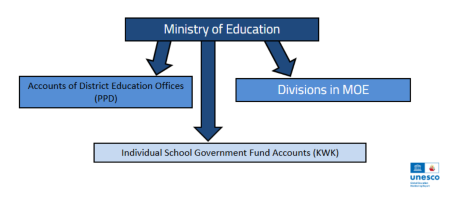
1. Education resources to subnational governments
No mechanism was found to ensure the equitable transfer of large general funds from the central level to local sectors.
2. Education resources to schools
Per Capita Grant (Bantuan Geran Per Kapita, PCG)
The Bantuan Geran Per Kapita (PCG), or Per Capita Grant, provides financial assistance to all government and government-aided schools. Funding is allocated based on subject type, with core subjects such as languages, mathematics, and science receiving higher per-student amounts. Rates vary according to the level of education and school enrolment. Funds are deposited directly into the school’s bank account. Additional allocations are provided for students with disabilities, including RM 200 per student with visual impairment, RM 50 per student with hearing impairment, and RM 45 per student with learning disabilities.
3. Education resources to students and families
There are 22 education assistance programmes provided by the Ministry of Education (MOE), constituting the third largest number of social assistance programmes.
Federal Small Scholarship (Biasiswa Kecil Persekutuan, BKP)
Since the 1970s, the Federal Small Scholarship (BKP) has offered financial support to students from families earning below the Poverty Income Line (PGK), which is set at RM 2,589 per month as of 2025. Secondary students in forms 1-4 (ages 14-17) receive RM 70 per month for 12 months, while form 5 students (ages 17-18) receive the same amount for 11 months. At pre-university level (form 6, ages 18-20), literature stream students receive RM 90 per month, and science stream students RM 110 per month, with differing durations across the two years of study. Recipients are expected to maintain good academic performance.
Early Schooling Assistance (Bantuan Awal Persekolahan, BAP)
The Early Schooling Assistance (BAP) provides one-off financial support of RM 150 to parents or guardians of students in year 1 to form 6 (ages 6–20). In Malaysia, secondary school finishes at form 5, while form 6 is considered post-secondary education but prior to tertiary education. The funds are distributed at the beginning of the school term to help parents prepare for the school year. Assistance is distributed by the Ministry of Education to eligible students across all school levels.
Allowance for Students with Special Education Needs (EMBPK)
Since 2005, the Ministry of Education has provided an allowance for students with special educational needs under the EMBPK scheme. Students classified as People with Disabilities (OKU) and holding a valid OKU card receive RM 150 per month for 12 months to support their schooling.
Among Malaysia’s student assistance programmes, BKP, BAP, and EMBPK are financed directly through the Ministry of Education budget, while KWAPM (see section 4 below) is financed via a federal Treasury trust fund, with the Ministry of Education is an implementor.
4. Social policies and family support programmes
There are several programmes which provide cash grants to families in need.
Bantuan Kanak-kanak (BKK)
The BKK is a cash grant that targets children who are a part of households below the current average poverty link (PGK) and children without qualified guardians. The grant provides RM 250 per person for children below the age of 6 and RM 200 for children
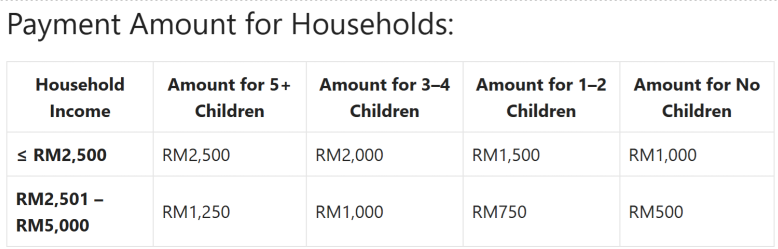
Sumbangan Tunai Rahmah (STR) a financial assistance program which provides cash grants to poor families. The payment levels depend on the household size and income level. For households with children, the payment amounts are as follows:
Poor Student Trust Fund (Kumpulan Wang Amanah Pelajar Miskin, KWAPM)
The Poor Student Trust Fund (Kumpulan Wang Amanah Pelajar Miskin, KWAPM), established in 2003, offers targeted financial support to students from low-income families categorized as as “poor” or “severe poor” under the eKASIH or eDAMAK systems, and whose household income is below the National Poverty Income Line. KWAPM provides two main types of assistance: General School Assistance (BAmP)—which grants RM 100 for elementary school students and RM 150 for secondary students (Year 1 to Form 3)—and Emergency Assistance (BK), supplying RM 300 for both elementary and secondary students (Year 1 to Form 5). This funding is designed to help qualifying students overcome economic barriers and continue their education without disruption.
KWAPM is a programme introduced alongside the 2003 implementation of the Compulsory Education Policy. The Ministry of Education receives funds for this programme from the Ministry of Finance as well as monetary donations from Malaysian citizens.
5. School meal programmes
Sumbangan Asas Rahmah (SARA) is a food assistance programme that provides cash grants to poor and extremely poor recipients. In 2025, eligible households can receive up to 2,100 for the entire year, split into monthly payments. Beneficiaries can purchase select basic necessities using their SARA accounts. This includes food, basic hygiene items, medicines, and school supplies.
The MyKasih ‘Love My School’ Student Bursary Programme provides underprivileged families with cashless bursaries which can be used to purchase food, school books, and stationery from the school. Eligible students from families earning less than RM 1,500. Students receive a monthly spending allowance of RM 30-40.
Supplementary Food Plan (Rancangan Makanan Tambahan, RMT)
The Supplementary Food Plan (RMT) has been implemented by the Ministry of Education since 1979 to support primary school students, particularly those from rural and low-income communities. Eligible students in years 1–6 at government and government-aided schools include children from households below the National Poverty Line, those in extreme poverty, students from indigenous Orang Asli and Penan communities, and students with special educational needs holding a disability card. Food supplies are provided on every school day, for up to 190 days per year. Allocations are distributed to schools through their respective local education divisions.










