


Financing for equity in primary and secondary education
1. Education resources to subnational governments
2. Education resources to schools
3. Education resources to students and families
4. Social policies and family support programmes
Introduction
In South Sudan, public education expenditure is managed by both the Ministry of General Education and Instruction (MoGEI) and corresponding state-level ministries across the ten states and three administrative areas. Operating under a decentralised governance system, states and counties are responsible for implementing education policies and ensuring the daily operation of educational institutions.
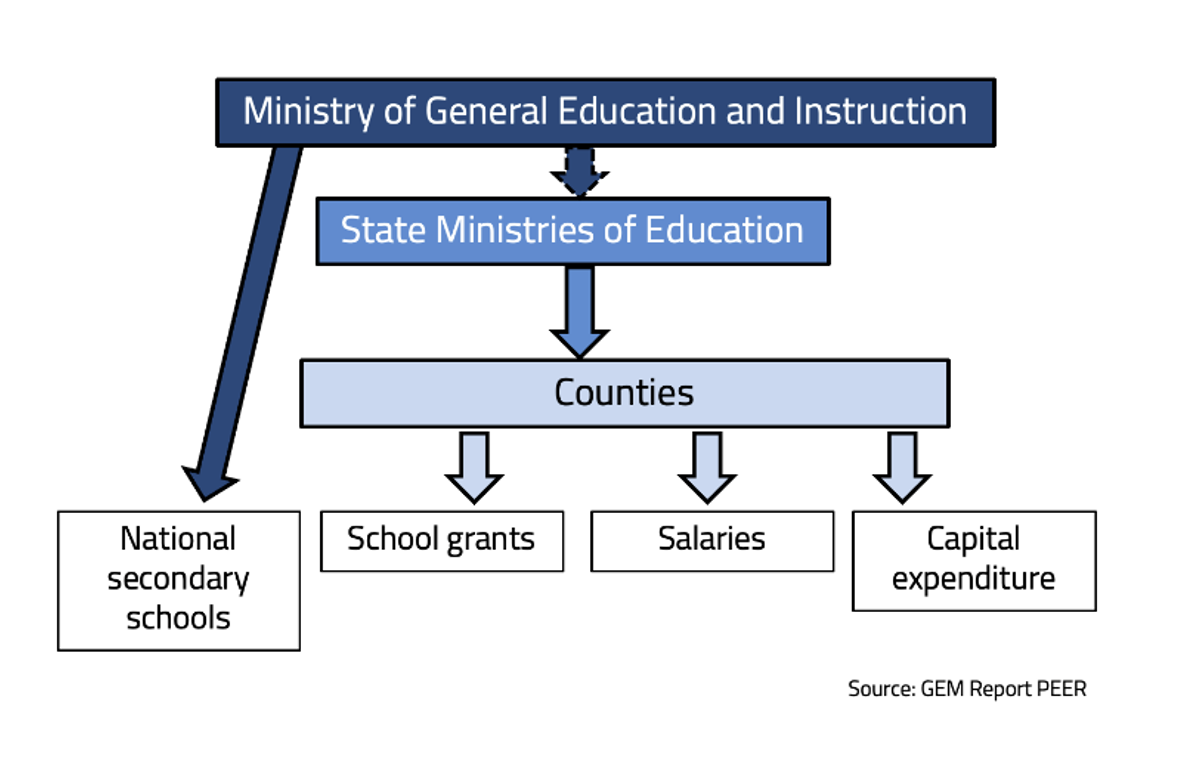
At the central level, MoGEI oversees policy development, administrative coordination, and financial accountability to ensure effective use of public resources. Counties finance and manage early childhood development, primary schools, and Alternative Education Centres, while states supervise secondary education, technical and vocational education and training (TVET), and teacher training. National secondary schools and teacher training institutes remain directly under MoGEI administration and are funded by the national government.
Education financing reflects this decentralised structure, with funds transferred from the central government to states and administrative areas to support educational activities, including teacher salaries. The majority of education delivery is managed at the state and county levels, where funds are primarily used to cover service delivery in schools, with a smaller portion allocated to administrative expenses of State Ministries of Education (SMoEs) and County Education Departments (CEDs).
Prior to January 2022, education funds were routed from the Ministry of Finance to MoGEI, then through state ministries of finance before reaching SMoEs. This multi-step process proved inefficient and was restructured in 2021, establishing direct transfers from MoGEI to SMoEs, bypassing state finance ministries. States now distribute funds directly to counties.
Community contributions remain vital to education financing, with parents and local communities covering costs for learning materials, transport, and feeding. Additionally, the sector continues to rely heavily on off-budget support from development partners.
Flows of funding for public educational institutions in South Sudan
1. Education resources to subnational governments
Transfers to states and counties are determined by the number of counties and schools, in line with the Guidelines on Education Conditional Transfers to States and Counties. The amount allocated per student and per school varies widely across states and administrative areas. Three main types of transfers are made to the subnational level: conditional salary transfers, operating transfers, and transfers to service delivery units.
Conditional Salary Transfers
These transfers fund the salaries of education staff at both county and state levels. At county level, they cover employees of county education departments as well as government-paid pre-primary, primary, and Alternative Education System (AES) teachers and school staff. At state level, they support salaries for personnel in the State Ministries of Education and government-paid secondary, TVET, and TTI teachers. The Ministry of General Education and Instruction (MoGEI) uses data from SAMS or EMIS for school-based staff and Ministry of Labour records for administrative staff to calculate salary transfers by grade, including both government and community school staff, although only a fraction are officially on the payroll.
Operating Transfers
Operating transfers support the running costs of education offices. For counties, allocations are based on a 60/40 formula, with 60% of the total resource envelope, set by the Ministry of Finance, shared equally among all counties, and 40% distributed according to the number of public schools in each county. The same formula applies to state operating transfers, with the fixed 60% portion divided equally among the ten states and three administrative areas, while the remaining 40% is distributed according to the number of schools in each jurisdiction.
Transfers to Service Delivery Units
Transfers to service delivery units, primarily schools, consist of capitation grants and teacher incentives. Capitation grants are provided to government early childhood development centres, Alternative Learning Programme (ALP) schools, primary schools, and secondary schools to support essential running costs such as stationery, maintenance, extra-curricular activities, and transport. In 2021, capitation grant rates were set at 43,000 SSP per primary school plus 500 SSP per enrolled child, and 86,000 SSP per secondary school plus 1,000 SSP per student. Grants for secondary schools are paid through the Girls’ Education South Sudan (GESS) project, while grants for other levels are financed by the government. Teacher incentives are distributed as fixed top-up payments to motivate and retain teachers.
Reforming the Transfer Formula
The current education transfer formula does not account for total student enrolment or the distinct characteristics of each state, including size, rurality, and risk index. Acknowledging these shortcomings, the 2023–2027 General Education Sector Plan seeks to promote greater equity in funding across decentralised administrations. The plan proposes a review of the transfer formula to incorporate additional considerations, including a supplementary transfer for the most at-risk states, as identified in the 2023 Education Sector Analysis.
2. Education resources to schools
Capitation Grants
Capitation grants are provided to schools as fixed amounts per student and per school, varying by education level. The purpose of these grants is to support the basic operational needs of schools, including maintenance, school supplies, extracurricular activities, and transport. Under the current arrangement, the Girls’ Education South Sudan (GESS) programme (see Section 3) is responsible for distributing these grants to secondary schools, while the government finances those for primary schools. The system presently lacks an explicit equity element in the allocation formula, which limits its capacity to address disparities between schools in different regions or socioeconomic contexts.
Alternative Education System
The Alternative Education System (AES), established in 2002, offers flexible and inclusive education opportunities to learners unable to access formal schooling due to conflict, displacement, poverty, or other barriers. It targets out-of-school children, overaged learners, illiterate adults, and pastoralist communities. AES programmes are provided free of charge, with learning materials supplied by the government and no requirement for uniforms.
The system comprises several programme streams designed to meet the varied needs of different population groups. The Accelerated Learning Programme condenses eight years of primary education into four and serves older children and youth who have missed schooling, including those formerly associated with armed groups. The Community-Based Girls’ Schools Programme provides early primary education to girls in remote areas without schools, also enrolling boys up to 40% of the total intake. The Basic Adult Literacy Programme supports adults over 18 years who have been excluded from literacy and numeracy education. The Pastoralist Education Programme reaches nomadic populations through mobile and flexible learning models, while the Intensive English Course enables adults, teachers, and government officials to acquire or improve English proficiency.
The Accelerated Learning Programme is the most widespread, implemented in 85% of AES centres, followed by the Basic Adult Literacy Programme, Community-Based Girls’ Schools, Functional Adult Literacy, and Pastoralist Education programmes. Most centres are operated by the government, with community and private providers accounting for a smaller share.
3. Education resources to students and families
There is no government-funded scholarship or bursary scheme for students at the primary/secondary level.
Girls’ Education South Sudan Programme
The Girls’ Education South Sudan (GESS) Programme, financed by development partners and implemented by the Ministry of General Education and Instruction (MoGEI), is the country’s largest education intervention in terms of funding and reach. Operating since 2014, the programme provides cash transfers to girls from Grade 5 onwards, which has positively influenced female enrolment and helped achieve gender parity from Grade 5. The first phase ran from 2014 to 2018, and following successful outcomes, the second phase began in 2018 and continues to 2024, with additional donors joining. Programme funds are managed through the project rather than directly through the government, and are therefore not reflected in national financial accounts.
In addition to cash transfers, GESS administers capitation grants for eligible public and community secondary schools, targeting the most remote areas and poorest quintiles. The government intends to review the guidelines for capitation grants and cash transfers, integrating them so that schools receive increased funding based on the total number of girls enrolled. Plans also include expanding cash transfers to female learners before Grade 5.
GESS collects data from schools on budgets, accounts, enrolment, and attendance to ensure compliance with minimum criteria for capitation grants. As part of accountability measures, schools submit budgets detailing how capitation grant funds would be spent if allocated.
4. Social policies and family support programmes
National Social Protection Framework
At the national level, the Ministry of Gender, Child and Social Welfare is responsible for strategic planning and coordination of social protection, including the design and implementation of relevant programmes. The government has committed to allocating 1% of its annual budget to support the National Social Protection Policy Framework through this ministry. While these resources provide broad social protection, there are no programmes under the ministry that include a dedicated education component.
5. School meal programmes
WFP School Feeding Programme
The World Food Programme (WFP) School Feeding Programme in South Sudan has been operational since 2011, targeting primary-level learners to ensure access to safe and nutritious food while supporting the livelihoods of food-insecure smallholder farmers in non-conflict areas. The programme is fully donor-funded and uses geographic-based targeting, focusing on areas identified through food security and education indicators.
The programme provides food equivalent to one-third of daily nutritional requirements, delivered throughout the school term either as a daily meal prepared on-site or as a monthly take-home ration designed for a household of six, contingent on over 80% school attendance in the preceding month.
Although political commitment and national ownership of the programme exist, financial contributions from the government remain limited. In 2019, the government introduced the National Home-Grown School Feeding Strategy, promoting the use of locally produced food for school meals. This approach has been piloted in parts of Eastern Equatoria, Lakes, and Western Equatoria in collaboration with humanitarian and development partners. The government plans to continue advocating for increased budgetary allocations from the national treasury to support the education sector, including management costs for school feeding at both national and sub-national levels.
This profile has been reviewed by Dr Ebaidalla Mahjoub Ebaidalla, Qatar University.










