
Financing for equity in primary and secondary education
1. Education resources to subnational governments
2. Education resources to schools
3. Education resources to students and families
4. Social policies and family support programmes
Introduction
In Tokelau, education financing is managed through a combination of centralised oversight and local implementation. The Department of Education, under the Office of the Council for the Ongoing Government (OCOG), is responsible for national education standards, policy development, and scholarship administration. Operational control of schools rests with the local village councils (Taupulega) of Atafu, Nukunonu, and Fakaofo, which have managed education delivery since responsibilities were devolved in 2004.
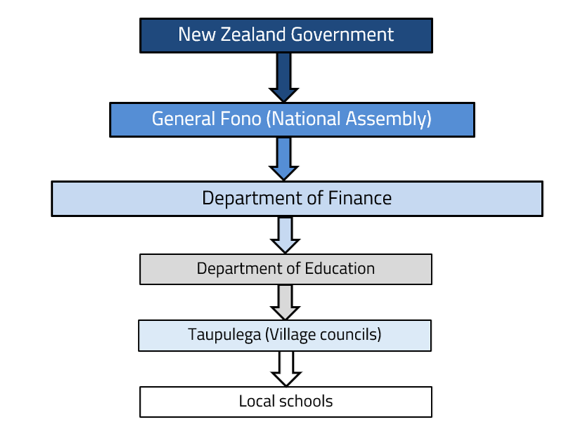
New Zealand provides the majority of Tokelau’s government budget, including education funding, and supports improvements through the 2011 Joint Commitment for Development, focusing on strengthening education systems and operations. Australia contributes through the Tokelau International Trust Fund, primarily supporting early childhood education. Nationally, the General Fono approves the government budget, which the Department of Finance allocates to sectors such as education. The Department of Education then disburses funds to the Taupulega, which manage local schools and implement educational services in their communities.
1. Education resources to subnational governments
The primary funding mechanism for Tokelau is general budget support from New Zealand’s central government, administered by the New Zealand Ministry of Foreign Affairs and Trade (MFAT). This fixed, unconditional operating subsidy covers essential services and infrastructure across the three atolls—Atafu, Nukunonu, and Fakaofo.
Although there is no formal funding formula, allocation decisions prioritise equity, taking into account population size, remoteness, and service delivery needs to address logistical challenges and infrastructure gaps. Funds are distributed through a decentralised governance structure: the General Fono, Tokelau’s national assembly, sets overall budget priorities, while each atoll retains autonomy over local planning and service delivery.
2. Education resources to schools
No information has been found.
3. Education resources to students and families
No information has been found.
4. Social policies and family support programmes
Regional Social Protection Initiative
From 2020 to 2022, Tokelau participated in a regional initiative to establish inclusive and equitable social protection systems, including education-related components. This programme was part of the United Nations Joint Programme on Social Protection, which also included Samoa, the Cook Islands, and Niue.
Access to New Zealand Social Assistance Programmes
While Tokelau does not operate its own national social assistance scheme, residents, as New Zealand citizens, are eligible to access New Zealand’s social security benefits. Several initiatives support education and training for Tokelauans. The School and Year Start-up Payment assists families with the costs of enrolling children in school, helping to cover expenses such as uniforms, stationery, and other essential supplies. The Training Incentive Allowance provides financial support to individuals participating in approved training or education programmes, promoting skills development and long-term employability. These programmes complement local education and social support efforts in Tokelau.
5. School meal programmes
Tokelau does not operate a government-run school meal programme. However, standards have been established to ensure that food provided in school canteens is healthy and safe. The territory is also engaged in broader initiatives to improve nutrition outcomes, particularly for young children and vulnerable populations. These efforts form part of integrated policy approaches supported by international organisations, focusing on enhancing food and nutrition security across the community.