


Financing for equity in primary and secondary education
1. Education resources to subnational governments
2. Education resources to schools
3. Education resources to students and families
4. Social policies and family support programmes
Introduction
In El Salvador, the Ministry of Education, Science, and Technology (MINEDUCYT) regulates, finances, evaluates, supervises, and controls national education resources. In Basic Education, resources are transferred to schools through various councils, including the School Board of Directors (CDE), the Catholic School Education Council (CECE), the Institutional Education Council (CIE), and the Community Education Associations (ACE).
For schools under the CDE, CECE, and CIE modalities, Acuerdo 15-0001 defines the funding methodology. For Early Childhood, Nursery, and Elementary Education—including Flexible Modalities and Special Education—the per-student fee, based on student numbers and school board type, is multiplied by the final enrollment figures from the previous academic year. For Secondary Education, total funding is based on the previous year’s aggregate allocations for salaries and operational expenses.
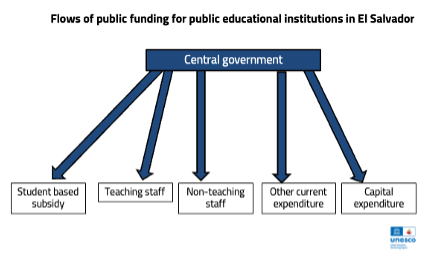
Over 90% of the Ministry’s budget is dedicated to current expenses, primarily salaries, which are paid directly to teachers and administrators. Transfers to schools cover basic operating costs, including utilities, educational resources, and maintenance, calculated according to enrollment.
1. Education resources to subnational governments
El Salvador operates a centralised education financing system, in which the Ministry of Education directly allocates resources to school administration agencies, bypassing any decentralised levels of government.
2. Education resources to schools
Official Education Centres are state-run and funded through the national budget. Private education centres operate with their own resources but must obtain MINEDUCYT approval to raise fees and may collaborate with the State. The government may only subsidise private, non-profit institutions that meet MINEDUCYT’s coverage and quality standards, as established in Article 79 of the General Education Law.
Full-Time Inclusive School Comprehensive System (SI-EITP)
The Inclusive School model in El Salvador began in 2005–2006, when the National Directorate of Education, supported by the Italian Government and the University of Bologna, initiated the transition from experimental inclusive schools to a territorial inclusive educational system. The model seeks to increase community participation in school life and develop community-based educational projects with curricula reflecting local contexts and priorities.
The Full-Time Inclusive School Comprehensive System (SI-EITP) is an organisational strategy supporting the Inclusive Education approach and the EITP pedagogical model, which promotes equity, improved learning, and broader opportunities for all students, particularly the disadvantaged. Schools are organised territorially with nearby institutions to share resources, expand learning opportunities, provide comprehensive educational services, formulate joint action plans, and integrate the community. MINED established guidelines for SI-EITP’s operational structure, creating an Integrated System Coordination Board (OCCSI) supported by four technical and advisory councils. Three administrative support units—Coordination of Training Areas, Coordination of Educational Levels, and Collegiate Administrative Body—work with each school and the Departmental Directorates of Education (DDEs), though the relationship between OCCSI and the DDEs is not clearly defined. The system aims to promote an inclusive educational model by integrating local schools and guiding students from early childhood through secondary education. It seeks to remove barriers to access, ensure educational quality, and foster life skills, citizenship, and democratic values. The curriculum accommodates students with or without physical, sensory, or cognitive disabilities, without segregation based on disability, ethnicity, or cultural background.
3. Education resources to students and families
School Supplies
The programme (2022) provides uniforms, shoes, and school supplies to all public school children from early childhood to high school, involved in social development programmes. As part of the Universal Social Protection System, it aims to support families affected by the economic crisis, reduce absenteeism and dropouts, and boost the local economy by fostering opportunities for micro and small businesses related to the supplied goods.
4. Social policies and family support programmes
Programa Comunidades Solidarias (Solidarity Communities Programme)
This programme was a Conditional Cash Transfer (CCT) initiative that existed between 2005 and 2016, previously known as Red Solidaria (Solidary Network) until 2009. It retained the foundational structure of Red Solidaria,encompassing the dimensions of human capital (cash transfers), basic services (expansion of local infrastructure), and income generation and productive development (microcredit programs and training focused on food security). Education conditionalities included enrollment and regular attendance through sixth grade for children 5–15 years old. While the programme initially operated exclusively in rural areas, it expanded its implementation to urban areas beginning in 2009.
No other programme has been found after 2016.
5. School meal programmes
Programa de Alimentación y Salud Escolar (PASE) (School Food and Health Programme)
The Ministry of Education, Science, and Technology (MINEDUCYT), through the National Directorate of Prevention and Social Programmes, implements the School Food and Health Programme (PASE), which provides a daily food ration to schools. The programme began in 1984 with support from the United Nations World Food Programme (WFP) to encourage school attendance. Since 2011, the programme’s School Meals component has supported students in the Full-Time Inclusive School (EITP) project, providing school lunch five days a week and breakfast for students with outstanding performance on the Saturday school day. For other students, the programme offers early-morning “refreshments,” including rice, beans, oil, fortified beverages, milk, and sugar. The School Food Law ensures that nutritional guidelines and standards are met.
PASE was institutionalised in 2014 with the approval of the Law of Development and Social Protection (LDPS) through Decree 647 of the Legislative Assembly, and its regulations were published via Executive Decree 43 in July 2016. The programme aims to address poverty, exclusion, and social inequality, promoting better nutrition and health practices to improve students’ learning conditions.
This profile was reviewed by D. Brent Edwards Jr., PhD, Chair and Professor, Department of Educational Foundations, University of Hawai‘i at Mānoa and Pauline Martin, Adjunct Professor and Professional tutor, Reading Area Community College.










