
Financing for equity in primary and secondary education
1. Education resources to subnational governments
2. Education resources to schools
3. Education resources to students and families
4. Social policies and family support programmes
Introduction
In Chile, the Ministry of Education serves as the central authority of the State responsible for guiding and promoting educational development across all levels of the system. Its internal structure is organised into the Undersecretary of Early Childhood Education, the Undersecretary of Education, the Undersecretary of Higher Education, and the Directorate of Public Education, each possessing its own cabinet, legal division, finance division, and specialised units to support policy implementation.
In addition to its internal organisation, the Ministry is linked to a number of autonomous institutions established to strengthen governance and quality assurance within the sector. Among these is the Superintendence of Education, created under Law No. 20.529 of 2011, which functions as an independent body mandated to ensure compliance with educational standards. Together with the Education Quality Agency, it is tasked with oversight, guidance, and technical support, thereby safeguarding the conditions necessary for effective and equitable learning across educational institutions.
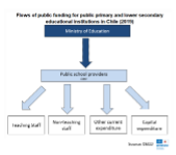
1. Education resources to subnational governments
Reform of Public Education Financing under the New Public Education Law (Law No. 21.040)
Public education financing in Chile has traditionally followed a market-oriented model based on demand and supply dynamics, with State resources directed to educational institutions through per-student subsidies.
A major reform was introduced through the New Public Education Law (2017), which marked a gradual transition towards a decentralised and territorially coordinated financing framework. Under this new model, Local Public Education Services (SLEPs) are progressively taking over the administration and governance of public schools, replacing municipalities as the legal and administrative authorities. Budget allocation to SLEPs is determined by criteria such as the number of educational establishments, educational levels and modalities, differentiated training, and performance indicators under Law No. 20.529, as well as factors including rurality, coverage, enrolment, and student vulnerability. The share of total programme resources assigned to Local Services corresponds to the proportion of enrolment in public education managed by municipalities and municipal corporations.
While the central government remains the main funding source, subnational entities—particularly SLEPs and, where still relevant, municipalities—are responsible for executing educational budgets. These entities receive transfers from the Ministry of Education through mechanisms such as the General Education Subsidy and targeted funds like the Support Fund for Public Education (FAEP), which seeks to strengthen the quality and equity of public education. The FAEP provides supplementary resources to improve infrastructure, pedagogy, and institutional management, with special attention to vulnerable areas.
FAEP resources are distributed to each public fund holder through a formula with three components: a fixed amount per establishment that varies by enrolment type and percentile; an additional amount per establishment adjusted according to local factors such as geographic dispersion and dependence on the Municipal Common Fund; and special adjustments for critical situations or municipal deficits, with limits on annual variations in total allocations.
Within this framework, subnational entities mainly perform operational and administrative functions, while funding allocations and policy decisions continue to be defined at the national level.
2. Education resources to schools
There are two main mechanisms for allocating resources: demand subsidies and supply subsidies. Demand subsidies involve the State allocating resources to schools based on student enrollment or attendance, using moving average attendance for this allocation. Supply-side subsidies involve funding based on school characteristics, including structural needs, staff numbers, and student demographics.
The current financing system encompasses four primary categories of resources allocated by the State to educational institutions. Student-Based Subsidies (81%) follow a demand-driven logic, providing resources through mechanisms linked to student characteristics. These include the general student subsidy, which varies according to educational level, modality, geographic location, and type of institution; special subsidies, such as the Pro-Retention Educational Subsidy and the Educational Reinforcement Grant, which address the needs of specific students or schools; and the preferential school subsidy, which supports the improvement of schools with high concentrations of socio-economically vulnerable students. Compliance with Agreement D.L. 3.166/80 (1%) follows a supply-based logic, allocating funds to schools under delegated administration according to the characteristics of the institution and its student population. Allocations to Other Public Entities (11%) also follow a supply-based approach, providing resources to improve the salaries of educational staff through a mechanism that does not depend on student attendance. Finally, Other Direct Contributions (7%) represent targeted supply-side funds allocated directly to schools, determined by each institution’s specific characteristics.
The school subsidy system distributes public resources to establish, maintain, and improve educational institutions, ensuring an adequate educational and cultural environment. The amount of subsidy per student is calculated using the Educational Subsidy Unit (USE), from which all related amounts are derived. The USE is adjusted annually in December or when public sector salaries are revised, using the same percentage. Each educational level and modality has a designated per-student value, which differs depending on whether the student is enrolled in a full school day programme (JEC).
Various subsidies further promote access and quality in education. The Boarding Subsidy covers room and board for boarding students, with annual rates determined by the Ministry of Education. The Educational Reinforcement Grant supports institutions offering remedial courses for underperforming students, especially those at higher social risk. The Annual Maintenance Support Subsidy covers maintenance costs for free or shared-financing schools, with amounts varying by student and education level and including additional funds for boarding students, aimed at preserving school facilities.
3. Education resources to students and families
Indigenous Scholarship—Beca Indigena (BI)
The Indigenous Scholarship Programme has been in place since 1991, following the enactment of Indigenous Law No. 19.253, and has been administered by JUNAEB since 2005. It provides financial support to students of Indigenous descent who are in vulnerable socioeconomic conditions, assisting them from basic to higher education with study-related expenses. The allocation criteria follow the same principles outlined in the previous section of SDG4 for the period 2005–2015, and the amount granted varies according to the educational level.
To qualify, students must have Indigenous ancestry certified by the National Corporation for Indigenous Development (CONADI) and belong to the lowest 60% income bracket, as determined by the Social Household Registry (RSH). A Targeting Model is used to identify eligible applicants, applying the Socioeconomic Evaluation Questionnaire to assess family background and assign a vulnerability score, prioritising those most in need. This questionnaire also provides detailed information on renewing students and their families, supporting the planning and evaluation of the programme within the framework of State social expenditure.
4. Social policies and family support programmes
The Chilean Ministry of Social Development and Family (MDSF) oversees national development through various programs and strategic measures. The Solidarity and Social Investment Fund (FOSIS), founded on October 26, 1990, aims to reduce poverty and social vulnerability by enhancing the skills of individuals and communities, emphasising territorial relevance and gender issues. The Subsecretariat for Children under the MDSF develops policies to promote children's rights and prevent violations.
Chile Solidario/Ingreso Ético Familiar
The Ingreso Ético Familiar (IEF), initially launched as Chile Solidario, was designed to assist families experiencing extreme poverty, with eligibility determined by scores on the Social Protection Form. Chile Solidario comprised three components. The Fosis Puente programme, which provided each family with a social professional for two years including home visits; preferential access to social programmes in education, early childhood care, and family support, addressing domestic violence and strengthening family ties; and guaranteed access to State monetary subsidies, such as the Single-Family Subsidy for children and the pro-retention subsidy for high school students. Participation required a formal five-year agreement with the State, during which families received social benefits and psychosocial support through Puente. Working with social workers, families developed customised poverty-alleviation strategies addressing multiple indicators across key areas including documentation, health, education, housing, employment, income, and family dynamics.
In 2012, Chile Solidario was replaced by IEF, now part of the Subsistema de Seguridades y Oportunidades (SSyOO), which continues to operate in Chile. The IEF combines conditional and unconditional cash transfers to support families in extreme poverty, including an intervention component and a larger cash transfer component. The intervention, known as Programa Eje, involves working with a social worker to identify strategies, with referrals to Apoyo Social and, in some cases, Apoyo Laboral. Apoyo Social includes 19 sessions over 24 months, during which families and social workers develop a skills development plan. Participation is mandatory for all families.
Financial support is linked to recognising social rights and fulfilling responsibilities in health, education, and employment. The Bono Base Familiar is a monthly benefit for families below the extreme poverty threshold, available for up to 24 months, contingent on meeting monthly requirements verified by the Ministry of Social Development and Family. The Protection Bonus provides monthly payments to all families in the Subsystem over 24 installments. Families receiving the Bono Base Familiar may also qualify for the Bono por Deberes, which supports households with children under 18. The Bono por “Control Niño Sano” offers a monthly payment of $11,000 to families with children under six who meet health check-up requirements. The School Attendance Bonus provides $11,000 monthly to families with children aged six to 18, dependent on an attendance rate of 85% or higher. The School Achievement Bonus is an annual benefit for families in the most vulnerable 30% with children in grades four to five attending schools recognised by the Ministry of Education.
5. School meal programmes
The School Meals Programme (PAE) of the National Board of School Aid and Scholarships (JUNAEB) was established in 1964 by Law No. 15,720. It provides meals to vulnerable students in public and subsidised private schools, covering kindergarten, elementary, middle, and adult education, to support learning and prevent school dropout. The programme also includes students covered by Law No. 20,595, residents in student homes, and participants in the “4 to 7” programme, with resources amounting to up to CLP 1,449,070 thousand. Additional support of up to CLP 630,820 thousand is provided for extracurricular activities benefiting students, teaching staff, and parents, as well as recreational programmes and family residences under the National Service of Specialised Protection for Children and Adolescents.
The PAE meets one-third of the daily nutritional needs of elementary and middle school students and 50% of preschool requirements. Food is supplied by 26 JUNAEB concessionary companies selected through public bidding.
The programme includes provision of meals for 70,000 children at the transition level, with additional rations for extended-day programmes, funding for vacation programme personnel through non-taxable payments, and food support linked to educational reinforcement and re-schooling programmes administered by the Undersecretary of Education. Supervision and quality control services for the programme may also be funded.
Additionally, the Third Service of the School Meal Programme provides a daily reinforcement snack to children and young students participating in the Chile Security and Opportunities Subsystem.
This profile was reviewed by Diana Vásquez Orjuela, Academic, University of Talca.