


Financing for equity in primary and secondary education
1. Education resources to subnational governments
2. Education resources to schools
3. Education resources to students and families
4. Social policies and family support programmes
Introduction
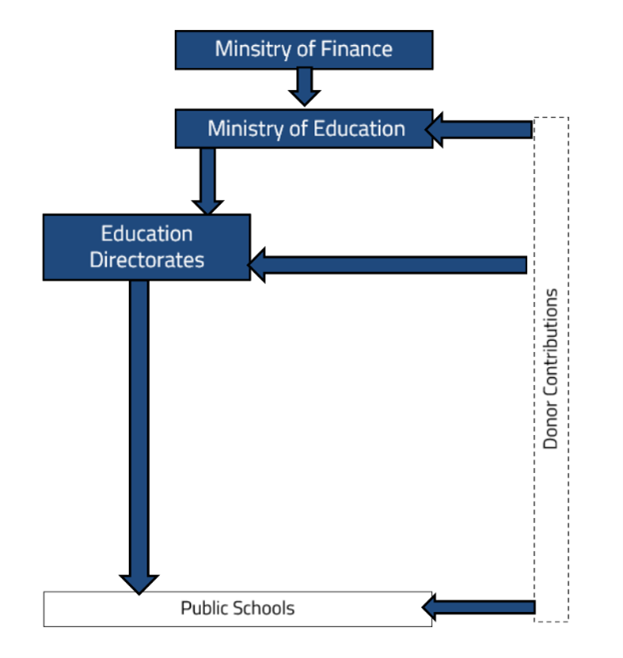
In Palestine, education financing is centrally managed by the Ministry of Education and Higher Education (MoE), which holds full responsibility for budgeting, allocating, and overseeing funds across all levels of basic education. The Ministry of Finance (MoF) plays a key role by reviewing and approving the MoE’s annual budget proposal before releasing funds. These funds flow from the central government to the MoE, which then distributes them to regional directorates and schools. Local education directorates operate under the MoE’s administrative and financial supervision but do not have independent budgetary authority. They implement policies, monitor schools, and manage operational needs, yet funding decisions remain firmly centralised. While some resources reach schools directly, most financing passes through these directorates to cover school-level expenditures.
The government’s education spending covers a broad range of services, with teacher and staff salaries comprising the largest share of recurrent costs. It also finances school operations, curriculum development, textbooks, and infrastructure—often in partnership with external donors such as the EU, World Bank, and UNICEF.
Resource allocation is largely influenced by historical budgets, national priorities, donor programme requirements, and urgent political or emergency needs.
1. Education resources to subnational governments
The allocation of education resources to subnational governments is centrally managed by the Ministry of Education (MoE) in coordination with the Ministry of Finance (MoF), with no formal fiscal decentralisation in place. Regional education directorates operate as administrative arms of the MoE and receive centrally allocated budgets based on school size, staffing needs, and historical expenditures, but with limited budgetary authority.
2. Education resources to schools
Schools receive resources through regional education directorates, which are managed centrally by the Ministry of Education. Allocations are based on enrollment numbers, staffing needs, and infrastructure conditions. School financial management remains at the directorate level.
The “School Adoption Programme” (برنامج تبنّي المدارس), launched by the Ministry of Education in the early 2010s, supports public schools nationwide, focusing on marginalised and underserved areas needing urgent rehabilitation or expansion. It enables individuals, companies, NGOs, and Palestinian expatriates to fund infrastructure improvements like classrooms, sanitation, sports facilities, and digital capacity for distance learning. Although not based on a formal equity formula, school selection is needs-based, considering infrastructure conditions, geographic disadvantage, and development plans. Funding is provided through direct implementation, local partnerships, or transfers to designated school accounts under ministry oversight.
3. Education resources to students and families
School Supplies and Textbook Subsidy Policy
The School Supplies and Textbook Subsidy Policy, launched in 2011, provides free textbooks and essential learning materials to public school students, particularly targeting those from marginalised areas, refugee camps, low-income families, children in Area C, East Jerusalem, Gaza, UNRWA schools, and emergency-affected zones.
While no other ongoing government-led initiatives exist, UNRWA supports students and families through programmes such as the Digital Learning Platform and Education in Emergencies.
4. Social policies and family support programmes
Information is available only on donor-funded programmes, not those by the government ministry of social affairs.
5. School meal programmes
The government does not have a current school meal programme in place.
This profile was reviewed by Dr. Alaa Ali Alandini, Assistant Professor of TEFL at Dhofar University.










