


Financing for equity in primary and secondary education
1. Education resources to subnational governments
2. Education resources to schools
3. Education resources to students and families
4. Social policies and family support programmes
Introduction
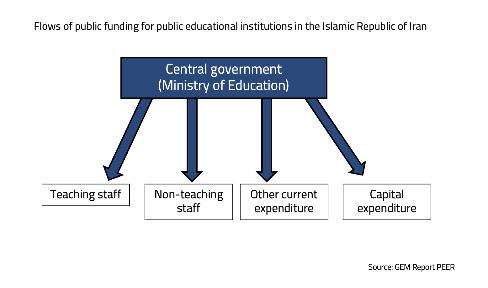
In the Islamic Republic of Iran, the governance and financing of education are highly centralised under the authority of the Ministry of Education. The ministry is responsible for the planning, budgeting, and overall administration of primary and secondary education. Its core functions include organizing teacher training, developing curricula and educational materials, administering national examinations, monitoring educational standards, and overseeing the construction and maintenance of schools.
1. Education resources to subnational governments
No financial mechanism transferring funds from central government to local governments with equity considerations has been found.
2. Education resources to schools
In 2023, UNICEF, in partnership with the Iranian Ministry of Education and international NGOs, launched an initiative to support schools with significant Afghan student populations. The effort focused on providing teaching and learning materials to primary schools, along with organizing remedial classes for children at risk of falling behind. To support school readiness and improve retention, students also received essential stationery and hygiene kits. This support remains active with continuous programming and international cooperation addressing Afghan refugees' needs in Iran.
3. Education resources to students and families
Educate A Child (EAC) Programme for Afghan Refugees
In 2012, UNHCR and the Iranian Ministry of Education launched the Educate A Child (EAC) programme to keep Afghan refugee children in school. The initiative provided teaching materials, IT devices, photocopiers, and sports equipment to students in primary schools across several provinces. To prevent dropouts among vulnerable children living far from school, it also funded daily transportation. The programme’s final report was issued in 2018, marking its completion.
4. Social policies and family support programmes
Plan for Honouring Orphans (2009)
This plan protected and supported children without guardians or financial backing by providing a monthly allowance and covering the costs of their education, medical treatments, and clinical services. Support for girls continued until marriage, while for boys it lasted until the age of 18. If they were pursuing education, the support extended up to the age of 25. In cases of illness or physical disability, the support was provided without any age limit.
Refugees and girls (2018-ongoing)
In 2018, the Iranian Ministry of Foreign Affairs and the Bureau for Aliens and Foreign Immigrants Affairs (BAFIA), in partnership with the World Food Programme, launched a project to provide refugees living in 20 settlements with assistance and cash transfers to support the continued education of vulnerable primary and secondary students.
Cash Plus and Humanitarian Cash Transfers (HCTs)
In 2021, UNICEF launched a soft conditional cash transfer pilot programme in Iran, in partnership with the Ministry of Cooperatives, Labour and Social Welfare (MCLSW), and funded by UNICEF and the Government of Austria. As part of UNICEF’s broader Cash Plus and Humanitarian Cash Transfers (HCTs) initiative, the programme aims to strengthen shock-responsive, child-sensitive social protection. It provides predictable cash assistance to vulnerable households with children, with education as a core condition, targeting families with out-of-school or at-risk children. Finally, the programme offers financial assistance for education, covering school fees, supplies, and transportation. It also includes parental training and employability initiatives to enhance family stability and income. Additionally, it provides cash transfers for better nutrition and access to essential health services.
5. School meal programmes
As of 2025, Iran does not have a nationwide school meal programme. However, in 2011, the Ministry of Health launched a small-scale initiative to provide one hot meal per day to children aged 3–6 years in disadvantaged rural daycare centres.
The Ministry of Health and the Ministry of Education introduced Healthy School Canteen guidelines in 2014.










