
Financing for equity in primary and secondary education
1. Education resources to subnational governments
2. Education resources to schools
3. Education resources to students and families
4. Social policies and family support programmes
Introduction
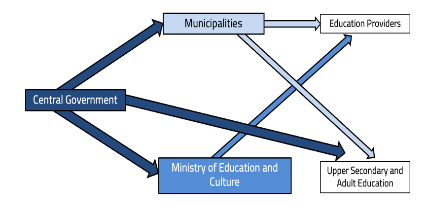
In Finland, the central government allocates education funding through two main channels (Figure 1). The first involves transfers to municipalities (see Section 1 for details). The second channel provides direct funding to education providers, bypassing municipalities. In this case, the Ministry of Education and Culture allocates resources for special programmes, including voluntary additional schooling, immigrant preparation, extended compulsory education, reform schools, boarding schools, flexible education, and education abroad. Funding is calculated based on student numbers and unit prices, with payments made directly to the provider.
Liberal adult education institutions, such as folk high schools and study centres, receive state subsidies covering approximately 57 to 65 per cent of their costs. In addition, the central government provides discretionary grants for education and development projects, allocated directly from the Ministry of Education and Culture’s budget to the provider.
Figure 1. Education Funding Mechanism
Source: GEM Report PEER
1. Education resources to subnational governments
Education funds are allocated to municipalities primarily based on population, with allocations broken down by age groups. Each age group has a set “price” per person, which determines the transfer amount. Municipalities may also receive supplementary funds to address special local conditions and are financially responsible for covering the schooling costs of their residents.
Reimbursements are calculated per age group - 6 years, 7-12 years, and 13-15 years - and set annually by the Ministry of Finance. Payments are channelled through the state transfer system to ensure that funds reach the education provider, whether located in the student’s home municipality or elsewhere. Upper secondary education is also funded through this mechanism, with approximately 36% of costs covered by the central government and 64 per cent by municipalities.
2. Education resources to schools
Discretionary Government Grants
Discretionary government grants to improve equality and quality in ECEC, pre-primary, primary and lower secondary education are allocated directly from the Ministry of Education and Culture to education providers, with a focus on enhancing equality and quality in early childhood education and care (ECEC), pre-primary, primary, and lower secondary education. The funds target schools in socioeconomically disadvantaged areas to improve learning outcomes, reduce group sizes, and hire additional staff. They also support inclusion, wellbeing, equity, and non-discrimination, ensuring that local schools remain strong educational options for families.
Funding for Disability Support
The 1998 Act on Primary and Lower Secondary Education, revised in 2024, together with initiatives such as the 2025 Programme for Equality and Non-Discrimination in Education and Training, provide for funding dedicated to disability support measures.
3. Education resources to students and families
No information is found.
4. Social policies and family support programmes
Student Financial Aid
The Social Insurance Institution provides student aid under four main categories: state guarantees for student loans, study grants and housing allowances, meal allowances for university students, and school travel allowances. The Ministry of Education and Culture oversees the management, guidance, and development of student financial aid policy.
5. School meal programmes
Finland operates a nationwide school meal programme, established in the 1940s, which provides free meals to all children in education without economic or geographic restrictions.
This profile has been reviewed by Prof. Sonja Kosunen and Kati Anttalainen, Senior Ministerial Adviser at the Finland Ministry of Education and Culture.