
Financing for equity in primary and secondary education
1. Education resources to subnational governments
2. Education resources to schools
3. Education resources to students and families
4. Social policies and family support programmes
Introduction
In the Plurinational State of Bolivia, Law 070 establishes a three-tiered system of education administration and management: central, departmental, and autonomous levels. At the central level, the Ministry of Education and its Vice-Ministries are responsible for designing, implementing, and executing educational policies and strategies, managing curricula, and overseeing educational administration. Deconcentrated entities reporting directly to the Ministry include Departmental Education Directorates (DDE), District Education Directorates, School Centre Directorates, and Educational Unit Directorates. Each entity operates under its hierarchical counterpart and is tasked with implementing educational policies, managing curricula, and administering resources within its jurisdiction.
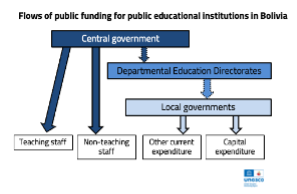
The Executive Branch regulates and defines national education policies and oversees technical and pedagogical services. All teaching, administrative, and specialised technical personnel responsible for delivering these services are employed and remunerated by the national government, ensuring unified provision of education. Decentralized levels are responsible for managing infrastructure, supplies, and school meals.
1. Education resources to subnational governments
Departmental Governments have administrative, financial, legal, and technical management autonomy. They are responsible for providing and financing basic services, infrastructure, furniture, educational materials, and equipment for Technical and Technological Institutes, as well as supporting educational programmes in line with current regulations. The Departmental Education Directorates (DDE) finance their activities through the National General Treasury, their own resources, transfers from autonomous territorial entities, donations, and other transfers.
Municipal Governments have similar responsibilities for Regular, Alternative, and Special Education Units, including financing school meals and breakfasts. Around 20% of taxes collected are allocated to education, leading to the expectation that municipalities dedicate a similar share of their budget to education, though no formal formula exists for distributing educational spending.
2. Education resources to schools
The Popular Participation Law, enacted in 1994, transferred the physical infrastructure of educational institutions to municipal governments and allocated 20% of total tax revenues to these local authorities. However, the law did not specify what proportion of this allocation should be directed specifically to education.
Salary incentives are available for teachers working in rural and hard-to-reach areas, including disadvantaged schools. These incentives are paid as bonuses in addition to the base salary. For example, the Bono Frontera (Law Decree 7190) provides an additional 20% of the basic salary to teachers working in border areas, while the Bono Incentivo a la Permanencia al Magisterio encourages teachers to remain in rural schools.
Alternative and Special Education Subsystem
The Sub-Directorate of Alternative and Special Education, established in 2009 under the Vice-Ministry of Alternative and Special Education, is a public entity composed of the General Directorates of Adult Education, Special Education, Post-literacy, and the Plurinational System of Competency Certification. Its mission is to support the construction of a Plurinational Social and Community State by promoting plural education and democratic access, prioritising marginalised and excluded populations. According to the Education Law No. 070, the Subsystem serves individuals over 15 years of age, communities, social organisations, and diverse populations, with particular emphasis on historically excluded groups. It aims to democratise access and ensure continuity in education that is culturally appropriate and socially relevant, tailored to the needs, expectations, and interests of individuals, families, communities, and organisations.
Alternative Education includes Youth and Adult Education (EPJA) for people over 15, offered through Humanistic-Technical programmes, programmes in confinement, military units, and for female domestic workers, and Lifelong Education, which strengthens community organisations and productive education. Literacy and post-literacy programmes provide basic and continuing literacy for adults. Special Education supports students with disabilities, extraordinary talent, or learning difficulties and includes social campaigns like “Bolivia Reads.” The subsystem also runs two main programmes: the Plurinational System of Certification of Competencies, which sets standards, certifies skills, and provides technical training, and the Plurinational Centre of Alternative Distance Education, offering technical training, distance Humanistic-Technical Baccalaureate courses, and continuing education to migrants and populations lacking access to face-to-face education.
3. Education resources to students and families
No equity programme implemented by the Ministry of Education providing resources directly to students and families at the basic education level has been identified.
4. Social policies and family support programmes
The Juancito Pinto Bonus, created in 2006 and supervised by the Minister of Development Planning, is a conditional cash transfer designed to incentivise enrolment, retention, and completion of the school year for students in public educational units. Initially, the programme targeted children in the first five years of primary school. Its coverage was expanded over time: in 2007 to 6th grade primary, in 2008 to 2nd grade secondary, in 2012 to 3rd grade secondary, in 2013 to 4th grade secondary, and since 2014 to 6th grade secondary. The programme’s antecedent was the Bono Esperanza, implemented by the Municipal Government of El Alto between 2003 and 2005.
Beneficiaries include students attending Vocational Community Primary Education or Productive Community Secondary Education in public and agreement (fiscal) educational units of the Regular Education Subsystem who have not reached the age of 21 as of 31 December 2019. Students enrolled in public and agreement (fiscal) Special Education Centres of the Alternative and Special Education Subsystem are also eligible, with no age limit.
5. School meal programmes
Programa Nacional de Alimentación Complementaria Escolar (PNACE) (Complementary School Meals)
The Complementary School Meals programme, formerly known as “School Breakfast,” aims to improve student coverage, retention, and performance while reducing dropout rates. Provision varies across municipalities, with some offering meals only during certain periods of the school year.
Under Law No. 622, PNACE implements the Complementary School Feeding Policy, promoting food sovereignty and a plural economy. Its goal is to enhance school performance and student nutrition in all public and private educational units by providing adequate, healthy, and culturally appropriate food. The programme supports the right to food, fosters local economic development, and is intended to complement—not replace—the home diet, supplying breakfast, snacks, or school lunches according to each school day.
PNACE was implemented gradually, beginning with municipalities lacking school feeding programmes or those with existing breakfast and lunch services, followed by the most food-insecure areas, and finally municipalities with medium and low vulnerability. The programme has four main components: Education, Health, and Nutrition; Strengthening Municipal Governments and Local Economic Organisations; Multisectoral Coordination; and Monitoring and Evaluation.
Nutritional content varies between municipalities and regions. Only a few municipalities have scientifically determined requirements documented in Basic Contracting Documents, while many have copied requirements from other areas without adapting to local food habits or production potential. Municipalities with established standards typically specify that foods must meet certain percentages of nutrient needs for schoolchildren.