


Financing for equity in primary and secondary education
NORTHERN IRELAND
1. Education resources to subnational governments
2. Education resources to schools
3. Education resources to students and families
4. Social policies and family support programmes
Introduction
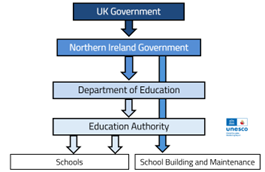
In Northern Ireland, United Kingdom, the Department of Education is responsible for education policy and the delivery of all levels of education. The Education Authority (EA) oversees the delivery of primary and secondary education and manages statutory provisions. As the Funding Authority for all grant-aided schools covered by the Common Funding Scheme (see section 2), the EA plays a central role in resource allocation.
Public expenditure for Wales, Scotland, and Northern Ireland is allocated by the UK central government using the Barnett formula, which is based on population rather than assessed need. The Northern Ireland Government then allocates funds to the Department of Education, and for most schools, the EA distributes these funds. The EA operates as a non-departmental public body sponsored by the Department of Education.
The Northern Ireland Assembly (2016, p. 2) has provided an overview of the education system, outlining the key bodies and their respective responsibilities.
1. Education resources to subnational governments
In Northern Ireland, public funds are not allocated to specific regions. Instead, resources are distributed among government departments on a yearly basis, with the Department of Education receiving the allocation for education.
In addition, NI legislation (Section 75 of the Northern Ireland Act 1998) requires Public Authorities, including the Department of Education when carrying out their functions to have due regard to the need to promote equality of opportunity between nine categories of persons, namely: between persons of different religious belief, political opinion, racial group, age, marital status or sexual orientation; between men and women generally; between persons with a disability and persons without; and between persons with dependants and persons without.
The NI Peace Agreement (1998) included confidence building measures and the establishment of an Equality Commission which has a role in protection against discrimination on the grounds of age, disability, race, religion and political opinion, sex and sexual orientation. The Equality Commission receives annual progress reports from all government departments, including Education.
Responsibility for school buildings and capital projects is shared between the Department of Education and the Education Authority.
2. Education resources to schools
The Education Authority (EA) finances all grant-aided schools through the Common Funding Scheme established by the Education and Libraries (Northern Ireland) Order 2003. The GSB represents the total sum spent under this scheme and is divided into three components. The Aggregated Schools Budget comprises two funding streams for Nursery and Primary schools and for Post-primary schools. Resources Held at Centre covers amounts allocated to school budgets outside these streams, while Centrally Held Resources Attributed to Schools are funds retained by the EA for services provided directly to schools. The GSB excludes expenditure for special schools, non–grant-aided schools, and community provision in schools.
The Aggregated Schools Budget in Northern Ireland is divided into two funding streams for Nursery and Primary schools and for Post-primary schools, each calculated using formulas with two key elements: school size and pupils. The school size element accounts for the operational costs linked to schools of different sizes, while the pupil element reflects factors such as age and background, including the Targeting Social Need (TSN) factor, which allocates additional funding to address social deprivation. This funding recognises the extra resources required by schools with high proportions of pupils from disadvantaged backgrounds, with allocations linked to the percentage of pupils eligible for free school meals and further supplemented by the ‘additional’ Social Deprivation funding factor.
Other equitable factors influencing allocations include the Small School Support Factor, which directs extra resources to smaller primary schools based on pupil numbers; targeted support for children of the traveller community, including Roma pupils; additional resources for children looked after by government authorities; and funding for newcomer pupils who may require extra language support due to not speaking English or Irish at home. Support is also available for Irish-medium schools and units to cover curricular development and teacher pay; for specialist provision classes catering to pupils outside mainstream SEN provision; and through the educational attainment factor, which provides extra resources for pupils at both primary and post-primary levels who are performing below the expected standard for their age.
Resources Held at Centre refers to allocations made outside of the standard funding stream formulas, allowing for more flexible and targeted support. For Special Educational Needs (SEN), this includes additional provisions such as classroom assistant support and specialised equipment. It also covers funding for dual-site schools and in-year increases in pupil enrolment. The Education Authority (EA) retains the discretion to apply these funds to advance specific priorities or policies within schools, which may include initiatives to promote the social inclusion of disadvantaged pupils or to foster inclusive learning environments for pupils with special educational needs.
Centrally Held Resources Attributed to Schools
Centrally held resources encompass the costs of services managed at the local authority or central level that are provided to schools. This includes, but is not limited to, home–school transport, school crossing patrols, library services, school development support, school meals, and targeted support for newcomer pupils and pupils from the traveller community.
The Extended School Programme, funded by the Department of Education, targets disadvantaged children and young people by offering additional support outside school hours. Established in 2006, the programme uses a dedicated funding formula. Schools qualify based on the Northern Ireland Multiple Deprivation Measure (NIMDM). Initial funding is distributed as a block allocation of GBP 3,000 per school, with additional funds allocated on a sliding scale according to the number of qualifying pupils. Extra allocations are also provided for schools that form clusters to share resources and initiatives.
3. Education resources to students and families
Uniform grants are available to pupils from low-income families, with eligibility similar to the criteria for Free School Meals (FSM). The grant amounts vary by pupil stage: GBP 42.90 for primary school pupils, GBP 61.20 for post-primary or special school pupils under 15, GBP 67.20 for post-primary or special school pupils over 15, and GBP 26.40 for post-primary or special school physical education kits. Applications must be submitted to the Education Authority.
Home to School Transport
The Education Authority may provide help with transport to school if the only suitable school for a child is more than two miles for primary pupils, and three miles for post-primary pupils. Children with disabilities or special educational needs may also receive special help.
Education Maintenance Allowance (EMA)
The EMA is a means-tested allowance of GBP 30 per week for pupils aged 16 to 19 to support continued education. Eligibility requires a household income below GBP 20,500 for one dependent child, or below GBP 22,500 for households with more than one dependent child. Pupils must be enrolled in an eligible course and attend all classes. Additionally, two GBP 100 bonus payments may be awarded to students who meet the goals and objectives outlined in their learning agreement.
4. Social policies and family support programmes
The following programmes apply to England, Wales, and Northern Ireland.
Child Benefit is a universal programme providing financial support to families with children under 16, or under 20 if they remain in approved education or training. Introduced under the 1975 Child Benefit Bill, it combined the previous family allowance and child tax allowance. Families receive GBP 26.05 per week for the eldest or only child, and GBP 17.25 for each additional child. Families with an individual parent income over GBP 60,000 (for the 2024-25 tax year) may be liable for the High-Income Child Benefit Charge, which is adjusted annually. Families can choose to receive Child Benefit and pay any associated tax, or opt out of payments.
Disability Living Allowance (DLA)
The Disability Living Allowance provides tax-free financial support for families of children under 16 who need help with care or mobility. For those aged 16 and above, support continues under the Personal Independence Payment (PIP). Care rates range from GBP 29.20 to GBP 110.40 per week, depending on the level of daily attention required. The mobility component is paid at GBP 29.20 for children who can walk but need guidance, and GBP 77.05 for children who cannot walk or have severe disabilities.
5. School meal programmes
School meals are provided to support the nutrition and well-being of pupils. Eligibility extends to students whose parents receive income-related benefits or universal credit, provided the household’s net income is below GBP 15,390 per year. Asylum seekers and students with special dietary needs are also included. Older students may qualify independently if they receive benefits in their own name and are enrolled in a full-time course.
Meals are supplied by the Education Authority Catering Service and must adhere to established Nutritional Standards. To further support children’s access to healthy food, the Extended Schools programme allows schools to operate breakfast clubs at the start of the school day.
These initiatives are guided by the Healthy Food for Healthy Outcomes – Food in Schools Policy, jointly issued by the Department of Education and the Department of Health. The policy consolidates existing strategies to improve nutrition and promote healthier eating habits among schoolchildren.
This profile has been reviewed by National Expert Dr. Alan Smith.










