


Financing for equity in primary and secondary education
1. Education resources to subnational governments
2. Education resources to schools
3. Education resources to students and families
4. Social policies and family support programmes
Introduction
Education financing in Switzerland mirrors the distribution of powers among the Confederation, cantons, and municipalities, each of which is fiscally autonomous. According to the Federal Constitution of Switzerland (Article 62), the 26 cantons hold responsibility for their respective education systems.
Cantons and communes oversee education budgets for compulsory education including kindergarten through their Department of Education and the municipal authorities. Other education levels are shared responsibilities. The federal government and the cantons jointly ensure free education and quality standards. Municipalities manage kindergartens, primary schools and lower secondary schools under canton supervision.
In the post-compulsory sector, including upper secondary and tertiary education, regulatory authority is shared between the cantons and the Confederation.
Education expenditure encompasses salaries for teachers and school staff, facility construction and maintenance, teaching materials, advisory and support services, special education measures and training contributions. The greatest share of public expenditure on education (51%) is spent on compulsory education. Most of the public education funding is provided by the cantons and communes, financed through locally collected tax revenues.
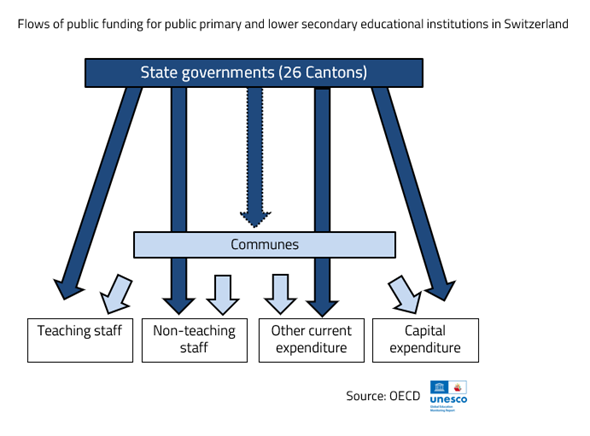
1. Education resources to subnational governments
The responsibility for educational funding is distributed among the Confederation, cantons and communes to varying degrees depending on the educational level concerned.
Cantons and communes share costs for compulsory education, including special needs schools. Most expenses for upper secondary (vocational and general education) and tertiary levels (professional education and university) are covered by the cantons.
Overall, education expenditure rises with higher education levels, factoring in private spending at the upper secondary level. Increased educational levels lead to higher wage costs and greater needs for administrative, technical staff, and infrastructure at both national and cantonal levels.
Cantonal grants and loans, along with contributions from the Confederation to the cantons, make up part of public education expenditure (1%).
In 2023, the Confederation accounted for 17% of funding for education, the cantons 51% and the communes 33%. If the administrative levels that make the expenditures are considered, cantons accounted for nearly two thirds (62%) of educational expenditure, communes for a quarter (27%) and the Confederation for the remainder 11%.
A national fiscal equalisation system ensures that economically strong cantons and the federal government help financially weaker cantons. This equalisation is intended to make the performance of government tasks more efficient and to reduce the cantonal differences in financial capacity, also with regard to education expenditure.
2. Education resources to schools
Inclusive Education
In Switzerland, the funding directed to schools for inclusive education originates mainly from cantonal (provincial) and communal taxes. The money allocated to schools supports a variety of services tailored to students’ individual needs. These include integrative schooling within mainstream classes where support teaching and specialised therapies such as speech and psychomotor therapy are provided. Schools may also organise special classes with reduced pupil numbers or specialised special needs schools for children requiring more intensive support. Additionally, the funding covers transport services for students with disabilities who cannot travel independently, as well as educational materials and staff salaries for special education teachers and support personnel. Funding mechanisms and services vary across the 26 cantons, each setting its own legislation and models, but all aim to ensure equitable access and tailored support within a decentralised policy framework.
In Zurich, for instance, the Department of Education’s “special support” division provides guidance on issues related to diversity and inclusion. Its work focuses particularly on funding for gifted and talented students, intercultural education, special education in both regular and special schools, and school psychology.
3. Education resources to students and families
Scholarships for Upper Secondary Education
Contributions to education are granted on a subsidiary basis when the financial situation of the person concerned, their parents, or their legal representative is insufficient. They are paid in the form of grants or student loans. Scholarships are awarded at all education levels, but they are most common in upper secondary education.
Additionally, the 2009 Intercantonal Agreement on the Harmonisation of Scholarship Schemes represents a key policy instrument aimed at promoting consistency and fairness in educational support across Switzerland's cantons. This agreement facilitates harmonization by setting principles and minimum standards for scholarship eligibility and benefits, particularly targeting students whose financial means (including those of their parents or legal supporters) are insufficient to cover educational costs.
Allowances are granted based on cantonal legislation, leading to variations among cantons. Nationally, and in half of the cantons, upper secondary scholarship recipients outnumber those at the tertiary level. Geneva has the highest upper secondary recipient rate at 16%.
National Programme against Poverty – Educational measures
The National Programme against Poverty (2015-2018), promoted by the Swiss Confederation, was a coordinated policy effort aimed at reducing poverty and social exclusion within Switzerland. Key focus areas included improving access to education, promoting employment opportunities, enhancing social protection systems, and facilitating the social integration of vulnerable groups. The initiative sought to ensure that economic growth translated into improved living conditions for those at risk of poverty, with particular attention to children, single parents, and the working poor. After 2018 the programme translated into a national platform against poverty.
It focuses its activities on the issues identified as priorities at the end of the programme, in three areas of action: educational opportunities, social and professional integration, and the living conditions of the people concerned, specifically family poverty.
Allocation de rentrée scolaire (Back-to-School Allowance)
The Allocation de rentrée scolaire (Back-to-School Allowance) in Switzerland is not a nationwide programme but is implemented at the canton or municipal level, making it a localised and variable practice across the country. For example, in the canton of Geneva, this allowance is provided as a one-time aid to families with children in compulsory schooling, amounting to CHF 130 per year for primary school children and CHF 180 for those in orientation cycle (secondary level). It is distributed in the form of an electronic payment card usable in partner stores for school-related purchases. Eligibility conditions include residency in the specific canton or municipality, income requirements, and the child attending school locally.
4. Social policies and family support programmes
According to the Federal Law on Family Allowances, families with one or more children receive one-off or periodic cash benefits to help offset financial burdens. These allowances are payable until children reach 16 years of age (child allowance, allocation pour enfant) or up to 25 years if they are pursuing education or training (education allowance, allocation de formation). The child allowance is at least CHF 215 per month, and the education allowance is a minimum of CHF 268 per month.
The cantons may provide higher minimum rates for child and education allowances in their family allowance regulations.
5. School meal programmes
In Switzerland, responsibility for school meals lies with the communes. In Geneva, school canteens are open to all elementary school children. In communes such as Epalinges (Vaud), families can apply for school meal subsidies based on a municipality-approved scale linked to monthly income; these subsidies are valid for the entire school year. In Geneva, any family whose children attend a school canteen subsidised by the City of Geneva can request meal cost coverage through their assigned social worker. The “Swiss Quality Standards for the Promotion of Health and Sustainability in Collective Catering, Education Domain” is a programme jointly funded by the federal and regional governments, with nutritionists actively involved.
This profile was reviewed by Alexander Gerlings, Co-Head IDES.










