


Financing for equity in primary and secondary education
1. Education resources to subnational governments
2. Education resources to schools
3. Education resources to students and families
4. Social policies and family support programmes
Introduction
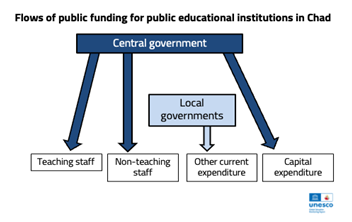
In Chad, education is financed through a dual system that combines centralised support from the State with decentralised allocations managed by local authorities. Local entities have the authority to establish dedicated budget lines to support specific educational initiatives, while the operational costs of public schools are largely borne by local communities and parents, reflecting a shared responsibility for maintaining educational provision.
The education system itself is organised into académies, each overseen by a regional delegation of the Education nationale. These académies serve as educational zones tailored to local needs and may cover multiple regions. Their creation and governance are determined by decrees from the Council of Ministers, with each academy led by a Recteur d’académie appointed by the Council.
1. Education resources to subnational governments
No mechanism with an equity formula has been identified to allocate resources to sub-national governments.
2. Education resources to schools
There are remote and motivation bonuses granted to primary school teachers assigned to the far north region and other isolated regions in an attempt to retain them.
Non-Formal Basic Education for Adolescents (EBNF)
Training programmes offered by the Ministry of National Education and Civic Promotion encompass non-formal basic education for out-of-school children aged 9 to 14, non-formal literacy training for individuals aged 15 and older, and vocational training for women and youth.
The aim of the EBNF in Chad is “to give young people aged 9 to 14 who are not in school or who have dropped out, a quality basic education enabling them to acquire the useful skills, know-how and interpersonal skills they need to participate in the development of their region and to integrate harmoniously into it, and to ensure quality basic education for all”. This is achieved by systematically introducing EBNF services, including pilot centres, partnerships with educational institutions, and involvement of EBNF professionals. Quality is enhanced through awareness initiatives for out-of-school youth, provision of teaching materials, creation of new resources, and a comprehensive monitoring and evaluation system. The programme was predominantly financed by external development partners, with limited government co-financing.
The state budget funds non-formal education through literacy activities under various programmes. In addition to state funding, non-formal education also receives support from various partners. Non-formal education is further financed by technical and financial partners of the Ministry of National Education and Civic Promotion, including UNICEF, which directly supports activities conducted in this area by specific organizations.
3. Education resources to students and families
No programmes offering resources to students and families have been identified in Chad. The current initiatives are implemented and entirely funded by external donors.
4. Social policies and family support programmes
Primary Education and Girls’ Schooling Support Programme
The Primary Education and Girls’ Schooling Support Programme, started in 2013, is a comprehensive initiative spearheaded by the Government of Chad in collaboration with organizations such as the World Food Programme and UNICEF aimed at removing barriers to education and improving the well-being of boys and girls, with a strong focus on girls’ enrollment, retention, and academic success, especially in vulnerable and crisis-affected communities. It integrates nutritional support, financial incentives, infrastructure enhancements, teacher training, and community mobilisation to increase girls' access to quality primary education and mitigate gender disparities in schooling. The programme offers bi-annual conditional cash grants to promote girls’ enrollment and retention in primary school, annual incentive kits to support their transition from primary to secondary school, and an Excellence Award to top-performing boys and girls at primary and secondary levels.
The National Social Insurance Fund of Chad also provides child benefits. Family allowances under the programme are paid to workers for each dependent child, from birth until the age of 14. The age is raised to 20 years if the child continues their studies. The funds are to be used for the child’s school and health expenses. If the allowances are not used for the child, a guardian may be appointed by the court.
5. School meal programmes
Primary Education and Girls’ Schooling Support Programme
The Primary Education and Girls’ Schooling Support Programme (cf. Section 4) includes nutritional support. This programme provides meals five times per week (in-school meals) during the academic year to primary grade levels, taking into account geographic factors and school characteristics such as net enrollment rates and local levels of food insecurity. The primary implementers are the Directorate of Food, Nutrition, School Health, and Emergency Actions (La direction de l’alimentation, de la nutrition, de la santé scolaire et des actions d’urgence). The national government oversees the programme through a centralised decision-making process, with nutritionists involved to ensure that nutritional objectives are met, while the implementing partner is responsible for food procurement. Additionally, the programme includes a Complementary Education Programme focused on food and nutrition.
This profile was reviewed by Tabo Symphorien Ndang.










