


Financing for equity in pre-primary education
1. Education resources to subnational governments
2. Education resources to institutions
3. Education resources to students and families
4. Social policies and family support programmes
Introduction
Key financing indicators (UIS Data)
The official entrance age to pre-primary education is 3 years old. 1 year of compulsory pre-primary education is granted in legal frameworks (UIS) between the ages 5 and 6. The net enrolment rate for pre-primary for both sexes (UIS) is 85.3% in 2023.
Governance
The Ministry of Education, Youth and Sports (MŠMT) is responsible for overseeing pre-primary education and allocating budgets.
Tuition-free status
Public pre-primary education in Czech Republic is not tuition-free according to national laws and policies.
1. Education resources to subnational governments
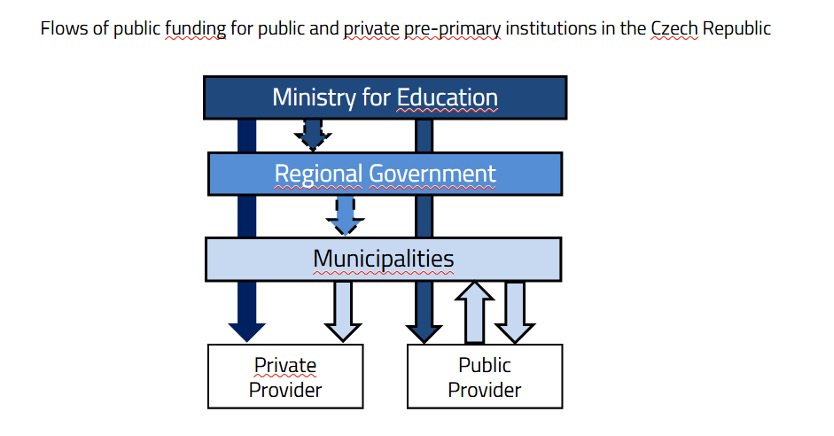
In 2025, pre-primary education in the Czech Republic is a complex network of public and private providers, both of which have recourse to public funds. Investment expenditure, such as buildings and upkeep, is the responsibility of the municipalities. Teachers' salaries are paid directly from the state budget. Funding from the central government sets a normative value set per student, which takes into account special educational needs and is higher for those in care. According to School Law 161 from 2004, a regional coefficient adjusts the level of funding to the context of the region, which covers relative local wages, special needs and children under state care. Plans are in place to expand extra funding in 2026, addressing more equity concerns such as socioeconomic factors.
2. Education resources to institutions
While public providers are administered by the municipal governments, private providers of pre-primary education are entitled to an 'operating contribution' from the governmental budget. This is to pay wages, staff training, meals and other operating expenses and is provided by the ministry.
Children are entitled to Czech language training support, in a group if there are more than 3 such children at the school. The law has been in place since 2014, applying to the children of foreigners and with a 2025 amendment, its coverage expanded to all children with additional language needs. This is funded through increasing the maximum number of funded pedagogical hours to the institution (PHMax).
Under the 2004 Education Act, national minority language speakers have the right to be educated in their own language in state schools. These are funded by the Ministry of Education in the same way as basic state education; in practice, only Polish schools exist within the state system. Minority languages are additionally supported by applying for grants from the Ministry of Education. In 2024, around CZK 11,000,000 was disbursed for diverse projects supporting languages such as German, Slovak and Vietnamese.
Preschools are entitled to apply for grants from the Ministry of Education in order to support preschool meals for disadvantaged children and support activities to improve attendance. The 2025 grant from the Ministry was to promote ‘participation in pre-school education of children with social disadvantages’. In 2024, it had a budget allocation of CZK 10,000,000.
3. Education resources to students and families
Guardians are statutorily exempted from fees if they receive social assistance such as means-tested benefits, have disabilities or are foster parents. A school head can also alter or remove fees for other cases of need. This is at the discretion of the head teacher and is funded from operational budgets. For example, the 2024 policy of Libotov School extends the fee waiver to asylum seekers and those in difficult social circumstances. At state providers, the cost of preschool provision is limited by decree. The monthly fee must not exceed 8% of the minimum wage, CZK 1,664 in 2025.
4. Social policies and family support programmes
Since the 2014 law on the Provision of Childcare Services in a Children’s Group, the Ministry of Labour and Social Affairs funds "dětské skupiny” or child groups. In 2024, there were 1720 such groups providing care for 23,169 children. While traditional pre-primary care starts at age 3, child groups offer care from 6 months to the start of primary education. The maximum roll of these groups is 24, and they have a focus on socio-emotional learning. All children are entitled to access these schools; however, in practice, the target is parents who require support with their children.
There are tax credits for children in the Czech Republic. In 2024, the parental entitlement varied depending on the first (CZK 15,204), second (CZK 22,320) and third child (CZK 27,840). As of 2024, credits are no longer linked to attendance at pre-school.
This profile was reviewed by Magdalena Lokayová, Ministerial Officer at the Czech Ministry of Education, Youth and Sports.










