


Financing for equity in primary and secondary education
1. Education resources to subnational governments
2. Education resources to schools
3. Education resources to students and families
4. Social policies and family support programmes
Introduction
The Russian Federation’s education system is administered by the Ministry of Education, which holds authority for establishing national standards, implementing regulations, and designing federal initiatives across all stages of education.
The federal government determines the financing standards for federal state educational institutions and funds nationwide programmes, including curriculum development and teacher training. Local governments can also set standards for financing municipal and state educational institutions from local budgets following federal state educational standards.
In Russia, more than 75 per cent of funds allocated to education are raised and spent at the regional level. Yet, federal transfers play a significant role in reducing interregional disparities in expenditure, which indicates the continued fiscal dependence of many regions due to their limited own-revenue capacity. Regional governments that consist of 85 federal subjects, such as oblasts, krais, republics, and federal cities, are primarily responsible for operating schools and covering teacher salaries. Regional governments transfer earmarked grants to first-tier municipalities based on enrolment formulas, and municipalities manage schools and pay utility costs.
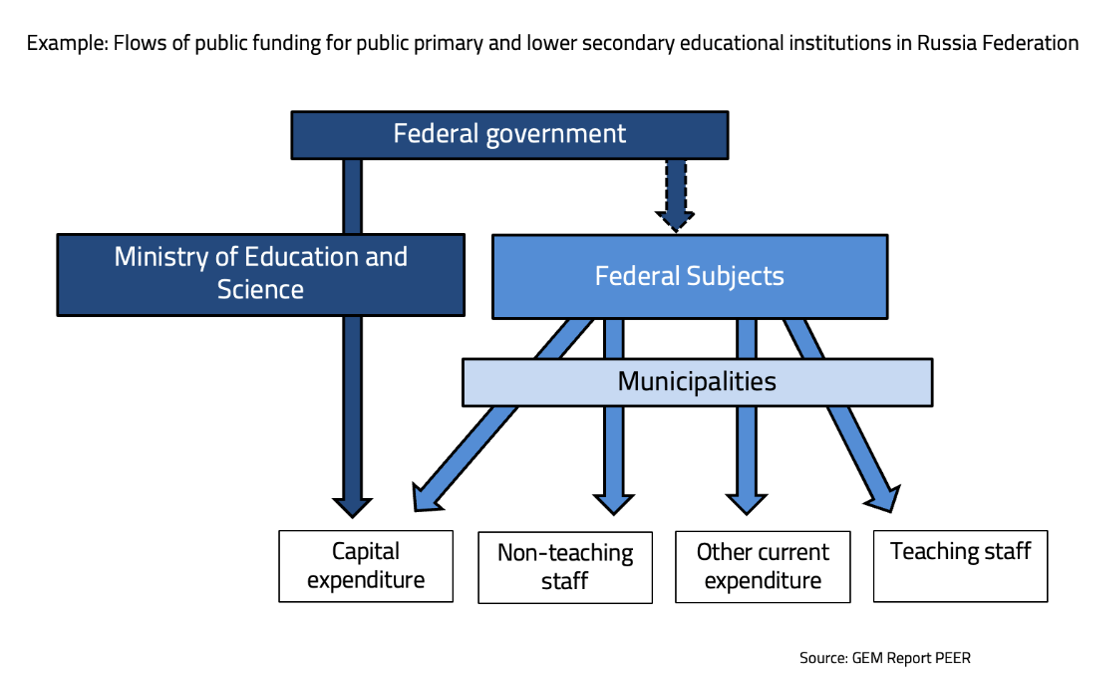
1. Education resources to subnational governments
General education in Russia is almost entirely funded from regional budgets, while federal transfers provide supplementary funding for specific programmes. There is no universal education-specific transfer mechanism distributed across all regions. However, the federal government supports education through targeted programmes—such as school infrastructure modernization, digital education development, and inclusion initiatives—co-financed with regional budgets.
The Regional Development Fund is a key federal instrument that co-finances regional investment projects, including those aimed at improving access to education in underserved or remote areas. Eligibility is based on factors like a region’s fiscal capacity and socio-economic development, with priority given to rural regions facing higher service delivery costs. Although not exclusively focused on education, the fund’s allocation criteria help reduce regional disparities in educational access.
2. Education resources to schools
The federal government established the per capita financing mechanism in 2003, through Federal Law No. 123-FZ, by defining the legal framework and setting minimum education standards. Its implementation relies on regional governments that calculate per-student norms and transfer funds to municipalities, which then distribute these resources to schools according to the formula. This model allocates school budgets according to the number of enrolled students, with adjustments for factors such as location, school size, and special education needs. Each region of the Russian Federation sets its own per capita funding amount, calculated to cover all essential expenses, including teacher salaries, procurement of materials and textbooks, and maintenance of school facilities. Under this scheme, schools receive a block grant determined by per-student norms and other coefficients, and it gives school directors autonomy as they open and operate a bank account for the school and manage the budget.
Special Education
The right to education for students with disabilities in Russia is guaranteed under Federal Law No. 273, which mandates adapted curricula, accessible learning environments, and individualized support. To implement this, the federal government provides targeted funding through initiatives like the Accessible Environment Programme, launched in 2011. This programme channels federal resources to educational institutions for procuring adaptive materials and assistive technologies, and for hiring specialised staff—such as educational psychologists, speech therapists, special educators, and tutors—to support students with disabilities in mainstream schools.
3. Education resources to students and families
In 2024, an official order for the distribution of school buses was signed by the Prime Minister as part of Russia’s ongoing school transportation policy for rural students. This policy is based on Federal Law No. 273-FZ “On Education in the Russian Federation,” which affirms the state’s obligation to ensure access to education for all children and assigns regional authorities the responsibility for organizing student transport. The programme is implemented by the Ministry of Education of the Russian Federation, which manages the procurement and distribution of school buses to regional governments using federal budget allocations. The service targets students in grades 1–11 living in rural areas, specifically those residing more than 2 km from school (grades 1–4) or more than 3 km (grades 5–11), to ensure safe and convenient access to education.
4. Social policies and family support programmes
Introduced in August 2021, the one-time payment was designed to assist families with school-related expenses at the start of the academic year. The programme was implemented under the coordination of the Government of the Russian Federation and administered by the Social Fund of Russia. The payment applies universally to all families raising children aged 6 to 18 enrolled in general education; however, the benefit expands to disadvantaged households such as low-income families. For eligible households, the support helps cover essential costs for school uniforms, stationery, textbooks and other educational expenses that represent a heavy financial burden at the start of the academic year. Each eligible child is entitled to a fixed one-time payment, transferred directly to parents’ bank accounts before September 1, ensuring timely preparation for school.
At the regional level, the Moscow Department of Social Protection provides an annual school preparation allowance to families with school-age children, specifically targeting low-income households and large families. Parents receive a payment of 13,987 rubles per child, with the same amount granted to families raising a child with disabilities.
5. School meal programmes
Article 37 of Federal Law No.273 (amended in 2020) mandates that all Russian regions provide free hot meals to students in grades 1 to 4 in general education institutions. Schools must offer at least one hot meal per day to every child in these grades, regardless of family income. This universal measure aims to support families and promote healthy nutrition, with implementation costs co-financed by the federal and regional budgets.
Across regions, including Moscow, St. Petersburg, and Krasnodar Krai, all students in grades 1–4 receive one free hot meal daily. Additionally, students from preferential categories—such as children from large families, orphans, children under guardianship or in foster care, children with disabilities, children of parents with disabilities, those receiving survivors’ pensions, and students from low-income households—are entitled to two free hot meals per school day throughout the academic year. Although implementation details vary slightly by region, this expanded benefit aims to support vulnerable groups beyond the universal provision.
This profile was reviewed by Stanislav Avdeev at the University of Amsterdam.










